
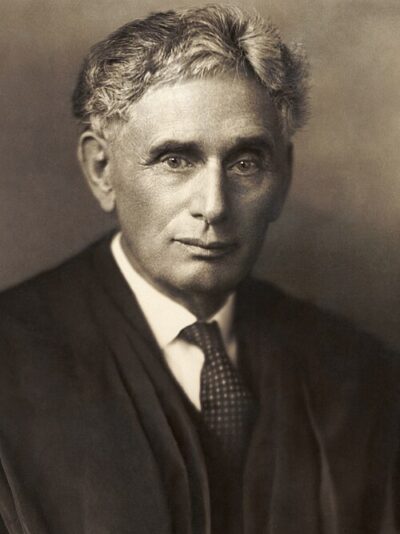
Louis Brandeis
Louis Brandeis was an American Supreme Court Justice. Born November 13, 1856, in Louisville. Died October 5, 1941, in Washington, D.C.. Positions held include Associate Justice of the Supreme Court of the United States (1916–1939). Educated at Harvard Law School and Louisville Male High School.
Facts
20 facts · 2 confirmed by two sources · 4 cited · 14 from one source
Where this comes from
Papalocal keeps its own record. It started from these sources; what each one said is kept here as it was copied, so a change on their side never changes this page by itself. Tap one to read its version.
What Wikidata says · copied November 13, 2026 · revision 2567491217
- Described as
- American Supreme Court Justice (1856-1941)
- Other names
- Louis Dembitz Brandeis, Louis David Brandeis
- Born
- November 13, 1856 · 6 references
- Died
- October 5, 1941 · 6 references
- Born in
- Louisville · 1 reference
- Died in
- Washington, D.C.
- Buried in
- Louisville · 1 reference
- Cause of death
- myocardial infarction
- Citizen of
- United States
- Occupation
- judge · 1 reference; lawyer; jurist · 1 reference
- Positions held
- Associate Justice of the Supreme Court of the United States (1916–1939)
- Political party
- Democratic Party
- Worked for
- Harvard University
- Education
- Harvard Law School; Louisville Male High School · 2 references
- Member of
- Phi Beta Kappa Society
- Spouse
- Alice Goldmark Brandeis
- Mother
- Fredericka Dembitz Brandeis
- Religion
- Judaism
- Lived in
- Brandeis House · 1 reference
- Wikipedias with a page
- 41
Wikidata item Q520840 (wikidata.org/wiki/Q520840), public domain (CC0). Copied November 13, 2026.
What Wikipedia says · copied November 13, 2026 · revision 1385514708
Louis Dembitz Brandeis ( BRAN-dice; November 13, 1856 – October 5, 1941) was an American lawyer and jurist who served as an associate justice of the U.S. Supreme Court from 1916 to 1939. Brandeis was a leading figure in the antitrust movement at the turn of the 20th century, particularly in his resistance to the monopolization of the New England railroad. His anti-monopolistic jurisprudence laid the intellectual foundation for the New Brandeis movement, a contemporary revival of antitrust thought spearheaded by figures such as Lina Khan and Tim Wu.
Starting in 1890, Brandeis helped develop the "right to privacy" concept by writing a Harvard Law Review article of that title, and was thereby credited by legal scholar Roscoe Pound as having accomplished "nothing less than adding a chapter to our law." In his books, articles, and speeches, he criticized the power of large banks, money trusts, powerful corporations, monopolies, public corruption, and mass consumerism, all of which he felt were detrimental to American values and culture. He also spoke in favor of syndicalist reforms like co-determination, workplace democracy and multi-stakeholder businesses. He later became active in the Zionist movement, seeing it as a solution to antisemitism in Europe, while at the same time being a way to "revive sense of the Jewish spirit."
When his family's finances became secure, he began devoting most of his time to public causes, and he was later dubbed the "People's Lawyer." He insisted on taking cases without pay so that he would be free to address the wider issues involved. The Economist newspaper called him "A Robin Hood of the law." Among his notable early cases were actions fighting railroad monopolies, defending workplace and labor laws, helping create the Federal Reserve System, and presenting ideas for the new Federal Trade Commission. He achieved recognition by submitting a case brief, later called the "Brandeis brief", which relied on expert testimony from people in other professions to support his case, thereby setting a new precedent in evidence presentation.
In 1916, President Woodrow Wilson nominated Brandeis to a seat on the Supreme Court. His nomination was bitterly contested, partly because, as Justice William O. Douglas later wrote, "Brandeis was a militant crusader for social justice whoever his opponent might be. He was dangerous not only because of his brilliance, his arithmetic, his courage. He was dangerous because he was incorruptible ... [and] the fears of the Establishment were greater because Brandeis was the first Jew to be named to the Court." The Senate confirmed Brandeis by a vote of 47 to 22, making him the first Jewish U.S. Supreme Court justice. Brandeis's opinions were, according to legal scholars, some of the "greatest defenses" of freedom of speech and the right to privacy ever written by a member of the Supreme Court.
- Born, in its opening lines
- November 13, 1856
- Died, in its opening lines
- October 5, 1941
From the Wikipedia article “Louis Brandeis” (en.wikipedia.org/wiki/Louis_Brandeis), by its contributors, under CC BY-SA 4.0 (creativecommons.org/licenses/by-sa/4.0/). Copied November 13, 2026; not changed.
Confirmed Two sources agree. Cited One source, and it names where it got it. One source One source, without a reference of its own. Sources disagree The sources disagree. We show the best-supported value and keep theirs below.
