
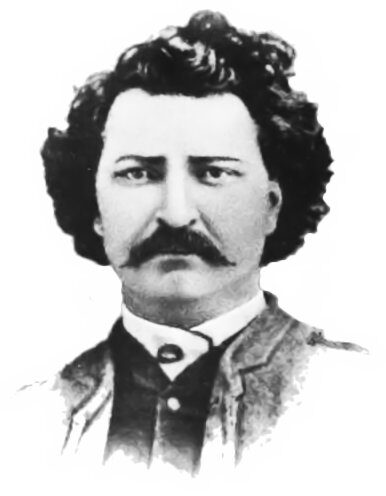
Louis Riel
Louis Riel was a Métis leader in Canada. Born October 22, 1844, in Saint Boniface. Died November 16, 1885, in Regina. Positions held include member of the Legislative Assembly of Assiniboia (1870) and member of the House of Commons of Canada (1873–1875). Known for Manitoba. Educated at Collège de Montréal. Awards include Person of National Historic Significance.
Facts
21 facts · 2 confirmed by two sources · 8 cited · 11 from one source
Where this comes from
Papalocal keeps its own record. It started from these sources; what each one said is kept here as it was copied, so a change on their side never changes this page by itself. Tap one to read its version.
What Wikidata says · copied November 13, 2026 · revision 2567723208
- Described as
- Métis leader in Canada (1844–1885)
- Other names
- Louis "David" Riel
- Born
- October 22, 1844 · 3 references
- Died
- November 16, 1885 · 4 references
- Born in
- Saint Boniface · 1 reference
- Died in
- Regina
- Buried in
- Saint Boniface Cathedral · 1 reference
- Cause of death
- hanging to death · 1 reference
- Citizen of
- United Kingdom of Great Britain and Ireland; Canada
- Occupation
- politician · 1 reference; writer · 1 reference; teacher · 1 reference
- Positions held
- member of the Legislative Assembly of Assiniboia (1870) · 1 reference; member of the House of Commons of Canada (1873–1875) · 1 reference
- Political party
- independent politician
- Education
- Collège de Montréal
- Known for
- Manitoba · 1 reference
- Awards
- Person of National Historic Significance · 1 reference
- Children
- Jean Riel · 1 reference
- Father
- Louis Riel, Sr.
- Siblings
- Sara Riel
- Religion
- Catholic Church
- Wikipedias with a page
- 50
Wikidata item Q313691 (wikidata.org/wiki/Q313691), public domain (CC0). Copied November 13, 2026.
What Wikipedia says · copied November 13, 2026 · revision 1383762578
Louis Riel (; French: [lwi ʁjɛl]; 22 October 1844 – 16 November 1885) was a Canadian politician, a founder of the province of Manitoba, and a political leader of the Métis people. He led two resistance movements against the Government of Canada and its first prime minister John A. Macdonald. Riel fought to defend Métis rights and identity as the Northwest Territories came progressively under the Canadian sphere of influence.
The first resistance movement led by Riel was the Red River Resistance of 1869–1870. The provisional government established by Riel ultimately negotiated the terms under which the new province of Manitoba entered the Canadian Confederation. However, while carrying out the resistance, Riel had a Canadian nationalist, Thomas Scott, executed. Riel soon fled to the United States to escape prosecution. He was elected three times as member of the House of Commons, but, fearing for his life, never took his seat. During these years in exile he came to believe that he was a divinely chosen leader and prophet. He married in 1881 while in exile in the Montana Territory.
In 1884 Riel was called upon by the Métis leaders in Saskatchewan to help resolve longstanding grievances with the Canadian government. He returned to Canada and led an armed conflict with government forces: the North-West Rebellion of 1885. Defeated at the Battle of Batoche, Riel was imprisoned in Regina where he was convicted at trial of high treason. Despite protests, popular appeals and the jury's call for clemency, Riel was executed by hanging. Riel was seen as a heroic victim by French Canadians; his execution had a lasting negative impact on Canada, polarizing the new nation along ethno-religious lines. The Métis were marginalized in the Prairie provinces by the increasingly English-dominated majority. A long-term effect of these actions was the bitter alienation felt by Francophones across Canada, and their anger against the repression by their countrymen.
Riel's historical reputation has long been polarized between portrayals as a dangerous religious fanatic and rebel opposed to the Canadian nation, and, by contrast, as a charismatic leader intent on defending his Métis people from the unfair encroachments by the federal government eager to give Orangemen-dominated Ontario settlers priority access to land. Riel has received among the most formal organizational and academic scrutiny of any figure in Canadian history.
- Born, in its opening lines
- October 22, 1844
- Died, in its opening lines
- November 16, 1885
From the Wikipedia article “Louis Riel” (en.wikipedia.org/wiki/Louis_Riel), by its contributors, under CC BY-SA 4.0 (creativecommons.org/licenses/by-sa/4.0/). Copied November 13, 2026; not changed.
Confirmed Two sources agree. Cited One source, and it names where it got it. One source One source, without a reference of its own. Sources disagree The sources disagree. We show the best-supported value and keep theirs below.
