
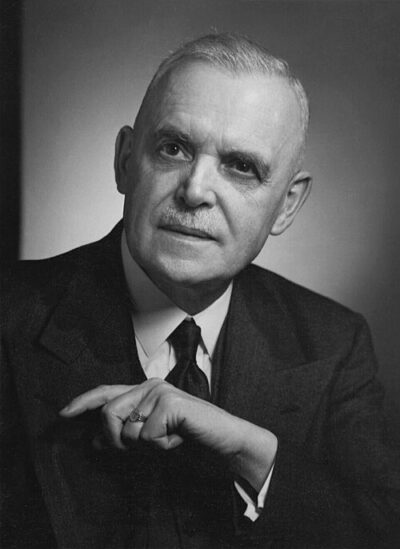
Louis St. Laurent
Louis St. Laurent was the 12th Prime Minister of Canada. Born February 1, 1882, in Compton. Died July 25, 1973, in Quebec City. Positions held include Prime Minister of Canada (1948–1957), Leader of the Liberal Party of Canada (1948–1958) and President of the Canadian Bar Association (1930–1932). Educated at Faculté de droit de l'Université Laval and Séminaire de Sherbrooke. Awards include Companion of the Order of Canada, Canadian Newsmaker of the Year and honorary doctorate at the Laval University.
Facts
30 facts · 2 confirmed by two sources · 8 cited · 19 from one source · 1 where the sources disagree
What’s different
- Name at birth: we show Louis Stephen St. Laurent (Sources disagree). Wikidata also lists Louis-Étienne St-Laurent
Where this comes from
Papalocal keeps its own record. It started from these sources; what each one said is kept here as it was copied, so a change on their side never changes this page by itself. Tap one to read its version.
What Wikipedia says · copied November 13, 2026 · revision 1375439758
Louis Stephen St. Laurent (French: [lwi sɛ̃ lɔʁɑ̃]; February 1, 1882 – July 25, 1973) was a Canadian lawyer and politician who served as the 12th prime minister of Canada from 1948 to 1957.
Born in Compton, Quebec, St. Laurent was a prominent lawyer and supporter of the Liberal Party of Canada. In 1941, he entered politics as minister of justice under Prime Minister William Lyon Mackenzie King, and in 1942 he won a by-election in the riding of Quebec East. In 1946, St. Laurent became secretary of state for external affairs and served in that post until two years later, when he became leader of the Liberal Party and prime minister, succeeding King who had retired. St. Laurent led the party to back-to-back landslide majority governments in the federal elections of 1949 and 1953.
The second French Canadian prime minister after Wilfrid Laurier, St. Laurent expanded the Canadian welfare state by introducing equalization payments, the registered retirement savings plan (RRSP), and the Hospital Insurance program—the last being an early form of Medicare. His government also initiated major public works projects, including the Trans-Canada Highway, the St. Lawrence Seaway, the Canso Causeway, and the Trans-Canada Pipeline. In 1953, his government authorized the High Arctic relocation, which resulted in the forced displacement of 92 Inuit to modern-day Nunavut. In foreign policy, St. Laurent's government oversaw Canada's entry to the North Atlantic Treaty Organization (NATO) and committed the third largest overall contribution of troops, ships, and aircraft to the Korean War. In 1956, St. Laurent's secretary of state for external affairs, Lester B. Pearson, helped resolve the Suez Crisis by proposing the United Nations Emergency Force (UNEF), for which Pearson received the 1957 Nobel Peace Prize.
St. Laurent earned the nickname "Uncle Louis" as he was popular among the general public throughout his tenure, and the popularity of his government led many to predict that he would easily win the 1957 federal election. However, his decision to rush the 1956 Trans-Canada Pipeline debate by invoking closure led to the perception that the Liberals had become arrogant from their two decades in power. In an upset, the party was narrowly defeated by John Diefenbaker's Progressive Conservatives, ending nearly 22 years of Liberal rule. After his defeat, St. Laurent retired from politics and returned to his law practice. He is ranked highly in rankings of Canadian prime ministers. According to historian Donald Creighton, St. Laurent was "eminently moderate, cautious...and a strong Canadian nationalist."
- Born, in its opening lines
- February 1, 1882
- Died, in its opening lines
- July 25, 1973
From the Wikipedia article “Louis St. Laurent” (en.wikipedia.org/wiki/Louis_St._Laurent), by its contributors, under CC BY-SA 4.0 (creativecommons.org/licenses/by-sa/4.0/). Copied November 13, 2026; not changed.
What Wikidata says · copied November 14, 2026 · revision 2569009571
- Described as
- 12th Prime Minister of Canada (1882-1973)
- Other names
- Louis Stephen St. Laurent, Louis-Étienne St-Laurent, Louis-Etienne St-Laurent
- Born
- February 1, 1882 · 11 references
- Died
- July 25, 1973 · 10 references
- Born in
- Compton · 1 reference
- Died in
- Quebec City
- Buried in
- St. Thomas Aquinas Cemetery · 1 reference
- Cause of death
- heart failure
- Name at birth
- Louis Stephen St. Laurent; Louis-Étienne St-Laurent
- Citizen of
- Canada
- Occupation
- politician; lawyer · 1 reference; diplomat; law professor · 1 reference
- Positions held
- Prime Minister of Canada (1948–1957); Leader of the Liberal Party of Canada (1948–1958); President of the Canadian Bar Association (1930–1932) · 1 reference; Bâtonnier du Québec (1929–1930); Bâtonnier de Québec (1929–1930); Leader of the Official Opposition (1957–1958); member of the House of Commons of Canada (1942–1958) · 1 reference
- Political party
- Liberal Party of Canada
- Worked for
- Laval University
- Education
- Faculté de droit de l'Université Laval; Séminaire de Sherbrooke
- Awards
- Companion of the Order of Canada; Canadian Newsmaker of the Year (1949); honorary doctorate at the Laval University (1952) · 1 reference; Person of National Historic Significance · 1 reference
- Spouse
- Jeanne St. Laurent
- Children
- Jean-Paul St. Laurent
- Religion
- Catholicism · 1 reference
- Wikipedias with a page
- 44
Wikidata item Q128626 (wikidata.org/wiki/Q128626), public domain (CC0). Copied November 14, 2026.
Confirmed Two sources agree. Cited One source, and it names where it got it. One source One source, without a reference of its own. Sources disagree The sources disagree. We show the best-supported value and keep theirs below.
