
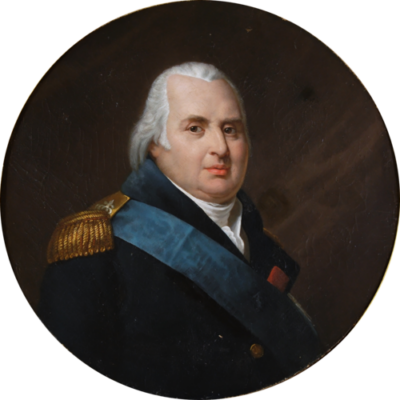
Louis XVIII of France
Louis XVIII of France was a King of France and Navarre from 1814 to 1815 and from 1815 to 1824. Born November 17, 1755, in Palace of Versailles. Died September 16, 1824, in Tuileries Palace. Positions held include King of the French (1814–1824), French co-prince of Andorra (1814–1824) and Grand Master of the Order of Our Lady of Mount Carmel and Saint Lazarus of Jerusalem (1772–1791). Awards include Knight of the Order of the Holy Spirit, Knight of the Order of Saint Michael and Knight of the Order of the Golden Fleece.
Facts
41 facts · 2 confirmed by two sources · 6 cited · 33 from one source
Where this comes from
Papalocal keeps its own record. It started from these sources; what each one said is kept here as it was copied, so a change on their side never changes this page by itself. Tap one to read its version.
What Wikidata says · copied November 16, 2026 · revision 2565544668
- Described as
- King of France and Navarre from 1814 to 1815 and from 1815 to 1824 (1755-1824)
- Other names
- Louis XVIII, the Desired
- Born
- November 17, 1755 · 8 references
- Died
- September 16, 1824 · 8 references
- Born in
- Palace of Versailles
- Died in
- Tuileries Palace
- Buried in
- Basilica of Saint-Denis
- Cause of death
- disease
- Citizen of
- Kingdom of France
- Occupation
- politician
- Positions held
- King of the French (1814–1824); French co-prince of Andorra (1814–1824); Grand Master of the Order of Our Lady of Mount Carmel and Saint Lazarus of Jerusalem (1772–1791) · 2 references; count of Provence (1755–); Duke of Anjou
- Awards
- Knight of the Order of the Holy Spirit; Knight of the Order of Saint Michael; Knight of the Order of the Golden Fleece (1767); Order of the Black Eagle; Order of Saint Anna, 1st class; Order of St. Andrew; Grand Master of the Legion of Honour; Grand Cross of the Sash of the Three Orders · 1 reference; Grand Cross of the Legion of Honour · 1 reference; Order of Our Lady of Mount Carmel and Saint Lazarus of Jerusalem · 1 reference; Order of Saint Louis · 1 reference; Décoration du Lys · 1 reference; Knight of the Garter (1814) · 1 reference; Order of Saint Stephen of Hungary · 1 reference; Knight of the Order of the Elephant (1818)
- Spouse
- Princess Marie Joséphine, Countess of Provence (1771–1810) · 1 reference
- Father
- Louis, Dauphin of France · 1 reference
- Mother
- Marie Josèphe of Saxony
- Siblings
- Marie Thérèse of France; Marie Zéphyrine of France; Xavier; Prince Louis, Duke of Burgundy; Louis XVI of France · 1 reference; Charles X of France · 1 reference; Princess Élisabeth of France · 1 reference; Marie Clotilde of France
- Religion
- Catholic Church
- Lived in
- Tuileries Palace · 1 reference
- Wikipedias with a page
- 90
Wikidata item Q7750 (wikidata.org/wiki/Q7750), public domain (CC0). Copied November 16, 2026.
What Wikipedia says · copied November 16, 2026 · revision 1382936462
Louis XVIII (Louis Stanislas Xavier; 17 November 1755 – 16 September 1824), known as the Desired (French: le Désiré), was King of France from 1814 to 1824, except for a brief interruption during the Hundred Days in 1815. Before his reign, he spent 23 years in exile from France beginning in 1791, during the French Revolution and the First French Empire.
Until his accession to the throne of France, he held the title of Count of Provence as brother of King Louis XVI, the last king of the Ancien Régime. On 21 September 1792, the National Convention abolished the monarchy and deposed Louis XVI, who was later executed by guillotine. When his young nephew Louis XVII died in prison in June 1795, the Count of Provence claimed the throne as Louis XVIII.
Following the French Revolution and during the Napoleonic era, Louis XVIII lived in exile in Prussia, Great Britain, and Russia. When the Sixth Coalition first defeated Napoleon in 1814, Louis XVIII was placed in what he, and the French royalists, considered his rightful position. However, Napoleon escaped from his exile in Elba and restored the Napoleonic Empire. Louis XVIII fled, and a Seventh Coalition declared war on the French Empire, defeated Napoleon again, and again restored Louis XVIII to the French throne.
Louis XVIII ruled as king for slightly more than a decade with his combined reigns. His Bourbon Restoration government was a constitutional monarchy, unlike the absolutist Ancien Régime in France before the Revolution. As a constitutional monarch, Louis XVIII's royal prerogative was reduced substantially by the Charter of 1814, France's new constitution. His return in 1815 led to a second wave of White Terror headed by the Ultra-royalist faction. The following year, Louis dissolved the unpopular parliament (the Chambre introuvable), giving rise to the liberal Doctrinaires. His reign was further marked by the formation of the Quintuple Alliance and a military intervention in Spain. Louis had no children, and upon his death the crown passed to his brother, Charles X. Louis XVIII was the last king or emperor of France to die a reigning monarch: his successor, Charles X (r. 1824–1830), abdicated; and both Louis Philippe I (r. 1830–1848) and Napoleon III (r. 1852–1870) were deposed.
- Born, in its opening lines
- November 17, 1755
- Died, in its opening lines
- September 16, 1824
From the Wikipedia article “Louis XVIII” (en.wikipedia.org/wiki/Louis_XVIII), by its contributors, under CC BY-SA 4.0 (creativecommons.org/licenses/by-sa/4.0/). Copied November 16, 2026; not changed.
Confirmed Two sources agree. Cited One source, and it names where it got it. One source One source, without a reference of its own. Sources disagree The sources disagree. We show the best-supported value and keep theirs below.
