
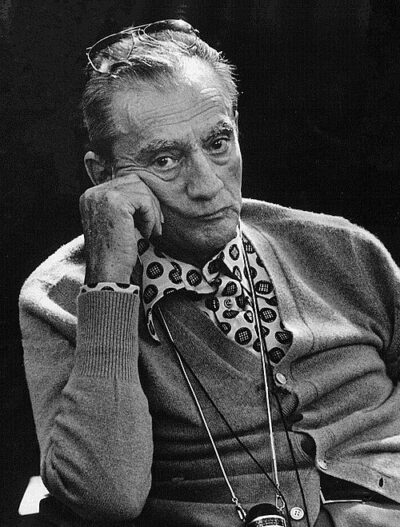
Luchino Visconti
Luchino Visconti was an Italian director. Born November 2, 1906, in Milan. Died March 17, 1976, in Rome. Positions held include President of the Jury at the Cannes Festival (1969). Known for The Leopard, Ludwig and Rocco and His Brothers. Awards include David di Donatello for Best Director, Nastro d'Argento for the director of the best film and Civil Order of Savoy.
Facts
37 facts · 2 confirmed by two sources · 13 cited · 22 from one source
Where this comes from
Papalocal keeps its own record. It started from these sources; what each one said is kept here as it was copied, so a change on their side never changes this page by itself. Tap one to read its version.
What Wikidata says · copied November 16, 2026 · revision 2569378352
- Described as
- Italian director (1906–1976)
- Other names
- Luchino Visconti, conte di Modorone, Don Luchino Visconti di Modrone, Conte di Lonate Pozzolo, Luchino Visconti di Modrone
- Born
- November 2, 1906 · 17 references
- Died
- March 17, 1976 · 16 references
- Born in
- Milan · 4 references
- Died in
- Rome · 3 references
- Buried in
- villa La Colombaia (2003–) · 3 references
- Cause of death
- stroke
- Citizen of
- Kingdom of Italy (–1946); Italy (1946–) · 1 reference
- Occupation
- theatre director · 1 reference; film director · 2 references; screenwriter · 1 reference; writer; director · 2 references; author · 1 reference; theatre designer · 1 reference; opera director
- Positions held
- President of the Jury at the Cannes Festival (1969)
- Genre
- Italian neorealism
- Known for
- The Leopard; Ludwig; Rocco and His Brothers; The Damned; Senso; Ossessione; The Innocent; Death in Venice
- Awards
- David di Donatello for Best Director; Nastro d'Argento for the director of the best film; Civil Order of Savoy · 1 reference; Silver Lion (1957) · 1 reference; Grand Jury Prize of the Venice Film Festival (1960) · 1 reference; Palme d'Or (1963) · 1 reference; Golden Lion (1965) · 1 reference
- Father
- Giuseppe Visconti di Modrone, 1st Duke of Grazzano Visconti · 1 reference
- Mother
- Carla Erba · 1 reference
- Siblings
- Donna Uberta Visconti di Modrone
- Lived in
- villa La Colombaia · 1 reference
- Wikipedias with a page
- 73
Wikidata item Q13888 (wikidata.org/wiki/Q13888), public domain (CC0). Copied November 16, 2026.
What Wikipedia says · copied November 16, 2026 · revision 1376140044
Luchino Visconti di Modrone, Count of Lonate Pozzolo (Italian: [luˈkiːno viˈskonti di moˈdroːne]; 2 November 1906 – 17 March 1976) was an Italian filmmaker, theatre and opera director, and screenwriter. He was one of the fathers of cinematic neorealism but later moved towards luxurious, sweeping epic films, dealing with the themes of beauty, decadence, death, and European history, especially the decay of the nobility and the bourgeoisie. Critic Jonathan Jones wrote that "no one did as much to shape Italian cinema as Luchino Visconti.”
Born into a Milanese noble family with close ties to the artistic world, Visconti began his career in France as an assistant director to Jean Renoir. His 1943 directorial debut, Ossessione, was condemned by the Fascist regime for its unvarnished depictions of working-class characters but was later renowned as a pioneering work of Italian cinema, generally regarded as the first neorealist film. During World War II, he served in the Italian resistance, and afterwards was active in left-wing politics.
Visconti's best-known films include Senso (1954) and The Leopard (1963), which are historical melodramas adapted from Italian literary classics, the gritty drama Rocco and His Brothers (1960), and his "German Trilogy" – The Damned (1969), Death in Venice (1971) and Ludwig (1973). He was also an accomplished director of operas and stage plays, both in Italy and abroad, and held a close association with La Scala in his hometown of Milan.
Visconti received several notable accolades, including both the Palme d'Or (for The Leopard) and the Golden Lion (for 1965's Sandra), the latter out of five total nominations. He won the David di Donatello for Best Director twice and the Nastro d'Argento for Best Director four times, and was both an Oscar and BAFTA Award nominee. Six of Visconti's films are on the list of 100 Italian films to be saved. Many of his works are regarded as highly-influential to future generations of filmmakers, including Francis Ford Coppola and Martin Scorsese.
- Born, in its opening lines
- November 2, 1906
- Died, in its opening lines
- March 17, 1976
From the Wikipedia article “Luchino Visconti” (en.wikipedia.org/wiki/Luchino_Visconti), by its contributors, under CC BY-SA 4.0 (creativecommons.org/licenses/by-sa/4.0/). Copied November 16, 2026; not changed.
Confirmed Two sources agree. Cited One source, and it names where it got it. One source One source, without a reference of its own. Sources disagree The sources disagree. We show the best-supported value and keep theirs below.
