
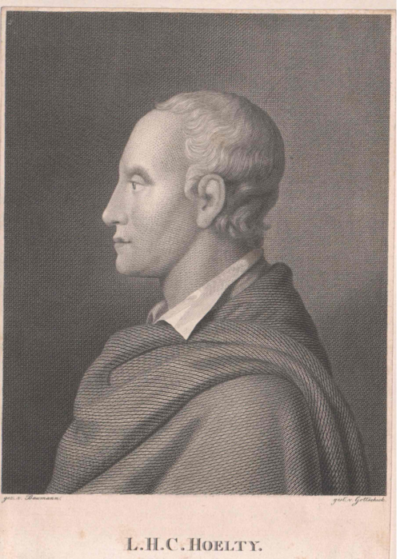
Ludwig Christoph Heinrich Hölty
Ludwig Christoph Heinrich Hölty was a German poet. Born December 21, 1748, in Mariensee. Died September 1, 1776, in Hanover. Educated at University of Göttingen.
Facts
11 facts · 2 confirmed by two sources · 3 cited · 6 from one source
Where this comes from
Papalocal keeps its own record. It started from these sources; what each one said is kept here as it was copied, so a change on their side never changes this page by itself. Tap one to read its version.
What Wikidata says · copied November 18, 2026 · revision 2567479975
- Described as
- German poet
- Other names
- Ludwig Heinrich Christoph Hölty
- Born
- December 21, 1748 · 9 references
- Died
- September 1, 1776 · 9 references
- Born in
- Mariensee · 1 reference
- Died in
- Hanover · 3 references
- Buried in
- Alter St.-Nikolai-Friedhof
- Cause of death
- tuberculosis
- Citizen of
- Holy Roman Empire
- Occupation
- poet · 1 reference; writer · 1 reference; translator · 1 reference
- Education
- University of Göttingen
- Wikipedias with a page
- 20
Wikidata item Q71456 (wikidata.org/wiki/Q71456), public domain (CC0). Copied November 18, 2026.
What Wikipedia says · copied November 18, 2026 · revision 1370247279
Ludwig Christoph Heinrich Hölty (21 December 1748 – 1 September 1776) was a German poet, known especially for his ballads.
Hölty was born in the Electorate of Hanover in the village of Mariensee (today part of Neustadt am Rübenberge) where his father was pastor. In 1769, he went to study theology at the University of Göttingen. There he formed a close friendship with Johann Martin Miller, Johann Heinrich Voss, Heinrich Christian Boie, the brothers Stolberg, and others, and became one of the founders of the famous society of young poets known as the Hain, or Göttinger Hainbund. By the time he left the university in 1774, he had abandoned all intention of becoming a clergyman, but he was not to enter any profession. He died of consumption at Hanover.
Hölty was the most gifted lyric poet of the Göttingen circle. He was influenced by Johann Uz and Friedrich Klopstock, but his love for the Volkslied and his delight in nature preserved him from the artificiality of Uz and the unworldliness of Klopstock. A strain of melancholy runs through all his lyrics. His ballads are the pioneers of the rich ballad literature on English models, which sprang up in Germany over the next few years. Among his most familiar poems are: "Üb' immer Treu' und Redlichkeit" (1776), "Tanzt dem schönen Mai entgegen", and "Wer wollte sich mit Grillen plagen" (1776).
To many, the opening lines of Hölty's poem "Der alte Landmann an seinen Sohn" ("The Old Farmer to His Son") are the very embodiment of all Prussian virtues. This poem was set to music by Mozart to a melody adapted from the aria "Ein Mädchen oder Weibchen" from his 1791 opera The Magic Flute. It was played daily by the carillon of the Potsdam Garrison Church where Frederick the Great was initially buried. The text reads as follows: "Üb' immer Treu und Redlichkeit / Bis an dein kühles Grab; / Und weiche keinen Fingerbreit / Von Gottes Wegen ab." Translation: "Practice always fidelity and honesty / Up to your cold grave; / And stray not one inch / From the ways of the Lord."
Hölty's collection Gedichte (poems) was published by his friends Count Friedrich Leopold zu Stolberg and J. H. Voss (Hamburg, 1783). A new edition, enlarged by Voss with a biography, came out in 1804, followed by a more complete but still imperfect edition by F. Voigts (Hanover, 1857). The first complete edition was that of Karl Halm (Leipzig, 1870), who had access to manuscripts not hitherto known.
Many of Hölty's poems were set to music by composers including Mozart, Beethoven, Schubert, Mendelssohn, Fanny Hensel, and Brahms, and his verse 'Ihr Freunde, hänget, wann ich gestorben bin' is inscribed above the final movement of the Harp Sonata by Paul Hindemith. Several streets and schools in Germany are named after him, including the Hölty-Gymnasium in Wunstorf near Hanover; in 2008, the biennial poetry prize Hölty-Preis was created in his name.
- Born, in its opening lines
- December 21, 1748
- Died, in its opening lines
- September 1, 1776
From the Wikipedia article “Ludwig Christoph Heinrich Hölty” (en.wikipedia.org/wiki/Ludwig_Christoph_Heinrich_Hölty), by its contributors, under CC BY-SA 4.0 (creativecommons.org/licenses/by-sa/4.0/). Copied November 18, 2026; not changed.
Confirmed Two sources agree. Cited One source, and it names where it got it. One source One source, without a reference of its own. Sources disagree The sources disagree. We show the best-supported value and keep theirs below.
