
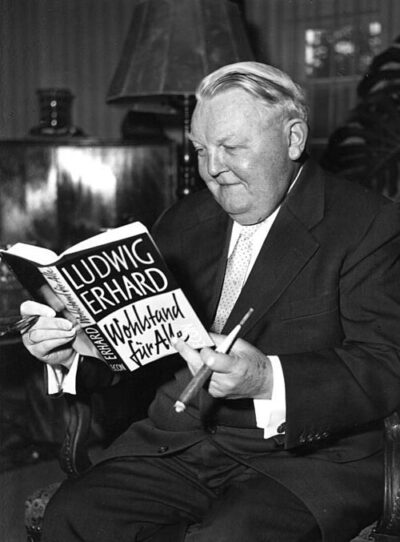
Ludwig Erhard
Ludwig Erhard was a Chancellor of West Germany. Born February 4, 1897, in Fürth. Died May 5, 1977, in Bonn. Positions held include member of the German Bundestag (1949–1977), Federal Chancellor of Germany (1963–1966) and Vice-Chancellor of Germany (1957–1963). Educated at School of Economics and Social Sciences Nuremberg and Goethe University Frankfurt. Awards include Bavarian Order of Merit, Grand Cross of the Order of Isabella the Catholic and honorary doctor of the University of Madrid Complutense.
Facts
37 facts · 2 confirmed by two sources · 8 cited · 27 from one source
Where this comes from
Papalocal keeps its own record. It started from these sources; what each one said is kept here as it was copied, so a change on their side never changes this page by itself. Tap one to read its version.
What Wikidata says · copied November 16, 2026 · revision 2568843926
- Described as
- Chancellor of West Germany (1963–1966)
- Other names
- Ludwig Wilhelm Erhard
- Born
- February 4, 1897 · 14 references
- Died
- May 5, 1977 · 15 references
- Born in
- Fürth · 2 references
- Died in
- Bonn · 3 references
- Buried in
- Gmund am Tegernsee
- Cause of death
- heart failure
- Name at birth
- Ludwig Wilhelm Erhard
- Citizen of
- Germany
- Occupation
- economist · 1 reference; politician · 1 reference; university teacher · 1 reference
- Positions held
- member of the German Bundestag (1949–1977) · 1 reference; Federal Chancellor of Germany (1963–1966); Vice-Chancellor of Germany (1957–1963); leader of the Christian Democratic Union (1966–1967) · 1 reference; Bavarian minister of economics (1945–1946)
- Political party
- Christian Democratic Union
- Worked for
- LMU Munich; University of Bonn
- Education
- School of Economics and Social Sciences Nuremberg; Goethe University Frankfurt; Hardenberg-Gymnasium Fürth
- Member of
- Mont Pelerin Society
- Awards
- Bavarian Order of Merit (1959); Grand Cross of the Order of Isabella the Catholic (1961) · 1 reference; honorary doctor of the University of Madrid Complutense (1960); Grand Cross of the Order of the Sun of Peru; Grand Cross 1st class of the Order of Merit of the Federal Republic of Germany (1953) · 1 reference; Knight Grand Cross of the Order of Merit of the Italian Republic (1955) · 1 reference; Grand Cross of the Military Order of Saint James of the Sword (1961) · 2 references; Honorary doctor of the Technical University of Berlin; honorary citizen of Bonn; Order of Merit for National Foundation · 1 reference; honorary citizen of Ulm (1977)
- Spouse
- Luise Erhard
- Religion
- Lutheranism
- Lived in
- Gmund am Tegernsee
- Wikipedias with a page
- 90
Wikidata item Q2496 (wikidata.org/wiki/Q2496), public domain (CC0). Copied November 16, 2026.
What Wikipedia says · copied November 16, 2026 · revision 1384888133
Ludwig Wilhelm Erhard (German: [ˈluːtvɪç ˈʔeːɐ̯haʁt]; 4 February 1897 – 5 May 1977) was a German politician and economist who served as the second chancellor of West Germany from 1963 until 1966. Affiliated with the Christian Democratic Union (CDU), he is known for leading the West German postwar economic reforms and economic recovery (Wirtschaftswunder, German for "economic miracle") in his role as Minister of Economic Affairs under Chancellor Konrad Adenauer from 1949 to 1963. During that period, he promoted the concept of the social market economy (soziale Marktwirtschaft), on which Germany's economic policy in the 21st century continues to be based.
In his tenure as Chancellor, however, Erhard lacked support from Adenauer, who remained chairman of the CDU party until 1966. Erhard failed to win the German public's confidence in his handling of a budget deficit and lacked public support for his direction of foreign policy. His popularity waned, and he resigned his chancellorship on 30 November 1966.
- Born, in its opening lines
- February 4, 1897
- Died, in its opening lines
- May 5, 1977
From the Wikipedia article “Ludwig Erhard” (en.wikipedia.org/wiki/Ludwig_Erhard), by its contributors, under CC BY-SA 4.0 (creativecommons.org/licenses/by-sa/4.0/). Copied November 16, 2026; not changed.
Confirmed Two sources agree. Cited One source, and it names where it got it. One source One source, without a reference of its own. Sources disagree The sources disagree. We show the best-supported value and keep theirs below.
