
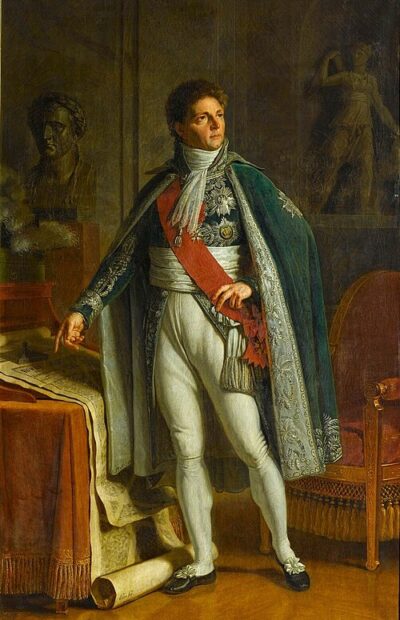
Luis Alejandro Berthier
Luis Alejandro Berthier was a Marshal and Vice-Constable of France. Born November 20, 1753, in Versailles. Died June 1, 1815, in Bamberg. Positions held include Minister of War, Pair of France and defence minister. Awards include Grand Cross of the Legion of Honour, Marshal of the Empire and Knight Commander of the Order of Saint Louis.
Facts
39 facts · 2 confirmed by two sources · 4 cited · 33 from one source
Where this comes from
Papalocal keeps its own record. It started from these sources; what each one said is kept here as it was copied, so a change on their side never changes this page by itself. Tap one to read its version.
What Wikidata says · copied November 16, 2026 · revision 2567720622
- Described as
- Marshal and Vice-Constable of France (1753-1815)
- Other names
- Alexandre Berthier, Louis-Alexandre Berthier
- Born
- November 20, 1753 · 8 references
- Died
- June 1, 1815 · 11 references
- Born in
- Versailles · 4 references
- Died in
- Bamberg · 2 references
- Buried in
- Tegernsee Abbey
- Cause of death
- alleged suicide
- Citizen of
- France
- Occupation
- sculptor; politician; military personnel; engineer; marshal · 1 reference
- Positions held
- Minister of War; Pair of France; defence minister · 1 reference
- Awards
- Grand Cross of the Legion of Honour; Marshal of the Empire (1804–); Knight Commander of the Order of Saint Louis; Marshal of France; list of names inscribed on the Arc de Triomphe; Order of the Black Eagle; Order of Saint Alexander Nevsky; Order of St. Andrew; Grand Officer of the Legion of Honour · 1 reference; Knight of the Legion of Honour · 1 reference; Order of the Crown · 1 reference; Order of Saint Joseph · 1 reference; Military Order of Max Joseph · 1 reference; Order of the Rue Crown · 1 reference; Military Order of St. Henry · 1 reference
- Spouse
- Duchess Maria Elisabeth in Bavaria · 1 reference
- Children
- Napoléon Alexandre Berthier; Caroline Josephine Berthier de Wagram; Anne Berthier de Wagram
- Father
- Jean-Baptiste Berthier
- Mother
- Marie Françoise L'Huillier de La Serre
- Siblings
- Léopold Berthier
- Military branch
- French Armed Forces · 1 reference
- Military rank
- Marshal of the Empire
- Wikipedias with a page
- 48
Wikidata item Q155734 (wikidata.org/wiki/Q155734), public domain (CC0). Copied November 16, 2026.
What Wikipedia says · copied November 16, 2026 · revision 1384933944
Louis-Alexandre Berthier, prince de Neuchâtel et Valangin, prince de Wagram (English: BUR-tee-ay, French: [lwi alɛksɑ̃dʁ bɛʁtje]; 20 November 1753 – 1 June 1815) was a French military commander who served during the French Revolutionary Wars and the Napoleonic Wars. He was twice Minister of War of France and was made a Marshal of the Empire in 1804. Berthier served as chief of staff to Napoleon Bonaparte from his first Italian campaign in 1796 until his first abdication in 1814. The operational efficiency of the Grande Armée owed much to his considerable administrative and organizational skills.
Born into a military family, Berthier served in the American Revolutionary War and survived suspicion of monarchism during the Reign of Terror before a rapid rise in the ranks of the French Revolutionary Army. Although a key supporter of the coup against the Directory that gave Napoleon supreme power, and present for his greatest victories, Berthier strongly opposed the progressive stretching of lines of communication during the Russian campaign. Allowed to retire by the restored Bourbon regime, he died by either suicide or murder shortly before the Battle of Waterloo. Berthier's reputation as a superb operational organiser remains strong among current historians.
- Born, in its opening lines
- November 20, 1753
- Died, in its opening lines
- June 1, 1815
From the Wikipedia article “Louis-Alexandre Berthier” (en.wikipedia.org/wiki/Louis-Alexandre_Berthier), by its contributors, under CC BY-SA 4.0 (creativecommons.org/licenses/by-sa/4.0/). Copied November 16, 2026; not changed.
Confirmed Two sources agree. Cited One source, and it names where it got it. One source One source, without a reference of its own. Sources disagree The sources disagree. We show the best-supported value and keep theirs below.
