
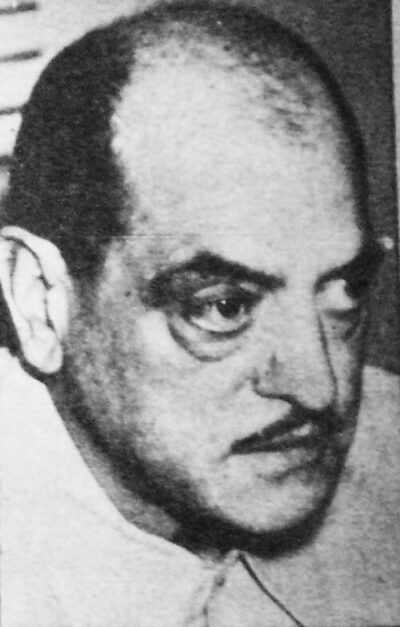
Luis Buñuel
Luis Buñuel was a Spanish-Mexican filmmaker. Born February 22, 1900, in Calanda. Died July 29, 1983, in Mexico City. Known for Un Chien Andalou, L’Age d’Or and Land Without Bread. Educated at Complutense University of Madrid and College of the Savior, Zaragoza. Awards include Grand Cross of the Order of Isabella the Catholic, National Prize for Arts and Sciences and honorary doctor of the University of Madrid Complutense.
Facts
46 facts · 2 confirmed by two sources · 10 cited · 34 from one source
Where this comes from
Papalocal keeps its own record. It started from these sources; what each one said is kept here as it was copied, so a change on their side never changes this page by itself. Tap one to read its version.
What Wikidata says · copied November 16, 2026 · revision 2565529044
- Described as
- Spanish-Mexican filmmaker (1900–1983)
- Born
- February 22, 1900 · 16 references
- Died
- July 29, 1983 · 14 references
- Born in
- Calanda · 1 reference
- Died in
- Mexico City · 2 references
- Buried in
- Tolocha · 1 reference
- Cause of death
- liver cirrhosis
- Name at birth
- Luis Buñuel Portolés
- Citizen of
- Spain (–1949) · 2 references; Mexico (1951–) · 1 reference
- Occupation
- film director; screenwriter · 1 reference; actor; film editor · 1 reference; writer · 1 reference; composer · 1 reference; poet · 1 reference; film producer · 1 reference
- Education
- Complutense University of Madrid; College of the Savior, Zaragoza
- Member of
- American Academy of Arts and Sciences
- Genre
- surrealism · 1 reference
- Known for
- Un Chien Andalou; L’Age d’Or; Land Without Bread; Los Olvidados; Nazarín; Viridiana; The Exterminating Angel; Belle de Jour; The Discreet Charm of the Bourgeoisie
- Awards
- Grand Cross of the Order of Isabella the Catholic (1983) · 1 reference; National Prize for Arts and Sciences (1977) · 1 reference; honorary doctor of the University of Madrid Complutense (1981); honorary doctor of the University of Zaragoza (1983); Palme d'Or · 1 reference; Golden Lion · 1 reference; Golden Ariel; Cannes Best Director Award (1951) · 1 reference; Grand Jury Prize of the Venice Film Festival (1965) · 1 reference; BAFTA Award for Best Screenplay (1974) · 1 reference; Gold Medal of Merit in the Fine Arts (1981) · 1 reference
- Spouse
- Jeanne Rucar (1934–)
- Children
- Juan Luis Buñuel · 1 reference
- Father
- Leonardo Buñuel González
- Siblings
- Alfonso Buñuel
- Religion
- atheism
- Wikipedias with a page
- 95
Wikidata item Q51545 (wikidata.org/wiki/Q51545), public domain (CC0). Copied November 16, 2026.
What Wikipedia says · copied November 16, 2026 · revision 1384695379
Luis Buñuel Portolés (Spanish: [ˈlwis βuˈɲwel poɾtoˈles]; 22 February 1900 – 29 July 1983) was a Spanish and Mexican filmmaker who worked in France, Mexico, and Spain. He has been widely considered by many film critics, historians, and directors to be one of the greatest and most influential filmmakers of all time. Buñuel's works are known for their avant-garde surrealism which was also infused with political commentary.
Often associated with the surrealist movement, Buñuel's career spanned the 1920s through the 1970s. He collaborated with surrealist painter Salvador Dalí on Un Chien Andalou (1929) and L'Age d'Or (1930). Both are considered masterpieces of surrealist cinema. From 1947 to 1960, he honed his skills as a director in Mexico, making grounded and human melodramas such as Gran Casino (1947), Los Olvidados (1950) and Él (1953).
Buñuel then transitioned to making artful, surrealistic and satirical films. He earned the Palme d'Or at the 1961 Cannes Film Festival for Viridiana (1961), which criticized the Francoist dictatorship. He satirized social conditions in The Exterminating Angel (1962) and The Discreet Charm of the Bourgeoisie (1972), the latter of which won the Academy Award for Best Foreign Language Film. He also directed Diary of a Chambermaid (1964) and Belle de Jour (1967). He earned the National Society of Film Critics Award for Best Director for his final film, That Obscure Object of Desire (1977).
Buñuel earned five Cannes Film Festival prizes, two Berlin International Film Festival prizes, a BAFTA Award and an Academy Award in 1972. Buñuel received numerous honors including National Prize for Arts and Sciences for Fine Arts in 1977, the Moscow International Film Festival Contribution to Cinema Prize in 1979, and the Career Golden Lion in 1982. He was nominated twice for the Nobel Prize in Literature, in 1968 and then in 1972. Seven of Buñuel's films are included in Sight & Sound's 2012 critics' poll of the top 250 films of all time. Buñuel's obituary in The New York Times called him "an iconoclast, moralist, and revolutionary who was a leader of avant-garde surrealism in his youth and a dominant international movie director half a century later".
- Born, in its opening lines
- February 22, 1900
- Died, in its opening lines
- July 29, 1983
From the Wikipedia article “Luis Buñuel” (en.wikipedia.org/wiki/Luis_Buñuel), by its contributors, under CC BY-SA 4.0 (creativecommons.org/licenses/by-sa/4.0/). Copied November 16, 2026; not changed.
Confirmed Two sources agree. Cited One source, and it names where it got it. One source One source, without a reference of its own. Sources disagree The sources disagree. We show the best-supported value and keep theirs below.
