
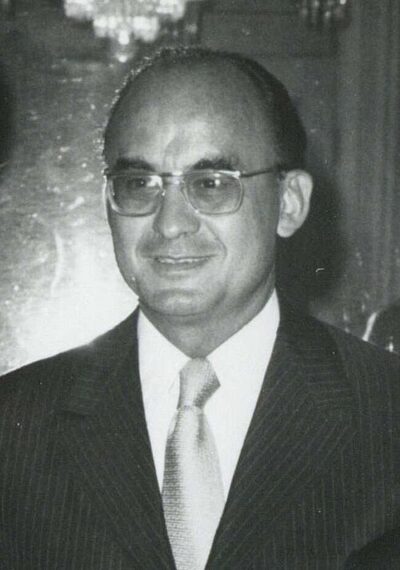
Luis Echeverría
Luis Echeverría was the 57th President of Mexico. Born January 17, 1922, in Mexico City. Died July 8, 2022, in Cuernavaca. Positions held include President of Mexico (1970–1976), Mexico presidential candidate for the Revolutionary Institutional Party (1969–1970) and Secretary of Government (1963–1969). Educated at National Autonomous University of Mexico. Awards include Grand Star of the Decoration for Services to the Republic of Austria, Order of Jamaica and Order of the Bath.
Facts
25 facts · 2 confirmed by two sources · 6 cited · 17 from one source
Where this comes from
Papalocal keeps its own record. It started from these sources; what each one said is kept here as it was copied, so a change on their side never changes this page by itself. Tap one to read its version.
What Wikidata says · copied November 16, 2026 · revision 2569711225
- Described as
- 57th President of Mexico
- Other names
- Luis Echeverria, Luis Echeverria Alvarez
- Born
- January 17, 1922 · 4 references
- Died
- July 8, 2022 · 2 references
- Born in
- Mexico City · 1 reference
- Died in
- Cuernavaca · 1 reference
- Name at birth
- Luis Echeverría Álvarez
- Citizen of
- Mexico
- Occupation
- diplomat; politician · 1 reference; jurist · 1 reference
- Positions held
- President of Mexico (1970–1976); Mexico presidential candidate for the Revolutionary Institutional Party (1969–1970); Secretary of Government (1963–1969)
- Political party
- Institutional Revolutionary Party (1946–2022)
- Education
- National Autonomous University of Mexico (1940–1945)
- Awards
- Grand Star of the Decoration for Services to the Republic of Austria (1974); Order of Jamaica; Order of the Bath (1973); Knight Grand Cross with Collar of the Order of Merit of the Italian Republic; Grand Cross, Special Class of the Order of the Sun of Peru (1974)
- Field
- politics · 1 reference; law · 1 reference
- Spouse
- María Esther Zuno (1945–1999)
- Children
- Álvaro Echeverría Zuno
- Siblings
- Rodolfo Landa
- Religion
- Catholicism
- Wikipedias with a page
- 48
Wikidata item Q317681 (wikidata.org/wiki/Q317681), public domain (CC0). Copied November 16, 2026.
What Wikipedia says · copied November 16, 2026 · revision 1371229033
Luis Echeverría Álvarez (Spanish pronunciation: [ˈlwis etʃeβeˈri.a ˈalβaɾes]; 17 January 1922 – 8 July 2022) was a Mexican lawyer, academic, and politician affiliated with the Institutional Revolutionary Party (PRI) who served as the 57th president of Mexico from 1970 to 1976. Previously, Echeverría was Secretary of the Interior from 1963 to 1969. He was the longest-lived president in Mexican history and the first to reach the age of 100.
Echeverría was a long-time CIA asset, known by the cryptonym, LITEMPO-8. His tenure as Secretary of the Interior during the Díaz Ordaz administration was marked by an increase in political repression. Dissident journalists, politicians, and activists were subjected to censorship, arbitrary arrests, torture, and extrajudicial killings. This culminated with the Tlatelolco massacre of 2 October 1968, which ruptured the Mexican student movement; Díaz Ordaz, Echeverría, and Secretary of Defense Marcelino Garcia Barragán have been considered as the intellectual authors of the massacre, in which hundreds of unarmed protestors were killed by the Mexican Army. The following year, Díaz Ordaz appointed Echeverría as his designated successor to the presidency, and he won in the 1970 general election.
Echeverría was one of the most high-profile presidents in Mexico's post-war history; he attempted to become a leader of the Third World, countries unaligned with the United States or the Soviet Union during the Cold War. He offered political asylum to Hortensia Bussi and other refugees of Augusto Pinochet's dictatorship in Chile, established diplomatic relations and a close collaboration with the People's Republic of China after visiting Beijing and meeting with Chairman Mao Zedong and Premier Zhou Enlai, and tried to use Mao's influence among Asian and African nations in an ultimately failed attempt to become Secretary-General of the United Nations. Echeverría strained relations with Israel after supporting a UN resolution that condemned Zionism.
Domestically, Echeverría led the country during a period of significant economic growth, with the Mexican economy aided by high oil prices, and growing at a yearly rate of 6.1%. He aggressively promoted the development of infrastructure projects such as new maritime ports in Lázaro Cárdenas and Ciudad Madero. His presidency was also characterized by authoritarian methods including death flights, the 1971 Corpus Christi massacre against student protesters, the Dirty War against leftist dissent in the country (despite Echeverría adopting a left-populist rhetoric), and a financial crisis that started near the end of his term (partly as result of overspending during his administration) which led to a devaluation of the peso. In 2006, he was indicted and ordered under house arrest for his role in the Tlatelolco and Corpus Christi massacres, but the charges against him were dismissed in 2009.
Echeverría is one of the most controversial presidents in the history of Mexico. Supporters have praised his populist policies such as a more enthusiastic application of land redistribution than his predecessor Díaz Ordaz, expansion of social security, the creation of the INFONAVIT, his intense diplomatic activity and Mexico's presence at the international stage during his administration, and instigating Mexico's first environmental protection laws. Detractors have criticized institutional violence such as the Dirty War and Corpus Christi massacre, and his administration's economic mismanagement and response to the financial crisis of 1976, as well as his constant conflicts with the private sector. His suspected role in the Tlatelolco Massacre prior to his presidency has also damaged his reputation.
Shortly after his presidential term ended, Echeverría was a candidate for the position of Secretary General of the United Nations in the 1976 UN election, being defeated by incumbent Kurt Waldheim from Austria. So far, Echeverría has been the last Mexican to have contended for the UN Secretary-Generalship.
- Born, in its opening lines
- January 17, 1922
- Died, in its opening lines
- July 8, 2022
From the Wikipedia article “Luis Echeverría” (en.wikipedia.org/wiki/Luis_Echeverría), by its contributors, under CC BY-SA 4.0 (creativecommons.org/licenses/by-sa/4.0/). Copied November 16, 2026; not changed.
Confirmed Two sources agree. Cited One source, and it names where it got it. One source One source, without a reference of its own. Sources disagree The sources disagree. We show the best-supported value and keep theirs below.
