
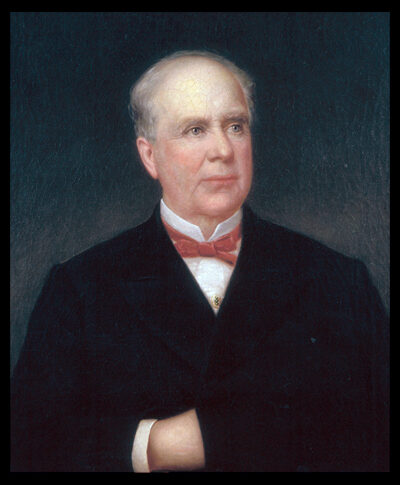
Luke Pryor Blackburn
Luke Pryor Blackburn was an American physician and governor of Kentucky. Born June 16, 1816, in Woodford County. Died September 14, 1887, in Frankfort. Positions held include Governor of Kentucky (1879–1883) and member of the Kentucky House of Representatives. Educated at Transylvania University.
Facts
16 facts · 2 confirmed by two sources · 5 cited · 9 from one source
Where this comes from
Papalocal keeps its own record. It started from these sources; what each one said is kept here as it was copied, so a change on their side never changes this page by itself. Tap one to read its version.
What Wikidata says · copied November 18, 2026 · revision 2567473672
- Described as
- American physician and governor of Kentucky (1816–1887)
- Other names
- Luke P. Blackburn
- Born
- June 16, 1816 · 2 references
- Died
- September 14, 1887 · 2 references
- Born in
- Woodford County
- Died in
- Frankfort · 1 reference
- Buried in
- Frankfort Cemetery
- Citizen of
- United States
- Occupation
- politician · 1 reference; physician · 2 references; governor · 1 reference
- Positions held
- Governor of Kentucky (1879–1883); member of the Kentucky House of Representatives
- Political party
- Democratic Party
- Education
- Transylvania University
- Children
- Cary Bell Blackburn
- Siblings
- J. C. S. Blackburn · 1 reference; James W. Blackburn
- Wikipedias with a page
- 17
Wikidata item Q361131 (wikidata.org/wiki/Q361131), public domain (CC0). Copied November 18, 2026.
What Wikipedia says · copied November 18, 2026 · revision 1382881807
Luke Pryor Blackburn (June 16, 1816 – September 14, 1887) was an American medical doctor, philanthropist, and politician from Kentucky. He was elected the 28th governor of Kentucky, serving from 1879 to 1883.
After earning a medical degree at Transylvania University, Blackburn moved to Natchez, Mississippi, and gained national fame for implementing the first successful quarantine against yellow fever in the Mississippi River valley in 1848. He came to be regarded as an expert on yellow fever and often worked pro bono to combat outbreaks. Among his philanthropic ventures was the construction of a hospital for Mississippi River boatmen using his personal funds. He later successfully lobbied Congress to construct a series of similar hospitals along the Mississippi.
In the early days of the American Civil War, he acted as a civilian agent for the governments of Kentucky and Mississippi. By 1863, he was aiding Confederate blockade runners in Canada. In 1864, he traveled to Bermuda to help combat a yellow fever outbreak that threatened Confederate blockade running operations there. Shortly after the war's end, a Confederate double agent accused him of having carried out a plot to start a yellow fever epidemic in the Northern United States that would have hampered the Union war effort. The evidence against Blackburn was considerable, although much of it was either circumstantial or provided by witnesses of questionable reputation. Although he was acquitted by a Toronto court, public sentiment was decidedly against him throughout much of the United States. Historians still disagree as to the strength of the evidence supporting Blackburn's role in the alleged plot.
Blackburn remained in Canada to avoid prosecution by U.S. authorities, but he returned to his home country in 1868 to help combat a yellow fever outbreak along the Gulf Coast of Texas and Louisiana. He rehabilitated his public image by rendering aid in yellow fever outbreaks in Memphis, Tennessee, in 1873, Fernandina, Florida, in 1877, and Hickman, Kentucky, in 1878. Dubbed the "Hero of Hickman", Blackburn's ministrations propelled him to the Democratic gubernatorial nomination the following year. In the general election, he defeated Republican Walter Evans by a wide margin. As governor, Blackburn won passage of several reforms in the areas of state finance and internal improvements, but his signature accomplishments were in the area of penal reform. Troubled by the conditions at the penitentiary in Frankfort, Blackburn attempted to ease overcrowding through liberal use of his gubernatorial pardon, earning him the derisive nickname "Lenient Luke". He also secured approval of the construction of a new penitentiary at Eddyville, the adoption of a warden system to replace the corrupt private oversight of the old penitentiary, and the implementation of the state's first parole system. Although his record of reform led historians to laud him as "the father of prison reform in Kentucky", his liberal pardon record and expenditure of scarce taxpayer money to improve the living conditions of prisoners was unpopular at the time, and he was booed and shouted down at his own party's nominating convention in 1883. After his term as governor, he returned to his medical practice and died in 1887. The Blackburn Correctional Complex, a minimum-security penal facility near Lexington, Kentucky, was named in his honor in 1972.
- Born, in its opening lines
- June 16, 1816
- Died, in its opening lines
- September 14, 1887
From the Wikipedia article “Luke P. Blackburn” (en.wikipedia.org/wiki/Luke_P._Blackburn), by its contributors, under CC BY-SA 4.0 (creativecommons.org/licenses/by-sa/4.0/). Copied November 18, 2026; not changed.
Confirmed Two sources agree. Cited One source, and it names where it got it. One source One source, without a reference of its own. Sources disagree The sources disagree. We show the best-supported value and keep theirs below.
