
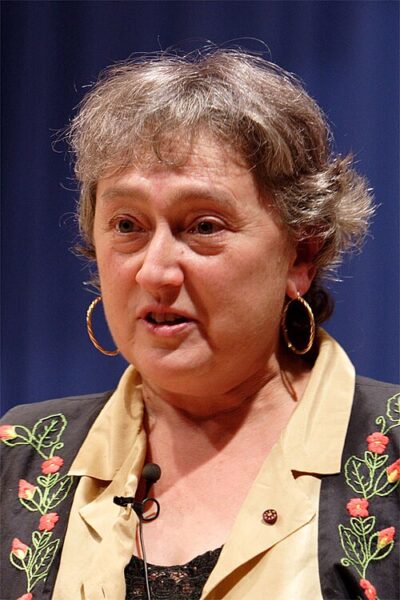
Lynn Margulis
Lynn Margulis was an American evolutionary biologist. Born March 5, 1938, in Chicago. Died November 22, 2011, in Amherst. Known for On the origin of mitosing cells. Educated at University of Wisconsin–Madison and Harvard University. Awards include Guggenheim Fellowship, National Medal of Science and Darwin–Wallace Medal.
Facts
42 facts · 2 confirmed by two sources · 22 cited · 18 from one source
Where this comes from
Papalocal keeps its own record. It started from these sources; what each one said is kept here as it was copied, so a change on their side never changes this page by itself. Tap one to read its version.
What Wikidata says · copied November 13, 2026 · revision 2558141913
- Described as
- American evolutionary biologist (1938–2011)
- Other names
- Margulis, Lynn Petra Alexander, Lynn Sagan
- Born
- March 5, 1938 · 7 references
- Died
- November 22, 2011 · 8 references
- Born in
- Chicago · 2 references
- Died in
- Amherst · 1 reference
- Citizen of
- United States · 1 reference
- Occupation
- university teacher · 1 reference; botanist; zoologist; ecologist · 1 reference; microbiologist · 1 reference; biologist · 2 references; lecturer · 1 reference; evolutionary biologist
- Worked for
- University of Massachusetts Amherst; Boston University
- Education
- University of Wisconsin–Madison (–1960) · 2 references; Harvard University · 1 reference; University of California, Berkeley (–1965) · 1 reference; University of Massachusetts Amherst; University of Chicago Laboratory Schools
- Member of
- National Academy of Sciences (1983–) · 2 references; American Academy of Arts and Sciences
- Known for
- On the origin of mitosing cells
- Awards
- Guggenheim Fellowship (1978) · 1 reference; National Medal of Science (1999) · 1 reference; Darwin–Wallace Medal (2008) · 2 references; William Procter Prize for Scientific Achievement (1999) · 1 reference; honorary doctor of the Autonomous University of Barcelona; honorary doctorate of the University of Vigo (2007) · 1 reference; honorary doctor of the University of Valencia (2001) · 1 reference; honorary doctor of Syracuse University (2008) · 1 reference; honorary doctorate of the Autonomous University of Madrid; Nevada Medal (1998) · 1 reference; Edinburgh Medal (2000); honorary doctorate from INP Toulouse (1999) · 1 reference; NASA Public Service Award · 1 reference; Commander of the French Order of Academic Palms · 1 reference
- Field
- cell biology
- Spouse
- Carl Sagan (1957–1965) · 1 reference
- Children
- Dorion Sagan; Jeremy Sagan
- Website
- http://www.geo.umass.edu/faculty/margulis/ · 1 reference
- Wikipedias with a page
- 59
Wikidata item Q234583 (wikidata.org/wiki/Q234583), public domain (CC0). Copied November 13, 2026.
What Wikipedia says · copied November 13, 2026 · revision 1383884778
Lynn Margulis (born Lynn Petra Alexander; March 5, 1938 – November 22, 2011) was an American evolutionary biologist, who was the primary modern proponent for the significance of symbiosis in evolution. In particular, Margulis transformed and fundamentally framed biologists' understanding of the evolution of the eukaryotes, organisms with nuclei in their cells.
She proposed that they came into being by symbiotic mergers of bacteria. Margulis was the co-developer of the Gaia hypothesis with the British chemist James Lovelock, proposing that the Earth functions as a unified self-regulating system, and the principal defender and promulgator of the five kingdom classification of Robert Whittaker.
Throughout her career, Margulis' work could arouse intense objections, and her formative paper, "On the Origin of Mitosing Cells", appeared in 1967 after being rejected by about fifteen journals. Still a junior faculty member at Boston University at the time, her theory that cell organelles such as mitochondria and chloroplasts were once independent bacteria was largely ignored for another decade, becoming widely accepted only after it was powerfully substantiated through genetic evidence. Margulis was elected a member of the US National Academy of Sciences in 1983. President Bill Clinton presented her the National Medal of Science in 1999. The Linnean Society of London awarded her the Darwin-Wallace Medal in 2008.
Margulis was a strong critic of neo-Darwinism. Her position sparked lifelong debate with leading neo-Darwinian biologists, including Richard Dawkins, George C. Williams, and John Maynard Smith. Margulis' work on symbiosis and her endosymbiotic theory had important predecessors, going back to the mid-19th century – notably Andreas Franz Wilhelm Schimper, Konstantin Mereschkowski, Boris Kozo-Polyansky, and Ivan Wallin – and Margulis not only promoted greater recognition for their contributions, but personally oversaw the first English translation of Kozo-Polyansky's Symbiogenesis: A New Principle of Evolution, which appeared the year before her death. Many of her major works, particularly those intended for a general readership, were collaboratively written with her son Dorion Sagan.
In 2002, Discover magazine recognized Margulis as one of the 50 most important women in science.
- Born, in its opening lines
- March 5, 1938
- Died, in its opening lines
- November 22, 2011
From the Wikipedia article “Lynn Margulis” (en.wikipedia.org/wiki/Lynn_Margulis), by its contributors, under CC BY-SA 4.0 (creativecommons.org/licenses/by-sa/4.0/). Copied November 13, 2026; not changed.
Confirmed Two sources agree. Cited One source, and it names where it got it. One source One source, without a reference of its own. Sources disagree The sources disagree. We show the best-supported value and keep theirs below.
