
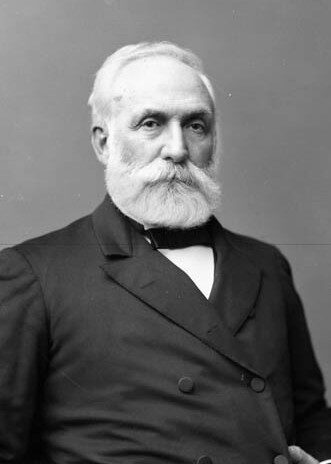
Mackenzie Bowell
Mackenzie Bowell was the 5th Prime Minister of Canada. Born December 27, 1823, in Rickinghall. Died December 10, 1917, in Belleville. Positions held include Prime Minister of Canada (1894–1896), Representative of the Government in the Senate (1893–1896) and Minister of Finance (1896). Awards include Knight Commander of the Order of St Michael and St George and Person of National Historic Significance.
Facts
26 facts · 2 confirmed by two sources · 8 cited · 16 from one source
Where this comes from
Papalocal keeps its own record. It started from these sources; what each one said is kept here as it was copied, so a change on their side never changes this page by itself. Tap one to read its version.
What Wikidata says · copied November 15, 2026 · revision 2568865709
- Described as
- 5th Prime Minister of Canada (1823-1917)
- Other names
- Sir Mackenzie Bowell
- Born
- December 27, 1823 · 4 references
- Died
- December 10, 1917 · 4 references
- Born in
- Rickinghall
- Died in
- Belleville · 1 reference
- Buried in
- Belleville Cemetery · 1 reference
- Cause of death
- pneumonia
- Name at birth
- Mackenzie Bowell
- Citizen of
- Canada
- Occupation
- politician · 1 reference; entrepreneur; journalist; printer · 1 reference; editor · 1 reference
- Positions held
- Prime Minister of Canada (1894–1896); Representative of the Government in the Senate (1893–1896); Minister of Finance (1896) · 1 reference; member of the House of Commons of Canada (1867–1892) · 1 reference; member of the Senate of Canada (1892–1917) · 1 reference
- Political party
- Conservative Party of Canada; Liberal-Conservative Party · 1 reference
- Member of
- Orange Order
- Awards
- Knight Commander of the Order of St Michael and St George; Person of National Historic Significance · 1 reference
- Spouse
- Harriet Moore
- Religion
- Presbyterianism
- Military rank
- Lieutenant Colonel
- Wikipedias with a page
- 33
Wikidata item Q128677 (wikidata.org/wiki/Q128677), public domain (CC0). Copied November 15, 2026.
What Wikipedia says · copied November 15, 2026 · revision 1370885856
Sir Mackenzie Bowell (; December 27, 1823 – December 10, 1917) was the fifth prime minister of Canada, serving from 1894 to 1896.
Bowell was born in Rickinghall, Suffolk, England. He and his family moved to Belleville, Upper Canada in 1832. When in his early teens, Bowell was apprenticed to the printing shop of the local newspaper, the Belleville Intelligencer, and some 15 years later, became its owner and proprietor.
In 1867, following Confederation, he was elected to the House of Commons for the Conservative Party. Bowell entered cabinet in 1878, and would serve under three prime ministers: John A. Macdonald, John Abbott, and John Thompson. He served variously as Minister of Customs (1878–1892), Minister of Militia and Defence (1892), and Minister of Trade and Commerce (1892–1894). Bowell kept his Commons seat continuously for 25 years, through a period of Liberal Party rule in the 1870s. In 1892, Bowell was appointed to the Senate. He became Leader of the Government in the Senate the following year.
In December 1894, Prime Minister Thompson unexpectedly died in office. The Earl of Aberdeen, Canada's governor general, appointed Bowell to replace Thompson as prime minister, due to his status as the most senior cabinet member. The main problem of Bowell's tenure as prime minister was the Manitoba Schools Question. His attempts at compromise alienated members of his own party, and following a Cabinet revolt in early 1896 he was forced to resign in favour of Charles Tupper. Bowell stayed on as a senator until his death at the age of 93, but never again held ministerial office; he served continuously as a Canadian parliamentarian for 50 years.
- Born, in its opening lines
- December 27, 1823
- Died, in its opening lines
- December 10, 1917
From the Wikipedia article “Mackenzie Bowell” (en.wikipedia.org/wiki/Mackenzie_Bowell), by its contributors, under CC BY-SA 4.0 (creativecommons.org/licenses/by-sa/4.0/). Copied November 15, 2026; not changed.
Confirmed Two sources agree. Cited One source, and it names where it got it. One source One source, without a reference of its own. Sources disagree The sources disagree. We show the best-supported value and keep theirs below.
