
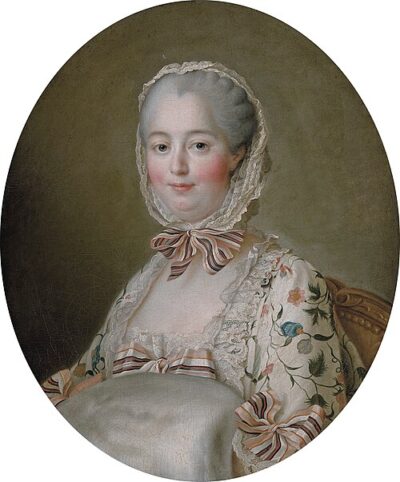
Madame de Pompadour
Madame de Pompadour was a chief mistress of Louis XV of France. Born December 29, 1721, in Paris. Died April 15, 1764, in Versailles. Positions held include favourite and royal mistress.
Facts
22 facts · 2 confirmed by two sources · 6 cited · 13 from one source · 1 where the sources disagree
What’s different
- Father: we show François Poisson (Sources disagree). Wikidata also lists Charles François Paul Le Normant de Tournehem
Where this comes from
Papalocal keeps its own record. It started from these sources; what each one said is kept here as it was copied, so a change on their side never changes this page by itself. Tap one to read its version.
What Wikidata says · copied November 16, 2026 · revision 2568157154
- Described as
- chief mistress of Louis XV of France (1721-1764)
- Other names
- M.e De Pompadour, Jeanne Antoinette Poisson Lenormand d'Etioles, Marquise de Pompadour Jeanne Antoinette Poisson, M.e Pompadour, Marquise De Pompadour, Madame De Pompadour, Reinette Poisson, Jeanne Antoinette Lenormand d'Etioles, Madame la Marquise de Pompadour, Marquise Jeanne Antoinette Poisson, Marquise de Pompadour, Jeanne Antoinette D'Etioles, Marquise De Pompadour
- Born
- December 29, 1721 · 13 references
- Died
- April 15, 1764 · 11 references
- Born in
- Paris · 1 reference
- Died in
- Versailles · 1 reference
- Cause of death
- tuberculosis
- Name at birth
- Jeanne-Antoinette Poisson
- Citizen of
- France · 1 reference
- Occupation
- salonnière; politician; lady-in-waiting · 1 reference; royal mistress
- Positions held
- favourite; royal mistress
- Spouse
- Charles Guillaume Le Normant d'Étioles (1741–) · 1 reference
- Children
- Alexandrine Le Normant d'Étiolles · 1 reference
- Father
- François Poisson; Charles François Paul Le Normant de Tournehem
- Mother
- Madeleine de La Motte · 1 reference
- Siblings
- Abel-François Poisson · 1 reference
- Religion
- Catholicism
- Lived in
- Appartement de la marquise de Pompadour (1745–1750); Château de Crécy (1746–1757); Château de Champs-sur-Marne
- Wikipedias with a page
- 70
Wikidata item Q188965 (wikidata.org/wiki/Q188965), public domain (CC0). Copied November 16, 2026.
What Wikipedia says · copied November 16, 2026 · revision 1381160231
Jeanne Antoinette Poisson, Marquise de Pompadour (, French: [pɔ̃paduʁ] ; 29 December 1721 – 15 April 1764), commonly known as Madame de Pompadour, was a member of the French court. She was the official chief mistress of King Louis XV from 1745 to 1751, and remained influential as court favourite until her death.
Pompadour took charge of the king's schedule and was a valued aide and advisor, despite her frail health and many political enemies. She secured titles of nobility for herself and her relatives, and built a network of clients and supporters. She was particularly careful not to alienate the popular Queen, Marie Leszczyńska. On 8 February 1756, the Marquise de Pompadour was named as the thirteenth lady-in-waiting to the queen, a position considered the most prestigious at the court, which accorded her honors.
Pompadour was a major patron of architecture and decorative arts, especially porcelain. She was a patron of the philosophes of the Enlightenment, including Voltaire.
Hostile critics at the time generally tarred her as a malevolent political influence, but historians are more favorable, emphasizing her successes as a patron of the arts and a champion of French pride. Modern historians suggest that the critics of Pompadour were driven by fears over the overturning of the existing hierarchies that Pompadour's power and influence represented, as a woman who was not born into the aristocracy.
- Born, in its opening lines
- December 29, 1721
- Died, in its opening lines
- April 15, 1764
From the Wikipedia article “Madame de Pompadour” (en.wikipedia.org/wiki/Madame_de_Pompadour), by its contributors, under CC BY-SA 4.0 (creativecommons.org/licenses/by-sa/4.0/). Copied November 16, 2026; not changed.
Confirmed Two sources agree. Cited One source, and it names where it got it. One source One source, without a reference of its own. Sources disagree The sources disagree. We show the best-supported value and keep theirs below.
