
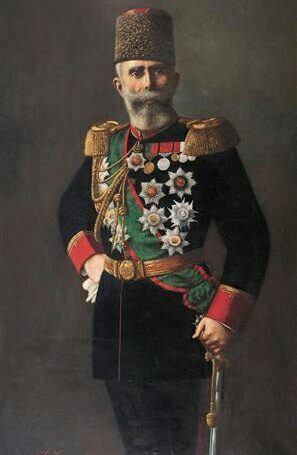
Mahmud Shevket Pasha
Mahmud Shevket Pasha was the 212nd Grand Vizier of the Ottoman Empire. Born 1856, in Baghdad. Died June 11, 1913, in Istanbul. Positions held include grand vizier of the Ottoman Empire (1913), governor (1905–1908) and Ottoman Minister of War (1910–1913). Educated at Ottoman Military College. Awards include Order of Osmanieh, 1st class, Order of the Medjidie and Grand Officer of the Legion of Honour.
Facts
25 facts · 2 confirmed by two sources · 8 cited · 15 from one source
What’s different
- Born: we show 1856 (Confirmed). Wikidata also lists 1858
- Died: we show June 11, 1913 (Confirmed). Wikidata also lists 1913
Where this comes from
Papalocal keeps its own record. It started from these sources; what each one said is kept here as it was copied, so a change on their side never changes this page by itself. Tap one to read its version.
What Wikidata says · copied November 16, 2026 · revision 2562650830
- Described as
- 212nd Grand Vizier of the Ottoman Empire (1856–1913)
- Other names
- Mahmud Sevket Pasha, Mahmud Sevket Pasa, Mahmud Şevket Paşa, Mahmut Şevket Paşa, Mahmut Sevket, Mahmud Şevket Pasha
- Born
- 1856 · 5 references; 1858 · 1 reference
- Died
- June 11, 1913 · 1 reference; 1913 · 1 reference
- Born in
- Baghdad · 1 reference
- Died in
- Istanbul · 1 reference
- Buried in
- Mahmut Şevket Pasha Tomb
- Cause of death
- gunshot wound
- Citizen of
- Ottoman Empire
- Occupation
- politician · 2 references; military officer; military personnel · 1 reference; grand vizier · 1 reference; military leader · 1 reference
- Positions held
- grand vizier of the Ottoman Empire (1913); governor (1905–1908); Ottoman Minister of War (1910–1913) · 1 reference
- Political party
- Committee of Union and Progress
- Education
- Ottoman Military College
- Awards
- Order of Osmanieh; 1st class, Order of the Medjidie · 1 reference; Grand Officer of the Legion of Honour · 1 reference
- Father
- Sulayman Fayiq
- Siblings
- Khalid Sulaiman Faeq; Hikmat Sulayman
- Religion
- Islam · 1 reference
- Military rank
- mushir
- Wikipedias with a page
- 29
Wikidata item Q722306 (wikidata.org/wiki/Q722306), public domain (CC0). Copied November 16, 2026.
What Wikipedia says · copied November 16, 2026 · revision 1384041814
Mahmud Shevket Pasha (Ottoman Turkish: محمود شوكت پاشا, Turkish: Mahmut Şevket Paşa; 1856 – 11 June 1913) was an Ottoman military commander and statesman.
During the 31 March Incident in 1909, Shevket Pasha and the Committee of Union and Progress overthrew Abdul Hamid II after an anti-Constitutionalist uprising in Constantinople. He played the role of a military dictator, surpassing the power of the CUP and the Grand Viziers after the crisis, with many observers ascribing to him the title of "generalissimo". As War Minister, he introduced military reform, including the incorporation of the empire's Air Squadrons. Shevket Pasha became Grand Vizier during the First Balkan War, in the aftermath of the CUP's 23 January 1913 coup d'état, resuming war with the Balkan League. He was assassinated 6 months later by partisans of the Freedom and Accord Party, as part of a larger counter-coup attempt against the CUP.
- Born, in its opening lines
- 1856
- Died, in its opening lines
- June 11, 1913
From the Wikipedia article “Mahmud Shevket Pasha” (en.wikipedia.org/wiki/Mahmud_Shevket_Pasha), by its contributors, under CC BY-SA 4.0 (creativecommons.org/licenses/by-sa/4.0/). Copied November 16, 2026; not changed.
Confirmed Two sources agree. Cited One source, and it names where it got it. One source One source, without a reference of its own. Sources disagree The sources disagree. We show the best-supported value and keep theirs below.
