
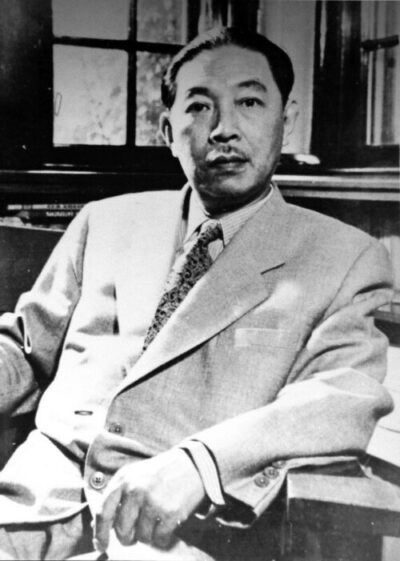
Mao Dun was a Chinese writer. Born July 4, 1896, in Tongxiang City. Died March 27, 1981, in Beijing. Positions held include Ministry of Culture of the People's Republic of China (1949–1965) and member of the National Committee of the Chinese People's Political Consultative Conference. Educated at Peking University.
Facts
21 facts · 2 confirmed by two sources · 4 cited · 15 from one source
Where this comes from
Papalocal keeps its own record. It started from these sources; what each one said is kept here as it was copied, so a change on their side never changes this page by itself. Tap one to read its version.
What Wikidata says · copied November 16, 2026 · revision 2558945400
- Described as
- Chinese writer (1896-1981)
- Born
- July 4, 1896 · 4 references
- Died
- March 27, 1981 · 5 references
- Born in
- Tongxiang City
- Died in
- Beijing
- Citizen of
- People's Republic of China
- Occupation
- translator; literary critic; journalist; writer · 2 references; politician · 1 reference; critic · 1 reference; literary historian · 1 reference; prose writer · 1 reference
- Positions held
- Ministry of Culture of the People's Republic of China (1949–1965); member of the National Committee of the Chinese People's Political Consultative Conference
- Political party
- Chinese Communist Party
- Education
- Peking University
- Member of
- Chinese Academy of Sciences (1955–)
- Father
- Shen Yongxi
- Siblings
- Shen Zemin
- Website
- http://www.maodun.org · 1 reference
- Wikipedias with a page
- 39
Wikidata item Q358494 (wikidata.org/wiki/Q358494), public domain (CC0). Copied November 16, 2026.
What Wikipedia says · copied November 16, 2026 · revision 1383733419
Shen Dehong (Shen Yanbing; 4 July 1896 – 27 March 1981), best known by the pen name of Mao Dun, was a Chinese novelist, essayist, journalist, playwright, and literary and cultural critic. He was highly celebrated for his realist novels, including Midnight, which depicts life in cosmopolitan Shanghai. Mao was one of the founders of the Chinese Communist Party and participated in a number of left-wing cultural movements during the 1920s and 1930s. He was the editor-in-chief of Fiction Monthly and helped lead the League of Left-Wing Writers. He formed a strong friendship with fellow left-wing Chinese author Lu Xun. From 1949 to 1965, Mao served as the first Minister of Culture in the People's Republic of China.
In addition to novels, Mao Dun published a number of essays, scripts, theories, short stories, and novellas. He was well known for translating Western literature, as he had gained academic knowledge of European literature from his studies at Peking University. Additionally, although he was not the first person in China to translate the works of Scottish historical novelist Walter Scott, he is considered to be the first person to popularize Walter Scott's work in China through his "Critical Biography".
He adopted the pen name "Mao Dun" (Chinese: 矛盾) to express the tension in the conflicting revolutionary ideology within China in the 1920s. The name means "contradiction", as Mao means spears and Dun means shields. His friend Ye Shengtao changed the first character from 矛 to 茅, which literally means "thatch".
- Born, in its opening lines
- July 4, 1896
- Died, in its opening lines
- March 27, 1981
From the Wikipedia article “Mao Dun” (en.wikipedia.org/wiki/Mao_Dun), by its contributors, under CC BY-SA 4.0 (creativecommons.org/licenses/by-sa/4.0/). Copied November 16, 2026; not changed.
Confirmed Two sources agree. Cited One source, and it names where it got it. One source One source, without a reference of its own. Sources disagree The sources disagree. We show the best-supported value and keep theirs below.
