
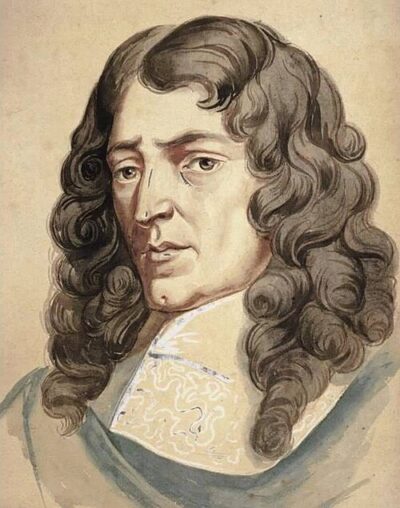
Marc-Antoine Charpentier
Marc-Antoine Charpentier was the 17th-century French composer. Born 1643, in Paris. Died February 24, 1704, in Paris. Known for Venez divin Messie and Te Deum.
Facts
18 facts · 2 confirmed by two sources · 3 cited · 13 from one source
Where this comes from
Papalocal keeps its own record. It started from these sources; what each one said is kept here as it was copied, so a change on their side never changes this page by itself. Tap one to read its version.
What Wikidata says · copied November 16, 2026 · revision 2568921441
- Described as
- 17th-century French composer
- Born
- 1643 · 16 references
- Died
- February 24, 1704 · 9 references
- Born in
- Paris · 2 references
- Died in
- Paris · 2 references
- Citizen of
- Kingdom of France
- Occupation
- composer · 1 reference; choreographer; singer; organist · 1 reference
- Instrument
- organ; voice
- Known for
- Venez divin Messie; Te Deum
- Field
- opera; pastoral; overture; motet
- Religion
- Catholicism
- Wikipedias with a page
- 49
Wikidata item Q55524 (wikidata.org/wiki/Q55524), public domain (CC0). Copied November 16, 2026.
What Wikipedia says · copied November 16, 2026 · revision 1369220677
Marc-Antoine Charpentier (French: [maʁk ɑ̃twan ʃaʁpɑ̃tje]; 1643 – 24 February 1704) was a French Baroque composer during the reign of Louis XIV. One of his most famous works is the prelude of his Te Deum H.146, Marche en rondeau, which has been used as the theme song fanfare before television broadcasts of the Eurovision Network since the inception of the European Broadcasting Union in 1954.
Marc-Antoine Charpentier dominated the Baroque musical scene in seventeenth century France because of the quality of his prolific output. He mastered all genres, and his skill in writing sacred vocal music was especially hailed by his contemporaries.
He began his career by going to Italy, where he fell under the influence of Giacomo Carissimi as well as other Italian composers, perhaps Domenico Mazzocchi. He would remain marked by the Italian style and become the only one with Jean-Joseph Cassanéa de Mondonville in France to approach the oratorio. In 1670, he became a master of music (composer and singer) in the service of the Duchess of Guise. From 1690 Charpentier composed Médée, on a piece by Corneille. It was a determining failure in his career of composer: he henceforth devoted himself to religious music. He became the composer of the Carmelites of the "Rue du Bouloir", Montmartre Abbey, Abbaye-aux-Bois and Port-Royal. In 1698, Charpentier was appointed music master for the children of the Sainte-Chapelle du Palais. After having obtained from the king Louis XIV a softening of Lully's monopoly, Molière turned to Charpentier to compose the music for the intermissions of Circe and Andromeda, as well as sung scenes for the revivals of The Forced Marriage, and finally the musical pieces of The Imaginary invalid.
He composed secular works, stage music, operas, cantatas, sonatas, symphonies, as well as sacred music, motets (large or small), oratorios, masses, psalms, Magnificats, Litanies.
At the time of his death, Charpentier's complete works must have numbered about 800 opus numbers, but today only 28 autograph volumes remain, or more than 500 pieces that he himself took care to classify. This collection, called Mélanges, is one of the most comprehensive sets of musical autograph manuscripts of all time.
- Born, in its opening lines
- 1643
- Died, in its opening lines
- February 24, 1704
From the Wikipedia article “Marc-Antoine Charpentier” (en.wikipedia.org/wiki/Marc-Antoine_Charpentier), by its contributors, under CC BY-SA 4.0 (creativecommons.org/licenses/by-sa/4.0/). Copied November 16, 2026; not changed.
Confirmed Two sources agree. Cited One source, and it names where it got it. One source One source, without a reference of its own. Sources disagree The sources disagree. We show the best-supported value and keep theirs below.
