
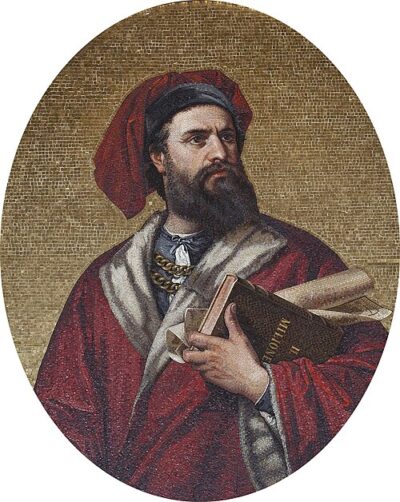
Marco Polo
Marco Polo was a Venetian explorer and merchant who travelled through Asia. Born September 15, 1254, in Venice. Died January 8, 1324, in Venice. Known for The book of Ser Marco Polo the Venetian concerning the kingdoms and marvels of the East.
Facts
25 facts · 2 confirmed by two sources · 12 cited · 11 from one source
Where this comes from
Papalocal keeps its own record. It started from these sources; what each one said is kept here as it was copied, so a change on their side never changes this page by itself. Tap one to read its version.
What Wikidata says · copied November 16, 2026 · revision 2568954806
- Described as
- Venetian explorer and merchant who travelled through Asia (1254–1324)
- Other names
- Polo, Marco Emilio Polo, M. Polo, Ser Polo, Magebeiluo
- Born
- September 15, 1254 · 1 reference
- Died
- January 8, 1324 · 3 references
- Born in
- Venice · 2 references
- Died in
- Venice · 2 references
- Buried in
- San Lorenzo, Venice
- Citizen of
- Republic of Venice
- Occupation
- merchant · 1 reference; diplomat; ambassador; world traveler · 1 reference; writer · 1 reference; entrepreneur · 1 reference; memoirist · 1 reference; traveler · 1 reference
- Known for
- The book of Ser Marco Polo the Venetian concerning the kingdoms and marvels of the East
- Field
- travel · 1 reference; commerce · 1 reference; diplomacy · 1 reference; travel book · 1 reference; memoir literature · 1 reference
- Spouse
- Donata Badoer (1300–1324)
- Children
- Fantina Polo; Agnese Polo · 1 reference
- Father
- Niccolò Polo
- Religion
- Catholicism
- Wikipedias with a page
- 215
Wikidata item Q6101 (wikidata.org/wiki/Q6101), public domain (CC0). Copied November 16, 2026.
What Wikipedia says · copied November 16, 2026 · revision 1382615098
Marco Polo (c. 1254 – 8 January 1324) was a Venetian merchant, explorer, and writer who travelled through Asia along the Silk Road between 1271 and 1295. His travels are recorded in The Travels of Marco Polo (also known as Book of the Marvels of the World and Il Milione, c. 1300), a book that described the then-mysterious culture and inner workings of the Eastern world, including the wealth and great size of the Mongol Empire and China under the Yuan dynasty, giving Europeans their first comprehensive look into China, Persia, India, Japan, and other Asian societies.
Born in Venice, Marco learned the mercantile trade from his father and his uncle, Niccolò and Maffeo, who travelled through Asia and met Kublai Khan. In 1269, they returned to Venice to meet Marco for the first time. The three of them embarked on an epic journey to Asia, exploring many places along the Silk Road until they reached "Cathay". They were received by the royal court of Kublai Khan, who was impressed by Marco's intelligence and humility. Marco was appointed to serve as Kublai's foreign emissary, and he was sent on many diplomatic missions throughout the empire and Southeast Asia, visiting present-day Myanmar, India, Indonesia, Sri Lanka, and Vietnam. As part of this appointment, Marco also travelled extensively inside China, living in the emperor's lands for 17 years and seeing many things previously unknown to Europeans.
Around 1291, the Polos offered to accompany the Mongol princess Kököchin to Persia; they arrived there around 1293. After leaving the princess, they travelled overland to Constantinople and then to Venice, returning home after 24 years. At this time, Venice was at war with Genoa. Marco joined the war effort on behalf of Venice and was captured by the Genoese. While imprisoned, he dictated stories of his travels to Rustichello da Pisa, a cellmate. He was released in 1299, became a wealthy merchant, married, and had three children. He died in 1324 and was buried in the church of San Lorenzo in Venice.
Though he was not the first European to reach China, Marco Polo was the first to leave a detailed chronicle of his experience. His account provided the Europeans with a clear picture of the East's geography and ethnic customs, and it included the first Western record of porcelain, gunpowder, paper money, and some Asian plants and exotic animals. His narrative inspired Christopher Columbus and many other travellers. There is substantial literature based on Polo's writings; he also influenced European cartography, leading to the introduction of the Catalan Atlas and the Fra Mauro map.
- Born, in its opening lines
- c. 1254
- Died, in its opening lines
- January 8, 1324
From the Wikipedia article “Marco Polo” (en.wikipedia.org/wiki/Marco_Polo), by its contributors, under CC BY-SA 4.0 (creativecommons.org/licenses/by-sa/4.0/). Copied November 16, 2026; not changed.
Confirmed Two sources agree. Cited One source, and it names where it got it. One source One source, without a reference of its own. Sources disagree The sources disagree. We show the best-supported value and keep theirs below.
