
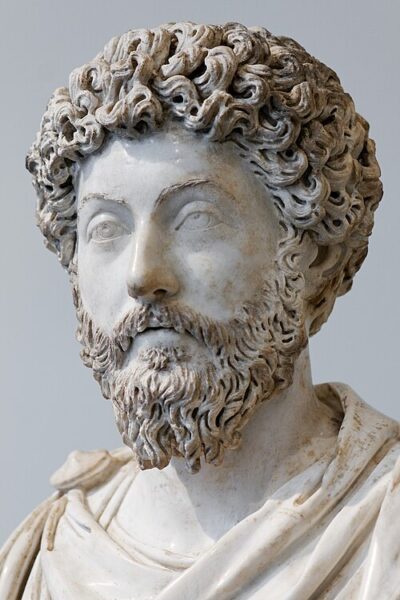
Marcus Aurelius
Marcus Aurelius was the 16th Roman Emperor from 161 to 180 and Stoic philosopher. Born April 26, 121, in Rome. Died March 17, 180, in Vindobona. Positions held include Roman emperor (161–180), ancient Roman senator and Roman consul. Known for Meditations.
Facts
35 facts · 2 confirmed by two sources · 7 cited · 25 from one source · 1 where the sources disagree
What’s different
- Father: we show Marcus Annius Verus (Sources disagree). Wikidata also lists Antoninus Pius
Where this comes from
Papalocal keeps its own record. It started from these sources; what each one said is kept here as it was copied, so a change on their side never changes this page by itself. Tap one to read its version.
What Wikidata says · copied November 16, 2026 · revision 2568299095
- Described as
- 16th Roman Emperor from 161 to 180 and Stoic philosopher
- Other names
- Marcus Aurelius Verus, Verissimus, Antoninus, Marcus Annius Verus, Marcus Catilius Severus Annius Verus, Caesar Marcus Aurelius Antoninus Augustus, Marcus Aurelius Antoninus
- Born
- April 26, 121 · 2 references
- Died
- March 17, 180 · 3 references
- Born in
- Rome · 1 reference
- Died in
- Vindobona
- Buried in
- Castel Sant'Angelo
- Cause of death
- plague
- Name at birth
- Marcus Catilius Severus Annius Verus
- Citizen of
- Ancient Rome
- Occupation
- politician; philosopher · 1 reference; writer · 1 reference; monarch; emperor · 1 reference
- Positions held
- Roman emperor (161–180) · 1 reference; ancient Roman senator; Roman consul; quaestor (139) · 1 reference
- Member of
- Five Good Emperors
- Known for
- Meditations
- Field
- philosophy
- Spouse
- Faustina the Younger · 1 reference
- Children
- Commodus · 1 reference; Marcus Annius Verus Caesar; Annia Aurelia Galeria Faustina; Fadilla; Lucilla; Annia Cornificia Faustina Minor; Vibia Aurelia Sabina; Titus Aurelius Fulvus Antoninus; Domitia Faustina
- Father
- Marcus Annius Verus · 1 reference; Antoninus Pius
- Mother
- Calvisia Domitia Lucilla
- Siblings
- Annia Cornificia Faustina
- Religion
- ancient Roman religion
- Lived in
- Rome
- Wikipedias with a page
- 178
Wikidata item Q1430 (wikidata.org/wiki/Q1430), public domain (CC0). Copied November 16, 2026.
What Wikipedia says · copied November 16, 2026 · revision 1384384321
Marcus Aurelius Antoninus ( or-EE-lee-əs; Latin: [ˈmaːrkʊs au̯ˈreːli.us antoːˈniːnʊs]; 26 April 121 – 17 March 180) was Roman emperor from 161 to 180 and a Stoic philosopher. He was a member of the Nerva–Antonine dynasty, the last of the rulers later known as the Five Good Emperors and the last emperor of the Pax Romana, an age of relative peace, calm, and stability for the Roman Empire lasting from 27 BC to 180 AD. He served as Roman consul in 140, 145, and 161.
Marcus Aurelius was the son of the praetor Marcus Annius Verus and his wife Domitia Calvilla. He was related through marriage to the emperors Trajan and Hadrian. Marcus was three when his father died, and he was raised by his mother and paternal grandfather. After Hadrian's adoptive son, Aelius Caesar, died in 138, Hadrian adopted Marcus's uncle Antoninus Pius as his new heir. In turn, Antoninus adopted Marcus and Lucius, the son of Aelius. Hadrian died that year, and Antoninus became emperor. Now heir to the throne, Marcus studied Greek and Latin under tutors such as Herodes Atticus and Marcus Cornelius Fronto. He married Antoninus's daughter Faustina in 145.
After Antoninus died in 161, Marcus acceded to the throne alongside his adoptive brother, who took the regnal name Lucius Aurelius Verus. Under the reign of Marcus Aurelius, the Roman Empire witnessed much military conflict. In the East, the Romans fought the Parthian War of Lucius Verus with a revitalised Parthian Empire and the rebel Kingdom of Armenia. Marcus defeated the Marcomanni, Quadi, and Iazyges in the Marcomannic Wars. These and other Germanic peoples began to represent a troubling reality for the Empire. He reduced the silver purity of the Roman currency, the denarius. The persecution of Christians in the Roman Empire appears to have increased during his reign, although his involvement is unlikely since there are no Christian sources ascribing him the blame, and he was praised by Justin Martyr and Tertullian. The Antonine Plague broke out in 165 or 166 and devastated the population of the Roman Empire, causing the deaths of five to ten million people. Lucius Verus may have died from the plague in 169. When Marcus himself died in 180, he was succeeded by his son Commodus.
Commodus's succession after Marcus has been a subject of debate among both contemporary and modern historians. The column and equestrian statue of Marcus Aurelius still stand in Rome, where they were erected in celebration of his military victories. As a philosopher, his work Meditations is one of the most important sources for the modern understanding of ancient Stoic philosophy. These writings have been praised by fellow writers, philosophers, monarchs, and politicians centuries after his death.
- Born, in its opening lines
- April 26, 121
- Died, in its opening lines
- March 17, 180
From the Wikipedia article “Marcus Aurelius” (en.wikipedia.org/wiki/Marcus_Aurelius), by its contributors, under CC BY-SA 4.0 (creativecommons.org/licenses/by-sa/4.0/). Copied November 16, 2026; not changed.
Confirmed Two sources agree. Cited One source, and it names where it got it. One source One source, without a reference of its own. Sources disagree The sources disagree. We show the best-supported value and keep theirs below.
