
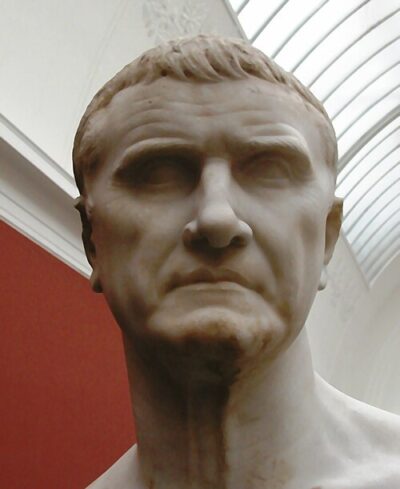
Marcus Licinius Crassus
Marcus Licinius Crassus was a member of the First Triumvirate. Born 115 BC, in Ancient Rome. Died June 8, 53 BC, in Harran. Positions held include Roman governor, ancient Roman senator and Roman consul (-70).
Facts
18 facts · 0 confirmed by two sources · 8 cited · 9 from one source · 1 where the sources disagree
What’s different
- Died: we show June 8, 53 BC (Sources disagree). Wikidata also lists June 9, 53 BC
Where this comes from
Papalocal keeps its own record. It started from these sources; what each one said is kept here as it was copied, so a change on their side never changes this page by itself. Tap one to read its version.
What Wikidata says · copied November 16, 2026 · revision 2558150749
- Described as
- member of the First Triumvirate
- Other names
- Crassus
- Born
- 115 BC · 2 references
- Died
- June 8, 53 BC · 1 reference; June 9, 53 BC · 1 reference
- Born in
- Ancient Rome
- Died in
- Harran
- Citizen of
- Ancient Rome
- Occupation
- politician · 1 reference; military personnel; army officer
- Positions held
- Roman governor; ancient Roman senator · 1 reference; Roman consul (-70) · 1 reference
- Political party
- optimates
- Member of
- First Triumvirate
- Spouse
- Tertulla · 1 reference
- Children
- Publius Licinius Crassus · 2 references; Marcus Licinius Crassus · 2 references
- Father
- Publius Licinius Crassus Dives · 4 references
- Siblings
- Publius Licinius Crassus · 2 references
- Wikipedias with a page
- 74
Wikidata item Q175121 (wikidata.org/wiki/Q175121), public domain (CC0). Copied November 16, 2026.
What Wikipedia says · copied November 16, 2026 · revision 1385507975
Marcus Licinius Crassus (; 115–53 BC) was a Roman general and statesman who played a key role in the transformation of the Roman Republic into the Roman Empire. Often called "the richest man in Rome", Crassus began his public career as a military commander under Lucius Cornelius Sulla during his civil war. Following Sulla's assumption of the dictatorship, Crassus amassed an enormous fortune through property speculation. He rose to political prominence following his victory over the slave revolt led by Spartacus, sharing the consulship with his rival Pompey the Great.
A political and financial patron of Julius Caesar, Crassus joined Caesar and Pompey in the unofficial political alliance known as the First Triumvirate. Together, the three men dominated the Roman political system, but the alliance did not last due to their respective ambitions, egos and jealousies. While Caesar and Crassus were lifelong allies, Crassus and Pompey disliked each other and Pompey grew increasingly envious of Caesar's spectacular successes in the Gallic Wars. The alliance was restabilized at the Luca Conference in 56 BC, after which Crassus and Pompey again served jointly as consuls.
Following his second consulship, Crassus was appointed as the governor of Roman Syria, which he used as the launchpad for a military campaign against the Parthian Empire. The campaign was a disastrous failure, ending in his defeat and death after the Battle of Carrhae. Crassus' death permanently unraveled the alliance between Caesar and Pompey, since his political influence and wealth had maintained a balance between the two great leaders. Within four years of Crassus' death, Caesar crossed the Rubicon and began a civil war against Pompey and the optimates.
From the Wikipedia article “Marcus Licinius Crassus” (en.wikipedia.org/wiki/Marcus_Licinius_Crassus), by its contributors, under CC BY-SA 4.0 (creativecommons.org/licenses/by-sa/4.0/). Copied November 16, 2026; not changed.
Confirmed Two sources agree. Cited One source, and it names where it got it. One source One source, without a reference of its own. Sources disagree The sources disagree. We show the best-supported value and keep theirs below.
