
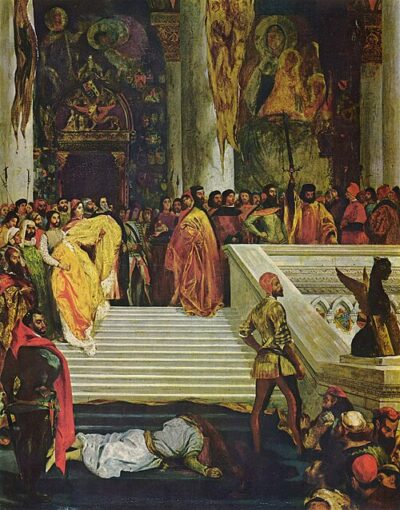
Marino Faliero was a Doge of Venice. Born 1274, in Venice. Died April 17, 1355, in Venice. Positions held include Doge of Venice (1354–1355) and Podestà of Treviso (2 times) (1339–1347).
Facts
12 facts · 2 confirmed by two sources · 1 cited · 9 from one source
Where this comes from
Papalocal keeps its own record. It started from these sources; what each one said is kept here as it was copied, so a change on their side never changes this page by itself. Tap one to read its version.
What Wikidata says · copied November 17, 2026 · revision 2558155238
- Described as
- Doge of Venice
- Other names
- Marin Faliero, Marin Falier
- Born
- 1274 · 1 reference
- Died
- April 17, 1355 · 4 references
- Born in
- Venice
- Died in
- Venice · 1 reference
- Buried in
- Santi Giovanni e Paolo · 1 reference
- Cause of death
- decapitation
- Citizen of
- Republic of Venice
- Occupation
- diplomat; military personnel · 1 reference
- Positions held
- Doge of Venice (1354–1355); Podestà of Treviso (2 times) (1339–1347)
- Spouse
- Aluica Gradenigo
- Wikipedias with a page
- 26
Wikidata item Q434940 (wikidata.org/wiki/Q434940), public domain (CC0). Copied November 17, 2026.
What Wikipedia says · copied November 17, 2026 · revision 1380845067
Marino Faliero (Venetian: Marin Falier, c. 1274 – 17 April 1355) was the 55th Doge of Venice from 11 September 1354 to 15 April 1355, 2 days before his execution for attempting a coup d'état.
Faliero was born into one of the most ancient Venetian patrician families and held various state positions, including several military appointments, governorships, and ambassadorships. He was already eighty years old at the time of his election as doge. The reasons for his involvement in a coup attempt to overthrow Venice's republican government and install himself as prince are not entirely clear. According to a later tradition, Faliero attempted the coup as vengeance for an insult against his younger wife by a patrician, who was lightly punished. However, modern historians often dismiss this tradition and argue that Faliero wanted to secure Venice's survival by establishing autocratic rule, which had become the norm outside of Venice.
A painting of a black shroud with the words "This is the place of Marino Faliero, beheaded for crimes" hangs in the Great Council Hall of Venice among the portraits of the doges. Faliero's coup attempt has been depicted in several works of art, including plays, paintings, and an opera.
- Born, in its opening lines
- c. 1274
- Died, in its opening lines
- April 17, 1355
From the Wikipedia article “Marino Faliero” (en.wikipedia.org/wiki/Marino_Faliero), by its contributors, under CC BY-SA 4.0 (creativecommons.org/licenses/by-sa/4.0/). Copied November 17, 2026; not changed.
Confirmed Two sources agree. Cited One source, and it names where it got it. One source One source, without a reference of its own. Sources disagree The sources disagree. We show the best-supported value and keep theirs below.
