
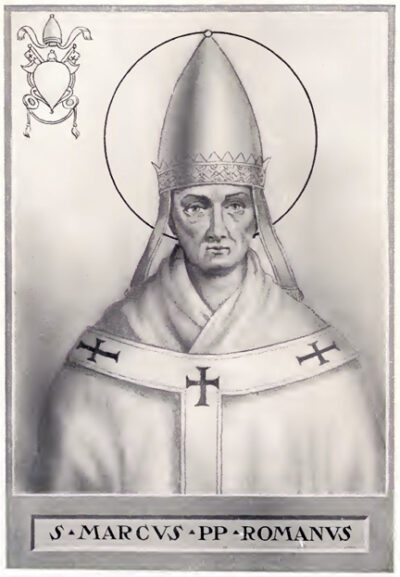
Mark was the 4th-century pope. Born 3rd century, in Rome. Died October 8, 336, in Rome. Positions held include Pope (336).
Facts
9 facts · 0 confirmed by two sources · 2 cited · 7 from one source
Where this comes from
Papalocal keeps its own record. It started from these sources; what each one said is kept here as it was copied, so a change on their side never changes this page by itself. Tap one to read its version.
What Wikidata says · copied November 16, 2026 · revision 2569133729
- Described as
- 4th-century pope
- Other names
- Pope Mark, Marcus, Pope Marcus, Papa Marcus
- Born
- 3rd century
- Died
- October 8, 336
- Born in
- Rome
- Died in
- Rome
- Citizen of
- Ancient Rome
- Occupation
- Catholic priest; religious leader · 1 reference
- Positions held
- Pope (336)
- Religion
- Catholic Church · 1 reference
- Wikipedias with a page
- 79
Wikidata item Q132797 (wikidata.org/wiki/Q132797), public domain (CC0). Copied November 16, 2026.
What Wikipedia says · copied November 16, 2026 · revision 1368282639
Pope Mark (Latin: Marcus) was the bishop of Rome from 18 January to his death on 7 October 336.
Little is known of Mark's early life. According to the Liber Pontificalis, he was a Roman, and his father's name was Priscus. Mark succeeded Sylvester I as pope on 18 January 336.
Some evidence suggests that the early lists of bishops and martyrs known as the Depositio episcoporum and Depositio martyrum were begun during his pontificate. According to the Liber Pontificalis, Pope Mark issued a constitution investing the bishop of Ostia with a pallium and confirming his power to consecrate newly elected popes. Likewise according to the Liber Pontificalis, Pope Mark is credited with the foundation of the Basilica of San Marco, a basilica in Rome, and a cemetery church over the Catacomb of Balbina, just outside the city on lands obtained as a donation from Emperor Constantine.
Mark died of natural causes on 7 October and was buried in the catacomb of Balbina. In 1048, his remains were removed to the town of Velletri, and in 1145 were relocated to the Basilica of San Marco in Rome, where they are kept in an urn under the altar. His feast day is celebrated on 7 October. He is particularly venerated at the Abbadia San Salvatore at Monte Amiata.
From the Wikipedia article “Pope Mark” (en.wikipedia.org/wiki/Pope_Mark), by its contributors, under CC BY-SA 4.0 (creativecommons.org/licenses/by-sa/4.0/). Copied November 16, 2026; not changed.
Confirmed Two sources agree. Cited One source, and it names where it got it. One source One source, without a reference of its own. Sources disagree The sources disagree. We show the best-supported value and keep theirs below.
