
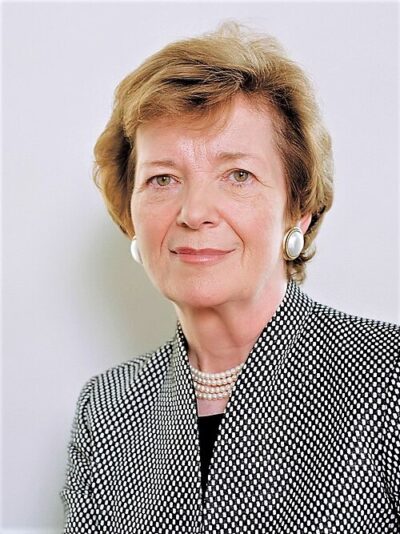
Mary Robinson
Mary Robinson is a former President of Ireland and former United Nations High Commissioner for Human Rights. Born May 21, 1944, in Ballina. Positions held include president of Ireland (1990–1997), senator of Ireland (1969–1989) and United Nations High Commissioner for Human Rights (1997–2002). Educated at Trinity College, Dublin and Harvard Law School. Awards include Order of Tomáš Garrigue Masaryk, 1st class, Presidential Medal of Freedom and Erasmus Prize.
Facts
40 facts · 1 confirmed by two sources · 20 cited · 19 from one source
Where this comes from
Papalocal keeps its own record. It started from these sources; what each one said is kept here as it was copied, so a change on their side never changes this page by itself. Tap one to read its version.
What Wikidata says · copied November 16, 2026 · revision 2567379922
- Described as
- former President of Ireland and former United Nations High Commissioner for Human Rights
- Other names
- Máire Bean Mhic Róibín, Mary Bourke, Mary Therese Winifred Robinson, Mary Therese Winifred Bourke, Maire Bean Mhic Roibin, Máire Mhic Róibín, Máire Treasa Úna Mhic Róibín, Her Excellency Mary Robinson
- Born
- May 21, 1944 · 5 references
- Born in
- Ballina · 1 reference
- Name at birth
- Mary Therese Winifred Bourke
- Citizen of
- Ireland
- Occupation
- politician · 1 reference; jurist · 1 reference; university teacher; barrister
- Positions held
- president of Ireland (1990–1997); senator of Ireland (1969–1989) · 1 reference; United Nations High Commissioner for Human Rights (1997–2002)
- Political party
- Labour Party (1977–1985)
- Worked for
- Columbia University; University of Pretoria · 1 reference
- Education
- Trinity College, Dublin; Harvard Law School; Columbia University; Mount Anville Secondary School
- Member of
- Royal Irish Academy (1991–) · 1 reference; American Philosophical Society · 1 reference; The Elders (2007–) · 1 reference
- Awards
- Order of Tomáš Garrigue Masaryk, 1st class (2003); Presidential Medal of Freedom (2009) · 1 reference; Erasmus Prize (1999) · 1 reference; Félix Houphouët-Boigny Peace Prize (2000) · 1 reference; Indira Gandhi Peace Prize (2000) · 1 reference; Princess of Asturias Award for Social Sciences (2006) · 1 reference; Four Freedoms Award – Freedom Medal (1998) · 1 reference; North–South Prize (1997) · 1 reference; honorary doctor of the University of Rennes 2 (1996) · 3 references; James Parks Morton Interfaith Award (1997) · 1 reference; Ambassador of Conscience Award (2004) · 1 reference; Otto Hahn Peace Medal (2003) · 1 reference; Global Economy Prize (2009) · 2 references; J. William Fulbright Prize (1999) · 1 reference; honorary doctor of the Katholieke Universiteit Leuven
- Spouse
- Nicholas Robinson
- Religion
- Catholicism
- Lived in
- Zurich; Ireland (1993) · 1 reference
- Wikipedias with a page
- 79
Wikidata item Q188214 (wikidata.org/wiki/Q188214), public domain (CC0). Copied November 16, 2026.
What Wikipedia says · copied November 16, 2026 · revision 1384388430
Mary Therese Winifred Robinson (née Bourke; born 21 May 1944) is an Irish politician who served as the president of Ireland from December 1990 to September 1997. She was the country's first female president. Robinson had previously served as a senator in Seanad Éireann from 1969 to 1989, and as a councillor on Dublin Corporation from 1979 to 1983. Although she had been briefly affiliated with the Labour Party during her time as a senator, she became the first independent candidate to win the presidency and the first not to have had the support of Fianna Fáil. Following her time as president, Robinson became the United Nations High Commissioner for Human Rights from 1997 to 2002.
During her tenure as High Commissioner, she visited Tibet in 1998 (the first holder of the office to do so) and criticised Ireland's immigration policy and the use of capital punishment in the United States. She extended her intended single four-year term as High Commissioner by one year to preside over the World Conference against Racism 2001 in Durban, South Africa; the conference proved controversial due to a draft document which equated Zionism with racism. Robinson resigned her post in September 2002. After leaving the United Nations, Robinson formed Realizing Rights: the Ethical Globalization Initiative, which came to a planned end at the end of 2010.
Robinson also served as Chancellor of the University of Dublin from 1998 until 2019, and as Oxfam's honorary president from 2002 until she stepped down in 2012. She returned to live in Ireland at the end of 2010 and has since founded The Mary Robinson Foundation – Climate Justice. Robinson continues to campaign globally on issues of civil rights. She has been the honorary president of the European Inter-University Centre for Human Rights and Democratisation (EIUC) since 2005. She is a former Chair of the International Institute for Environment and Development (IIED) and is also a founding member and chair of the Council of Women World Leaders. She was a member of the European members of the Trilateral Commission.
Robinson's presidency is regarded as having a transformative effect on Ireland. Having successfully campaigned on several liberalising issues as a senator and a lawyer, Robinson was a key figure in the decriminalisation of homosexuality in 1993, the legalisation of contraception and divorce, enabling women to sit on juries and securing the right to legal aid in civil legal cases in Ireland. Regularly polling approval ratings above 90%, approval of Robinson peaked at 93% among the Irish public, the highest rating of any Irish president.
- Born, in its opening lines
- May 21, 1944
From the Wikipedia article “Mary Robinson” (en.wikipedia.org/wiki/Mary_Robinson), by its contributors, under CC BY-SA 4.0 (creativecommons.org/licenses/by-sa/4.0/). Copied November 16, 2026; not changed.
Confirmed Two sources agree. Cited One source, and it names where it got it. One source One source, without a reference of its own. Sources disagree The sources disagree. We show the best-supported value and keep theirs below.
