
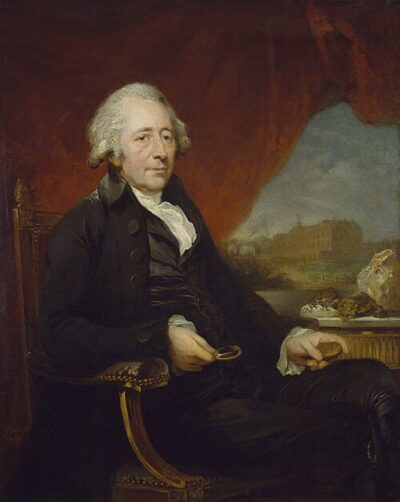
Matthew Boulton
Matthew Boulton was an English manufacturer, industrialist, business partner of James Watt. Born September 3, 1728, in Birmingham. Died August 17, 1809, in Birmingham. Positions held include High Sheriff of Staffordshire (1794–1795). Awards include Fellow of the Royal Society and Fellow of the Royal Society of Edinburgh.
Facts
35 facts · 2 confirmed by two sources · 21 cited · 12 from one source
Where this comes from
Papalocal keeps its own record. It started from these sources; what each one said is kept here as it was copied, so a change on their side never changes this page by itself. Tap one to read its version.
What Wikidata says · copied November 16, 2026 · revision 2569369096
- Described as
- English manufacturer, industrialist, business partner of James Watt (1728–1809)
- Born
- September 3, 1728 · 7 references
- Died
- August 17, 1809 · 6 references
- Born in
- Birmingham · 1 reference
- Died in
- Birmingham
- Buried in
- St Mary's Church
- Cause of death
- kidney failure
- Citizen of
- Kingdom of Great Britain; United Kingdom of Great Britain and Ireland
- Occupation
- businessperson; inventor; engineer; mechanical engineer · 1 reference; entrepreneur · 2 references; industrialist · 1 reference; merchant · 1 reference; designer · 1 reference
- Positions held
- High Sheriff of Staffordshire (1794–1795) · 1 reference
- Member of
- Royal Society of Edinburgh (1783–) · 1 reference; Royal Society of London (1785–); Lunar Society of Birmingham · 1 reference
- Awards
- Fellow of the Royal Society; Fellow of the Royal Society of Edinburgh
- Field
- mechanical engineering · 1 reference; discoveries and inventions · 1 reference; steam engine · 1 reference; pump · 1 reference; design · 1 reference; coin · 1 reference
- Spouse
- Anne Robinson · 1 reference; Mary Robinson · 1 reference
- Children
- Matthew Robinson Boulton · 2 references; Anne Boulton · 1 reference
- Father
- Matthew Boulton, Senior · 1 reference
- Mother
- Christiana Piers · 1 reference
- Lived in
- Soho House (1766–1809)
- Wikipedias with a page
- 43
Wikidata item Q469269 (wikidata.org/wiki/Q469269), public domain (CC0). Copied November 16, 2026.
What Wikipedia says · copied November 16, 2026 · revision 1384870258
Matthew Boulton ( BOHL-tən; 3 September 1728 – 17 August 1809) was an English businessman, inventor, mechanical engineer, and silversmith. He was a business partner of the Scottish engineer James Watt. In the final quarter of the 18th century, the partnership installed hundreds of Boulton & Watt steam engines, which were a great advance on the state of the art, making possible the mechanisation of factories and mills. Boulton applied modern techniques to the minting of coins, striking millions of pieces for Britain and other countries, and supplying the Royal Mint with up-to-date equipment.
Born in Birmingham, he was the son of a Birmingham manufacturer of small metal products who died when Boulton was 31. By then Boulton had managed the business for several years, and thereafter expanded it considerably, consolidating operations at the Soho Manufactory, built by him near Birmingham. At Soho, he adopted the latest techniques, branching into silver plate, ormolu ("gilt bronze") and other decorative arts. He became associated with James Watt when Watt's business partner, John Roebuck, was unable to pay a debt to Boulton, who accepted Roebuck's share of Watt's patent as settlement. He then successfully lobbied Parliament to extend Watt's patent for an additional 17 years, enabling the firm to market Watt's steam engine. The firm installed hundreds of Boulton & Watt steam engines in Britain and abroad, initially in mines and then in factories.
Boulton was a key member of the Lunar Society, a group of Birmingham-area men prominent in the arts, sciences, and theology. Members included Watt, Erasmus Darwin, Josiah Wedgwood and Joseph Priestley. The Society met each month near the full moon. Members of the Society have been given credit for developing concepts and techniques in science, agriculture, manufacturing, mining, and transport that laid the groundwork for the Industrial Revolution.
Boulton founded the Soho Mint, to which he soon adapted steam power. He sought to improve the poor state of Britain's coinage, and after several years of effort obtained a contract in 1797 to produce the first British copper coinage in a quarter century. His "cartwheel" pieces were well designed and difficult to counterfeit, and included the first striking of the large copper British penny, which continued to be coined until decimalisation in 1971. He retired in 1800, though continuing to run his mint, and died in 1809. His image appeared alongside his partner James Watt on the Bank of England's Series F £50 note.
- Born, in its opening lines
- September 3, 1728
- Died, in its opening lines
- August 17, 1809
From the Wikipedia article “Matthew Boulton” (en.wikipedia.org/wiki/Matthew_Boulton), by its contributors, under CC BY-SA 4.0 (creativecommons.org/licenses/by-sa/4.0/). Copied November 16, 2026; not changed.
Confirmed Two sources agree. Cited One source, and it names where it got it. One source One source, without a reference of its own. Sources disagree The sources disagree. We show the best-supported value and keep theirs below.
