
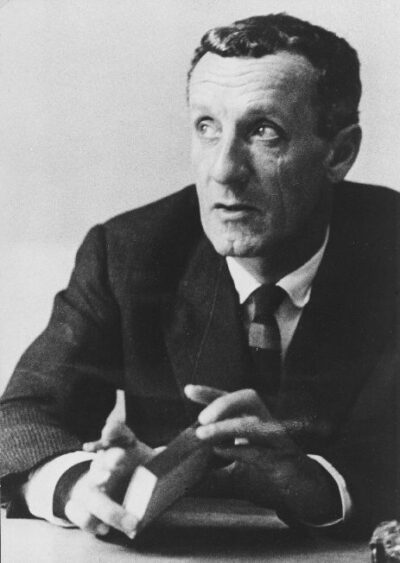
Maurice Merleau-Ponty
Maurice Merleau-Ponty was a French phenomenological philosopher. Born March 14, 1908, in Rochefort. Died May 3, 1961, in 6th arrondissement of Paris. Educated at École Normale Supérieure and Lycée Louis-le-Grand.
Facts
23 facts · 2 confirmed by two sources · 9 cited · 12 from one source
Where this comes from
Papalocal keeps its own record. It started from these sources; what each one said is kept here as it was copied, so a change on their side never changes this page by itself. Tap one to read its version.
What Wikidata says · copied November 16, 2026 · revision 2562730357
- Described as
- French phenomenological philosopher
- Other names
- Maurice Jean Jacques Merleau-Ponty
- Born
- March 14, 1908 · 12 references
- Died
- May 3, 1961 · 8 references
- Born in
- Rochefort · 2 references
- Died in
- 6th arrondissement of Paris · 1 reference
- Buried in
- Père Lachaise Cemetery
- Cause of death
- myocardial infarction
- Name at birth
- Maurice Merleau-Ponty
- Citizen of
- France · 1 reference
- Occupation
- philosopher · 3 references; professor · 1 reference; art theorist · 1 reference; aesthetician · 1 reference
- Worked for
- Collège de France (1952–1961) · 1 reference; University of Paris; University of Lyon · 2 references
- Education
- École Normale Supérieure; Lycée Louis-le-Grand; University of Paris
- Member of
- comité de lecture des éditions Gallimard (1947)
- Field
- philosophy
- Spouse
- Suzanne Merleau-Ponty
- Children
- Marianne Merleau-Ponty
- Father
- Bernard Merleau-Ponty
- Wikipedias with a page
- 59
Wikidata item Q212639 (wikidata.org/wiki/Q212639), public domain (CC0). Copied November 16, 2026.
What Wikipedia says · copied November 16, 2026 · revision 1381897103
Maurice Jean Jacques Merleau-Ponty ( MUR-loh PON-tee; French: [mɔʁis mɛʁlo pɔ̃ti]; 14 March 1908 – 3 May 1961) was a French phenomenological philosopher, strongly influenced by Edmund Husserl and Martin Heidegger. The constitution of meaning in human experience was his main interest and he wrote on perception, art, politics, religion, biology, psychology, psychoanalysis, language, nature, and history. He was the lead editor of Les Temps modernes, the leftist magazine he established with Jean-Paul Sartre and Simone de Beauvoir in 1945.
At the core of Merleau-Ponty's philosophy is a sustained argument for the foundational role that perception plays in the human experience of the world. Merleau-Ponty understands perception to be an ongoing dialogue between one's lived body and the world which it perceives, in which perceivers passively and actively strive to express the perceived world in concert with others. He was the only major phenomenologist of the first half of the twentieth century to engage extensively with the sciences. It is through this engagement that his writings became influential in the project of naturalising phenomenology, in which phenomenologists use the results of psychology and cognitive science.
Merleau-Ponty emphasised the body as the primary site of knowing the world, a corrective to the long philosophical tradition of placing consciousness as the source of knowledge, and maintained that the perceiving body and its perceived world could not be disentangled from each other. The articulation of the primacy of embodiment (corporéité) led him away from phenomenology towards what he was to call "indirect ontology" or the ontology of "the flesh of the world" (la chair du monde), seen in his final and incomplete work, The Visible and Invisible, and his last published essay, "Eye and Mind".
- Born, in its opening lines
- March 14, 1908
- Died, in its opening lines
- May 3, 1961
From the Wikipedia article “Maurice Merleau-Ponty” (en.wikipedia.org/wiki/Maurice_Merleau-Ponty), by its contributors, under CC BY-SA 4.0 (creativecommons.org/licenses/by-sa/4.0/). Copied November 16, 2026; not changed.
Confirmed Two sources agree. Cited One source, and it names where it got it. One source One source, without a reference of its own. Sources disagree The sources disagree. We show the best-supported value and keep theirs below.
