
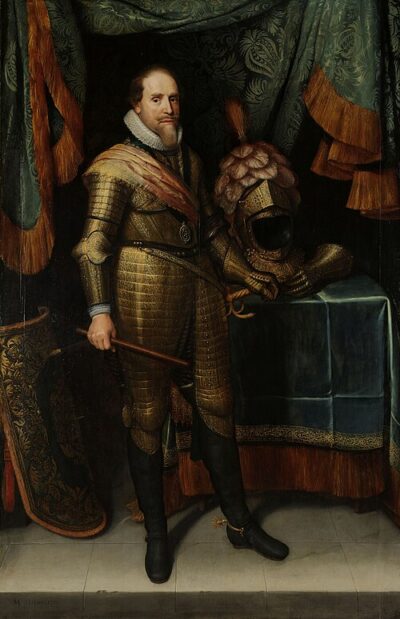
Maurice of Nassau
Maurice of Nassau was a Dutch Republic stadtholder and Prince of Orange. Born November 14, 1567, in Dillenburg. Died April 23, 1625, in The Hague. Positions held include Prince of Orange (1618–1625), stadtholder of Holland (1585–1625) and stadtholder. Educated at Leiden University. Awards include Knight of the Garter.
Facts
35 facts · 2 confirmed by two sources · 12 cited · 21 from one source
Where this comes from
Papalocal keeps its own record. It started from these sources; what each one said is kept here as it was copied, so a change on their side never changes this page by itself. Tap one to read its version.
What Wikidata says · copied November 16, 2026 · revision 2565542063
- Described as
- Dutch Republic stadtholder and Prince of Orange (1567-1625)
- Other names
- Maurice of Orange, Prins Maurits van Oranje, Prins Maurits, Stadthouder Maurits, Stadholder and Prince of Orange Maurits, Stadholder and Prince of Orange Maurice, Maurits van Oranje-Nassau (1567-1625), Maurice, Prince of Orange, Maurits of Orange, Maurice van Nassau, Maurice, prince of Orange-Nassau, Maurits van Oranje
- Born
- November 14, 1567 · 2 references
- Died
- April 23, 1625 · 5 references
- Born in
- Dillenburg · 2 references
- Died in
- The Hague · 2 references
- Buried in
- Nieuwe Kerk Delft
- Citizen of
- Dutch Republic · 1 reference
- Occupation
- politician; military officer; art collector; military commander · 1 reference; military leader · 1 reference
- Positions held
- Prince of Orange (1618–1625); stadtholder of Holland (1585–1625) · 1 reference; stadtholder · 1 reference
- Education
- Leiden University
- Awards
- Knight of the Garter (1612) · 1 reference
- Field
- military affairs · 1 reference; politics · 1 reference
- Children
- Louis of Nassau, Lord of De Lek and Beverweerd · 1 reference; William of Nassau; Eleonora van Nassau · 1 reference
- Father
- William the Silent · 1 reference
- Mother
- Anna of Saxony · 1 reference
- Siblings
- Countess Louise Juliana of Nassau; Christine von Dietz; Countess Elisabeth of Nassau; Countess Emilia Antwerpiana of Nassau; Countess Emilia of Nassau; Countess Catharina Belgica of Nassau; Countess Charlotte Flandrina of Nassau; Countess Charlotte Brabantina of Nassau; Countess Maria of Nassau; Countess Anna of Nassau
- Religion
- Protestantism
- Military rank
- admiral
- Wikipedias with a page
- 47
Wikidata item Q164062 (wikidata.org/wiki/Q164062), public domain (CC0). Copied November 16, 2026.
What Wikipedia says · copied November 16, 2026 · revision 1377405338
Maurice of Orange (Dutch: Maurits van Oranje; 14 November 1567 – 23 April 1625) was stadtholder of all the provinces of the Dutch Republic—except Friesland—from 1585 until his death. Prior to inheriting the title Prince of Orange from his elder half-brother, Philip William, in 1618, he was known as Maurice of Nassau (Dutch: Maurits van Nassau).
Born in Dillenburg, Nassau, Maurice was educated at the Heidelberg University and the University of Leiden. He succeeded his father, William the Silent, as stadtholder of Holland and Zeeland in 1585, and later assumed the same position in Utrecht, Guelders, and Overijssel (1590), and Groningen (1620). As Captain-General and Admiral of the Union, Maurice reorganized the Dutch States Army, transforming the Dutch Revolt into a disciplined and effective military campaign.
Working alongside the Land's Advocate of Holland, Johan van Oldenbarnevelt, Maurice led a series of victories that drove Spanish forces from much of the northern and eastern Netherlands. He gained wide recognition as one of the foremost military strategists of his time, particularly for his innovations in siege warfare and the development of a modern military drill system. He is widely credited with pioneering training methods that drew from classical principles outlined by Vegetius, forming one of the basis for early modern European armies.
During the Twelve Years' Truce (1609–1621), a theological and political conflict broke out within the Republic, culminating in a power struggle between Maurice and Oldenbarnevelt. The dispute ended with Oldenbarnevelt's arrest and execution by beheading in 1619, a controversial act that marked a shift in Maurice's political role. After the truce, his military campaigns saw little further success.
Maurice died in The Hague in 1625 without legitimate issue. He was succeeded by his half-brother, Frederick Henry. The island of Mauritius was named in his honor.
- Born, in its opening lines
- November 14, 1567
- Died, in its opening lines
- April 23, 1625
From the Wikipedia article “Maurice, Prince of Orange” (en.wikipedia.org/wiki/Maurice,_Prince_of_Orange), by its contributors, under CC BY-SA 4.0 (creativecommons.org/licenses/by-sa/4.0/). Copied November 16, 2026; not changed.
Confirmed Two sources agree. Cited One source, and it names where it got it. One source One source, without a reference of its own. Sources disagree The sources disagree. We show the best-supported value and keep theirs below.
