
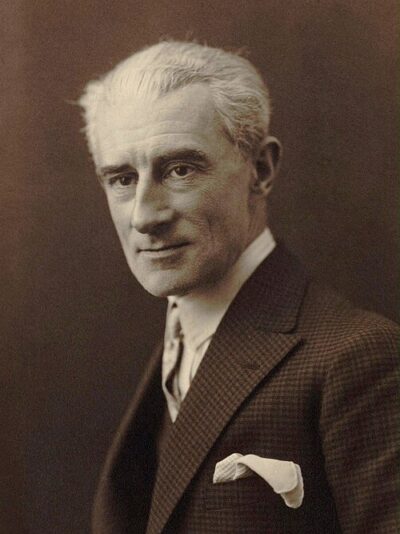
Maurice Ravel
Maurice Ravel was a French composer. Born March 7, 1875, in Ciboure. Died December 28, 1937, in 16th arrondissement of Paris. Known for Daphnis et Chloé, Boléro and Miroirs. Awards include Prix de Rome, Knight of the Legion of Honour and Grammy Hall of Fame.
Facts
30 facts · 2 confirmed by two sources · 9 cited · 19 from one source
Where this comes from
Papalocal keeps its own record. It started from these sources; what each one said is kept here as it was copied, so a change on their side never changes this page by itself. Tap one to read its version.
What Wikidata says · copied November 16, 2026 · revision 2568846138
- Described as
- French composer (1875–1937)
- Other names
- Maurice Joseph Ravel, Joseph Maurice Ravel
- Born
- March 7, 1875 · 19 references
- Died
- December 28, 1937 · 19 references
- Born in
- Ciboure · 4 references
- Died in
- 16th arrondissement of Paris
- Buried in
- Levallois-Perret Cemetery · 1 reference
- Cause of death
- neurological disorder
- Name at birth
- Joseph Maurice Ravel · 1 reference
- Citizen of
- France · 1 reference
- Occupation
- conductor · 1 reference; pianist · 1 reference; composer · 3 references
- Member of
- Royal Swedish Academy of Music; Société musicale indépendante
- Genre
- opera; classical music; impressionism in music
- Instrument
- piano
- Known for
- Daphnis et Chloé; Boléro; Miroirs; Piano Concerto; Gaspard de la nuit
- Awards
- Prix de Rome; Knight of the Legion of Honour (1920); Grammy Hall of Fame (1991); Honorary Member of the International Society for Contemporary Music
- Father
- Pierre-Joseph Ravel · 1 reference
- Mother
- Marie Ravel
- Siblings
- Édouard Ravel · 1 reference
- Religion
- atheism · 1 reference
- Wikipedias with a page
- 107
Wikidata item Q1178 (wikidata.org/wiki/Q1178), public domain (CC0). Copied November 16, 2026.
What Wikipedia says · copied November 16, 2026 · revision 1384429278
Joseph Maurice Ravel (7 March 1875 – 28 December 1937) was a French composer, pianist and conductor. He is often associated with Impressionism along with his elder contemporary Claude Debussy, although both composers rejected the term. In the 1920s and 1930s Ravel was internationally regarded as France's greatest living composer.
Born to a music-loving family, Ravel attended France's premier music college, the Paris Conservatoire; he was not well regarded by its conservative establishment, whose biased treatment of him caused a scandal. After leaving the conservatoire, Ravel found his own way as a composer, developing a style of great clarity and incorporating elements of modernism, baroque, neoclassicism and, in his later works, jazz. He liked to experiment with musical form, as in his best-known work, Boléro (1928), in which repetition takes the place of development. Renowned for his abilities in orchestration, Ravel made some orchestral arrangements of other composers' piano music, of which his 1922 version of Mussorgsky's Pictures at an Exhibition is the best known.
A slow and painstaking worker, Ravel composed fewer pieces than many of his contemporaries. Among his works to enter the repertoire are pieces for piano, chamber music, two piano concertos, ballet music, two operas and eight song cycles; he wrote no symphonies or church music. Many of his works exist in two versions: first, a piano score and later an orchestration. Some of his piano music, such as Gaspard de la nuit (1908), is exceptionally difficult to play, and his complex orchestral works such as Daphnis et Chloé (1912) require skilful balance in performance.
Ravel was among the first composers to recognise the potential of recording to bring their music to a wider public. From the 1920s, despite limited technique as a pianist or conductor, he took part in recordings of several of his works; others were made under his supervision.
- Born, in its opening lines
- March 7, 1875
- Died, in its opening lines
- December 28, 1937
From the Wikipedia article “Maurice Ravel” (en.wikipedia.org/wiki/Maurice_Ravel), by its contributors, under CC BY-SA 4.0 (creativecommons.org/licenses/by-sa/4.0/). Copied November 16, 2026; not changed.
Confirmed Two sources agree. Cited One source, and it names where it got it. One source One source, without a reference of its own. Sources disagree The sources disagree. We show the best-supported value and keep theirs below.
