
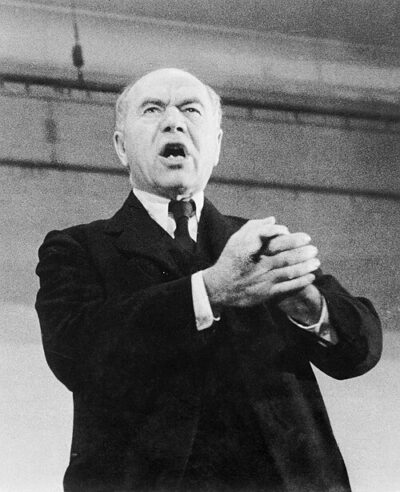
Max Aitken, 1st Baron Beaverbrook
Max Aitken, 1st Baron Beaverbrook was an Anglo-Canadian business tycoon, politician, and writer. Born May 25, 1879, in Maple. Died June 9, 1964, in Cherkley Court. Positions held include Minister of Production (1942), Lord Privy Seal (1943–1945) and Minister of Supply (1941–1942). Educated at University of New Brunswick Faculty of Law. Awards include Order of Suvorov, 1st class, Order of New Brunswick and Person of National Historic Significance.
Facts
34 facts · 2 confirmed by two sources · 15 cited · 17 from one source
Where this comes from
Papalocal keeps its own record. It started from these sources; what each one said is kept here as it was copied, so a change on their side never changes this page by itself. Tap one to read its version.
What Wikidata says · copied November 15, 2026 · revision 2567491026
- Described as
- Anglo-Canadian business tycoon, politician, and writer (1879-1964)
- Other names
- William Maxwell Aitken, 1st Baron Beaverbrook, The Lord Beaverbrook, William Maxwell, 1st Baron Beaverbrook Aitken, Max Aitken, Baron Beaverbrook, William Maxwell Aitken
- Born
- May 25, 1879 · 12 references
- Died
- June 9, 1964 · 11 references
- Born in
- Maple · 3 references
- Died in
- Cherkley Court · 1 reference
- Citizen of
- United Kingdom; Canada
- Occupation
- politician · 2 references; writer; historian; publisher · 1 reference; businessperson · 1 reference; newspaper proprietor · 2 references; member of parliament · 1 reference; minister · 1 reference
- Positions held
- Minister of Production (1942); Lord Privy Seal (1943–1945); Minister of Supply (1941–1942); Minister of Aircraft Production (1940–1941); Chancellor of the Duchy of Lancaster (1918); Member of the Privy Council of the United Kingdom; member of the 30th Parliament of the United Kingdom (1910–1916)
- Political party
- Conservative Party; Liberal Unionist Party
- Education
- University of New Brunswick Faculty of Law
- Awards
- Order of Suvorov, 1st class; Order of New Brunswick (2011); Person of National Historic Significance · 1 reference
- Spouse
- Marcia Anastasia Christoforides · 2 references; Gladys Drury · 1 reference
- Children
- Sir Max Aitken, 2nd Baronet · 1 reference; Janet Aitken · 1 reference; Peter Rudyard Aitken · 1 reference
- Father
- William Cuthbert Aitken · 1 reference
- Mother
- Jane Noble · 1 reference
- Wikipedias with a page
- 32
Wikidata item Q332454 (wikidata.org/wiki/Q332454), public domain (CC0). Copied November 15, 2026.
What Wikipedia says · copied November 15, 2026 · revision 1383626588
William Maxwell Aitken, 1st Baron Beaverbrook (25 May 1879 – 9 June 1964), was a Canadian-British newspaper publisher and backstage politician who was an influential figure in British media and politics of the first half of the 20th century. His base of power was the largest circulation newspaper in the world, the Daily Express, which appealed to the conservative working class with intensely patriotic news and editorials. During the Second World War, he played a major role in mobilising industrial resources as Winston Churchill's Minister of Aircraft Production.
The young Max Aitken had a gift for making money and was a millionaire by the age of 30. His business ambitions quickly exceeded opportunities in Canada, and he moved to Britain. There he befriended Andrew Bonar Law and with his support won a seat in the House of Commons at the December 1910 United Kingdom general election. A knighthood followed shortly after. During the First World War, he ran the Canadian Records office in London, and played a role in the removal of H. H. Asquith as prime minister in 1916. The resulting coalition government (with David Lloyd George as prime minister and Bonar Law as Chancellor of the Exchequer) rewarded Aitken with a peerage and, briefly, a Cabinet post as Minister of Information.
After the war, the now Lord Beaverbrook concentrated on his business interests. He built the Daily Express into the most successful mass-circulation newspaper in the world, with sales of 2.25 million copies a day across Britain. He used it to pursue personal campaigns, most notably for tariff reform and for the British Empire to become a free trade bloc. Beaverbrook supported the governments of Stanley Baldwin and Neville Chamberlain throughout the 1930s and was persuaded by another long-standing political friend, Winston Churchill, to serve as his Minister of Aircraft Production from May 1940. Churchill later praised his "vital and vibrant energy". He resigned due to ill-health in 1941 but later in the war was appointed Lord Privy Seal.
Beaverbrook spent his later life running his newspapers, which by then included the Evening Standard and the Sunday Express. He served as Chancellor of the University of New Brunswick and developed a reputation as a historian with his books on political and military history.
- Born, in its opening lines
- May 25, 1879
- Died, in its opening lines
- June 9, 1964
From the Wikipedia article “Max Aitken, 1st Baron Beaverbrook” (en.wikipedia.org/wiki/Max_Aitken,_1st_Baron_Beaverbrook), by its contributors, under CC BY-SA 4.0 (creativecommons.org/licenses/by-sa/4.0/). Copied November 15, 2026; not changed.
Confirmed Two sources agree. Cited One source, and it names where it got it. One source One source, without a reference of its own. Sources disagree The sources disagree. We show the best-supported value and keep theirs below.
