
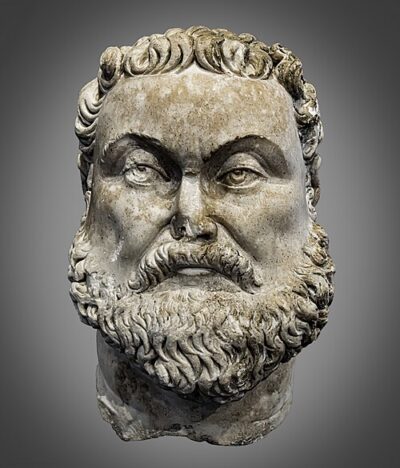
Maximian
Maximian was a Roman emperor. Born 240, in Sirmium. Died July 310, in Marseille. Positions held include Roman emperor (286–305), ancient Roman senator and Roman consul.
Facts
18 facts · 0 confirmed by two sources · 1 cited · 16 from one source · 1 where the sources disagree
What’s different
- Born: we show 240 (Sources disagree). Wikidata also lists 250
Where this comes from
Papalocal keeps its own record. It started from these sources; what each one said is kept here as it was copied, so a change on their side never changes this page by itself. Tap one to read its version.
What Wikidata says · copied November 16, 2026 · revision 2568944182
- Described as
- Roman emperor
- Other names
- Herculius, Marcus Aurelius Valerius Maximianus, Maximianus
- Born
- 240 · 1 reference; 250
- Died
- July 310
- Born in
- Sirmium
- Died in
- Marseille
- Citizen of
- Ancient Rome
- Occupation
- politician
- Positions held
- Roman emperor (286–305); ancient Roman senator; Roman consul
- Spouse
- Eutropia
- Children
- Theodora; Fausta; Maxentius · 2 references; Constantius Chlorus
- Father
- Diocletian
- Siblings
- Diocletian; Carausius
- Religion
- ancient Roman religion
- Wikipedias with a page
- 66
Wikidata item Q46768 (wikidata.org/wiki/Q46768), public domain (CC0). Copied November 16, 2026.
What Wikipedia says · copied November 16, 2026 · revision 1380489230
Maximian (Latin: Marcus Aurelius Valerius Maximianus; c. 250 – c. July 310), nicknamed Herculius, was Roman emperor from 286 to 305. He was Caesar from 285 to 286, then Augustus from 286 to 305. He shared the latter title with his co-emperor and superior, Diocletian, whose political brain complemented Maximian's military brawn. Maximian established his residence at Trier but spent most of his time on campaign. In late 285, he suppressed rebels in Gaul known as the Bagaudae. From 285 to 288, he fought against Germanic tribes along the Rhine frontier. Together with Diocletian, he launched a scorched earth campaign deep into Alamannic territory in 288, refortifying the frontier.
The man he appointed to police the Channel shores, Carausius, rebelled in 286, causing the secession of Britain and northwestern Gaul. Maximian failed to oust Carausius, and his invasion fleet was destroyed by storms in 289 or 290. Maximian's subordinate Constantius campaigned against Carausius' successor, Allectus, while Maximian held the Rhine frontier. The rebel leader was ousted in 296, and Maximian moved south to combat piracy near Hispania and Berber incursions in Mauretania. When these campaigns concluded in 298, he departed for Italy, where he lived in comfort until 305. At Diocletian's behest, Maximian abdicated on 1 May 305, gave the Augustan office to Constantius, and retired to southern Italy.
In late 306, Maximian took the title of Augustus again and aided his son, Maxentius, and his rebellion in Italy. In April 307, he attempted to depose his son, but failed and fled to the court of Constantius' successor, Constantine (Maximian's step-grandson and son-in-law), in Trier. At the Conference of Carnuntum in November 308, Diocletian and his successor, Galerius, forced Maximian to renounce his imperial claim again. In early 310, Maximian attempted to seize Constantine's title while the emperor was on campaign on the Rhine. Few supported him, and he was captured by Constantine in Marseille. Maximian killed himself in mid-310 on Constantine's orders. During Constantine's war with Maxentius, Maximian's image was purged from all public places. However, after Constantine ousted and killed Maxentius, Maximian's image was rehabilitated, and he was deified.
From the Wikipedia article “Maximian” (en.wikipedia.org/wiki/Maximian), by its contributors, under CC BY-SA 4.0 (creativecommons.org/licenses/by-sa/4.0/). Copied November 16, 2026; not changed.
Confirmed Two sources agree. Cited One source, and it names where it got it. One source One source, without a reference of its own. Sources disagree The sources disagree. We show the best-supported value and keep theirs below.
