
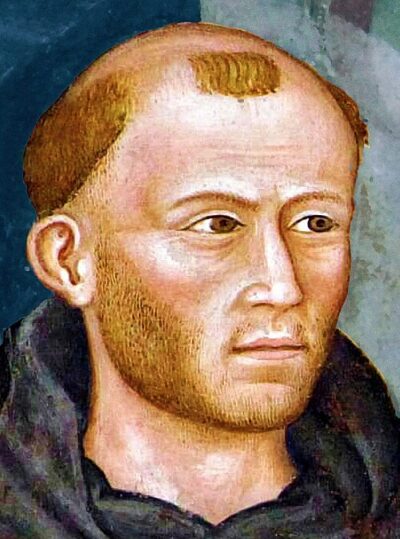
Meister Eckhart
Meister Eckhart was a German philosopher and theologian. Born 1260, in Nessetal. Died January 28, 1328, in Avignon. Positions held include prior (1294–1298), vicar (1296–) and provincial superior (1303–1311). Educated at University of Paris.
Facts
20 facts · 0 confirmed by two sources · 11 cited · 8 from one source · 1 where the sources disagree
What’s different
- Born in: we show Nessetal (Sources disagree). Wikidata also lists Tambach-Dietharz
Where this comes from
Papalocal keeps its own record. It started from these sources; what each one said is kept here as it was copied, so a change on their side never changes this page by itself. Tap one to read its version.
What Wikidata says · copied November 16, 2026 · revision 2569063168
- Described as
- German philosopher and theologian
- Other names
- Johannes Eckhart, Eckhart von Hochheim
- Born
- 1260 · 3 references
- Died
- January 28, 1328 · 1 reference
- Born in
- Nessetal; Tambach-Dietharz
- Died in
- Avignon · 1 reference
- Name at birth
- Eckhart
- Citizen of
- Germany · 1 reference
- Occupation
- philosopher · 3 references; theologian · 3 references; university teacher; theology teacher; mystic · 2 references
- Positions held
- prior (1294–1298) · 1 reference; vicar (1296–) · 1 reference; provincial superior (1303–1311) · 1 reference; vicar general (1307–1311) · 1 reference
- Worked for
- University of Paris
- Education
- University of Paris
- Field
- theology
- Religion
- Catholic Church
- Lived in
- Erfurt · 1 reference
- Wikipedias with a page
- 74
Wikidata item Q76548 (wikidata.org/wiki/Q76548), public domain (CC0). Copied November 16, 2026.
What Wikipedia says · copied November 16, 2026 · revision 1385562792
Eckhart von Hochheim (born Johannes Eckhart; c. 1260 – c. 1328), commonly known as Meister Eckhart (German: [ˈmaɪstɐ ˈʔɛkaʁt]), was a German Catholic priest, theologian, philosopher and mystic. He was born near Gotha in the Landgraviate of Thuringia in the Holy Roman Empire. He was a member of the Dominican Order.
Eckhart came into prominence during the Avignon Papacy at a time of increased tensions between monastic orders, diocesan clergy, the Franciscans, and the Dominicans. In later life, he was accused of heresy, brought up before the local Franciscan-led Inquisition and tried as a heretic by Pope John XXII with the bull In Agro Dominico of March 27, 1329. In the trial, excerpts of his Book of Divine Consolation were used against Eckhart. He seems to have died before his verdict was received.
Eckhart was well known for his work with pious lay groups such as the Friends of God and was succeeded by his more circumspect disciples Johannes Tauler and Henry Suso, the latter of whom was beatified. Since the 19th century, Eckhart has received renewed attention. He has acquired a status as a great mystic within contemporary new age spirituality, as well as considerable interest from scholars situating him within the medieval scholastic and philosophical tradition.
From the Wikipedia article “Meister Eckhart” (en.wikipedia.org/wiki/Meister_Eckhart), by its contributors, under CC BY-SA 4.0 (creativecommons.org/licenses/by-sa/4.0/). Copied November 16, 2026; not changed.
Confirmed Two sources agree. Cited One source, and it names where it got it. One source One source, without a reference of its own. Sources disagree The sources disagree. We show the best-supported value and keep theirs below.
