
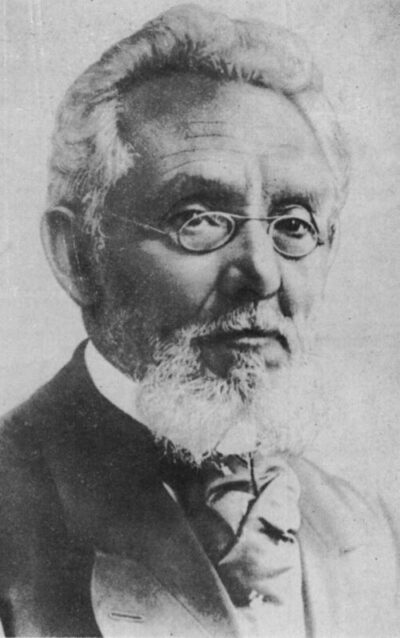
Mendele Mocher Sforim
Mendele Mocher Sforim was a Yiddish-Hebrew writer. Born December 21, 1835, in Kapyĺ. Died November 25, 1917, in Odesa.
Facts
14 facts · 0 confirmed by two sources · 2 cited · 10 from one source · 2 where the sources disagree
What’s different
- Born: we show December 21, 1835 (Sources disagree). Wikipedia says January 2, 1836
- Died: we show November 25, 1917 (Sources disagree). Wikipedia says December 8, 1917
Where this comes from
Papalocal keeps its own record. It started from these sources; what each one said is kept here as it was copied, so a change on their side never changes this page by itself. Tap one to read its version.
What Wikidata says · copied November 16, 2026 · revision 2559454489
- Described as
- Yiddish-Hebrew writer (1836-1917)
- Other names
- Mendele Moykher Sforim, Shalom Jacob Abramowich, Sholem Yankev Abramovitsh, Sholem Yankev Abramovich
- Born
- December 21, 1835
- Died
- November 25, 1917
- Born in
- Kapyĺ
- Died in
- Odesa · 1 reference
- Buried in
- 2nd Christian Cemetery
- Citizen of
- Russian Empire; Belarus
- Occupation
- writer · 1 reference; translator; rabbi; novelist; satirical novelist
- Children
- Mikhail Abramovich
- Religion
- Judaism
- Wikipedias with a page
- 34
Wikidata item Q359694 (wikidata.org/wiki/Q359694), public domain (CC0). Copied November 16, 2026.
What Wikipedia says · copied November 16, 2026 · revision 1375158220
Mendele Mocher Sforim (official name: Sholem Yankev Abramovich; January 2, 1836 – 8 December [O.S. 25 November] 1917) was a Belarusian Jewish author and one of the founders of modern Yiddish and Hebrew literature.
- Born, in its opening lines
- January 2, 1836
- Died, in its opening lines
- December 8, 1917
From the Wikipedia article “Mendele Mocher Sforim” (en.wikipedia.org/wiki/Mendele_Mocher_Sforim), by its contributors, under CC BY-SA 4.0 (creativecommons.org/licenses/by-sa/4.0/). Copied November 16, 2026; not changed.
Confirmed Two sources agree. Cited One source, and it names where it got it. One source One source, without a reference of its own. Sources disagree The sources disagree. We show the best-supported value and keep theirs below.
