
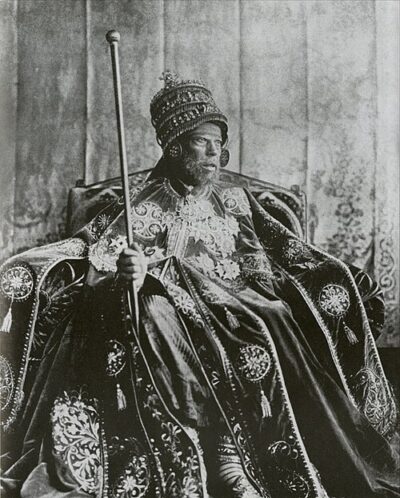
Menilek II
Menilek II was an Emperor of Ethiopia and King of Shewa. Born August 17, 1844, in Ankober. Died December 12, 1913, in Addis Ababa. Positions held include Emperor of Ethiopia (1889–1913). Awards include Knight Grand Cross of the Order of the Bath, Order of Saint Alexander Nevsky and Order of Solomon.
Facts
25 facts · 2 confirmed by two sources · 3 cited · 20 from one source
Where this comes from
Papalocal keeps its own record. It started from these sources; what each one said is kept here as it was copied, so a change on their side never changes this page by itself. Tap one to read its version.
What Wikidata says · copied November 16, 2026 · revision 2562995962
- Described as
- Emperor of Ethiopia and King of Shewa (1844-1913)
- Other names
- Menelek II of Ethiopia, Sahle Mariam, Sahle Maryam, Menelik II, Aba Dagnew
- Born
- August 17, 1844 · 6 references
- Died
- December 12, 1913 · 6 references
- Born in
- Ankober · 1 reference
- Died in
- Addis Ababa · 2 references
- Buried in
- Addis Ababa
- Cause of death
- stroke
- Citizen of
- Ethiopia
- Occupation
- politician
- Positions held
- Emperor of Ethiopia (1889–1913)
- Awards
- Knight Grand Cross of the Order of the Bath; Order of Saint Alexander Nevsky; Order of Solomon · 1 reference; Order of the Star of Ethiopia · 1 reference; Order of Saint Anthony · 1 reference; Order of Saint Michael and Saint George · 1 reference; Knight Grand Cross in the Order of the Holy Sepulchre (1907) · 1 reference; Order of Saint Stephen of Hungary · 1 reference
- Spouse
- Taytu Betul (1883–) · 1 reference; Emyat Bafana; Altash Tewodros
- Children
- Zewditu I of Ethiopia; Shoa Reggad Menelik
- Father
- Haile Melekot
- Mother
- Idzigajehu · 1 reference
- Religion
- Ethiopian Orthodox Tewahedo Church
- Wikipedias with a page
- 56
Wikidata item Q244748 (wikidata.org/wiki/Q244748), public domain (CC0). Copied November 16, 2026.
What Wikipedia says · copied November 16, 2026 · revision 1383424968
Menelik II (Ge'ez: ዳግማዊ ምኒልክ dagmawi mənilək; horse name Aba Dagnew (Amharic: አባ ዳኘው abba daññäw); 17 August 1844 – 12 December 1913), baptised as Sahle Maryam (ሣህለ ማርያም sahlä maryam), was king of Shewa from 1866 to 1889 and Emperor of Ethiopia from 1889 to his death in 1913. A member of the Solomonic dynasty, Menelik expanded the Ethiopian Empire to its greatest historical extent and defeated Italian colonial forces at the Battle of Adwa in 1896.
A member of the Shewan branch of the Solomonic dynasty, Menelik was born in Ankober, Shewa, as Sahle Maryam, the son of Haile Melekot (Negus of Shewa). Named "Menelik" by his grandfather King Sahle Selassie after the legendary Menelik I (son of Solomon and the Queen of Sheba), he was imprisoned at age 11 by Emperor Tewodros II at the fortress of Magdala following his father's death in 1855. He escaped in 1865 amid Tewodros's declining power, returned to Shewa, and was acclaimed as its rightful king. Though harboring imperial ambitions, he avoided challenging northern rivals during the British Expedition to Abyssinia in 1868 and submitted to Emperor Yohannes IV in 1878 after failed collaboration with the Egyptians during their invasion (1875–1876).
As quasi-independent ruler of Shewa from 1878 to 1889, Menelik built his power base through direct European diplomacy, securing modern weapons and expertise from advisors such as the Swiss engineer Alfred Ilg. He conquered southern territories inhabited by Oromo, Wolayta and Gurage peoples, exploiting ivory, coffee, gold, and slave trade revenues to fund arms, while establishing fortified katama settlements and the neftenya land system. The strategic conquest of Harar in 1887 turned it into principal trade hub under Ras Makonnen. Following the death of Yohannes at the Battle of Metemma in 1889, Menelik was crowned emperor at Mount Entoto on 3 November 1889.
Menelik signed the Treaty of Wuchale with Italy in 1889; the Italian version implied a protectorate, while the Amharic allowed optional use of Italian diplomatic assistance. Recognizing this deception, Menelik formally rejected the treaty in 1891 leading to an Italian invasion in 1895. Mobilising a unified army of over 100,000, he crushed Italian forces at the Battle of Adwa on 1 March 1896, securing Ethiopia's independence and full European recognition. He defined borders through treaties with Britain, France, and Italy, initiated the Addis Ababa–Djibouti Railway, and centralized governance with ministries, schools, and a state bank. After strokes from 1906 left him incapacitated by 1909, Empress Taytu Betul and later Ras Tessema Nadew served as regents. He died in 1913 and was succeeded by grandson Lij Iyasu (later deposed), followed by his daughter Zewditu and Ras Tafari Makonnen (the future Haile Selassie).
Menelik was a controversial figure for much of his reign. Although he was praised internationally as a symbol of African resistance to colonialism and credited with being the architect of modern Ethiopia, critics among incorporated ethnic groups accused him of forced assimilation, land expropriation, and cultural suppression that contributed to later ethnic tensions. He remains one of the most influential figures in Ethiopian history and is widely regarded as the founder of modern Ethiopia.
- Born, in its opening lines
- August 17, 1844
- Died, in its opening lines
- December 12, 1913
From the Wikipedia article “Menelik II” (en.wikipedia.org/wiki/Menelik_II), by its contributors, under CC BY-SA 4.0 (creativecommons.org/licenses/by-sa/4.0/). Copied November 16, 2026; not changed.
Confirmed Two sources agree. Cited One source, and it names where it got it. One source One source, without a reference of its own. Sources disagree The sources disagree. We show the best-supported value and keep theirs below.
