
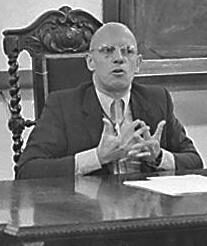
Michel Foucault
Michel Foucault was a French philosopher. Born October 15, 1926, in Poitiers. Died June 25, 1984, in 13th arrondissement of Paris. Known for Discipline and Punish, The Order of Things and The Archaeology of Knowledge. Educated at Lycée Henri-IV and École Normale Supérieure.
Facts
42 facts · 2 confirmed by two sources · 11 cited · 28 from one source · 1 where the sources disagree
What’s different
- Cause of death: we show disease (Sources disagree). Wikidata also lists HIV/AIDS
Where this comes from
Papalocal keeps its own record. It started from these sources; what each one said is kept here as it was copied, so a change on their side never changes this page by itself. Tap one to read its version.
What Wikidata says · copied November 16, 2026 · revision 2568298370
- Described as
- French philosopher (1926–1984)
- Other names
- Michel Foucalt, Foucault, Michael Foucault, Mišel Fuko, Paul-Michel Foucault
- Born
- October 15, 1926 · 20 references
- Died
- June 25, 1984 · 14 references
- Born in
- Poitiers · 4 references
- Died in
- 13th arrondissement of Paris · 2 references
- Cause of death
- HIV/AIDS; disease · 1 reference
- Name at birth
- Paul-Michel Foucault · 2 references
- Citizen of
- France · 3 references
- Occupation
- anthropologist; psychologist · 3 references; historian · 1 reference; writer · 2 references; sociologist; professor · 1 reference; screenwriter; literary critic
- Political party
- French Communist Party (1950–1953)
- Worked for
- University of California, Berkeley · 1 reference; University Lille-III; University at Buffalo; Collège de France (1970–1984) · 2 references; Paris 8 University; Uppsala University (1954–1958) · 1 reference; University of Warsaw · 1 reference; Tunis University · 1 reference
- Education
- Lycée Henri-IV; École Normale Supérieure; University of Paris
- Member of
- Les Amis de la bibliothèque du Saulchoir · 1 reference
- Known for
- Discipline and Punish; The Order of Things; The Archaeology of Knowledge; L'usage des plaisirs; The History of Sexuality; Madness and Civilization
- Field
- philosophy; history; sociology; history of ideas · 1 reference; epistemology · 1 reference; ethics · 1 reference
- Father
- Paul Foucault
- Religion
- atheism · 1 reference
- Wikipedias with a page
- 129
Wikidata item Q44272 (wikidata.org/wiki/Q44272), public domain (CC0). Copied November 16, 2026.
What Wikipedia says · copied November 16, 2026 · revision 1385410220
Paul-Michel Foucault, known as Michel Foucault, (UK: FOO-koh, US: foo-KOH; French: [pɔl miʃɛl fuko]; 15 October 1926 – 25 June 1984) was a French philosopher, literary critic, and historian of ideas who analyzed the relationships between power, knowledge, and liberty, and how they are used as a form of social control through institutions. Sometimes called a structuralist or postmodernist, he rejected these labels and sought to critique authority without limiting himself. His thought has influenced academics in many areas of study, including anthropology, communication studies, criminology, cultural studies, feminism, literary theory, psychology, and sociology. His arguments against homophobia, racial prejudice, and other ideological doctrines have also shaped scholarship on critical theory and Marxism.
Born in Poitiers, France, into an upper-middle-class family, Foucault was educated at the Lycée Henri-IV, at the École Normale Supérieure, developing an interest in philosophy and coming under the influence of his tutors Jean Hyppolite and Louis Althusser. At the University of Paris (Sorbonne), he earned degrees in philosophy and psychology. After several years as a cultural diplomat abroad, he returned to France and published his first major book, The History of Madness (1961). While working at the University of Clermont-Ferrand (1960–66), he produced The Birth of the Clinic (1963) and The Order of Things (1966), which have a structuralist affinity from which he later distanced himself. These first three histories exemplified "archeology", a historiographical technique he was developing.
Foucault lectured at the University of Tunis (1966–68), before returning to France, becoming head of the philosophy department at the new experimental university of Paris VIII, and publishing The Archaeology of Knowledge (1969). He was admitted to the Collège de France (1970), a membership he retained until his death. He also became active in several left-wing groups involved in anti-racist human rights campaigns, including penal reform. He later published Discipline and Punish (1975) and The History of Sexuality (1976), developing archaeological and genealogical methods that emphasize the role power plays in society.
Foucault died in Paris from complications of HIV/AIDS. He became the first public figure in France to die from complications of the disease, with his charisma and career influence changing mass awareness of the pandemic and influencing HIV/AIDS activism. His partner, Daniel Defert, founded the AIDES charity in his memory.
- Born, in its opening lines
- October 15, 1926
- Died, in its opening lines
- June 25, 1984
From the Wikipedia article “Michel Foucault” (en.wikipedia.org/wiki/Michel_Foucault), by its contributors, under CC BY-SA 4.0 (creativecommons.org/licenses/by-sa/4.0/). Copied November 16, 2026; not changed.
Confirmed Two sources agree. Cited One source, and it names where it got it. One source One source, without a reference of its own. Sources disagree The sources disagree. We show the best-supported value and keep theirs below.
