
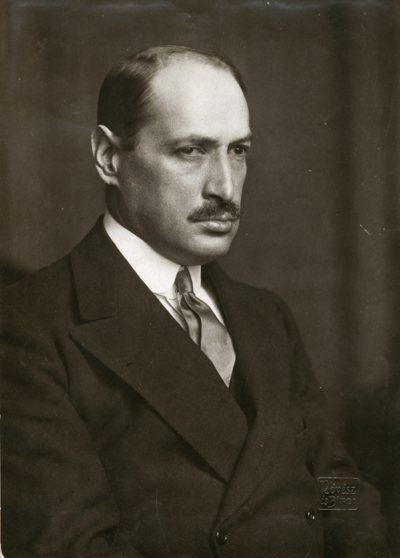
Mihály Károlyi
Mihály Károlyi was a Hungarian politician, president, prime minister of Hungary and ambassador to France. Born March 4, 1875, in Budapest. Died March 19, 1955, in Vence. Positions held include President of the Republic (1919), Prime Minister of Hungary (1918–1919) and ambassador of Hungary to France (1947–1949). Educated at Eötvös Loránd University. Awards include honorary citizen of Pécs.
Facts
31 facts · 2 confirmed by two sources · 15 cited · 14 from one source
Where this comes from
Papalocal keeps its own record. It started from these sources; what each one said is kept here as it was copied, so a change on their side never changes this page by itself. Tap one to read its version.
What Wikidata says · copied November 16, 2026 · revision 2562763807
- Described as
- Hungarian politician, president, prime minister of Hungary and ambassador to France (1875–1955)
- Other names
- Mihaly Karolyi, Mihály Graf Károlyi de Nagykároly, Michael Károlyi
- Born
- March 4, 1875 · 9 references
- Died
- March 19, 1955 · 1 reference
- Born in
- Budapest · 1 reference
- Died in
- Vence · 2 references
- Buried in
- Fiume Road Graveyard · 1 reference
- Name at birth
- Károlyi Mihály Ádám György Miklós
- Citizen of
- Hungary
- Occupation
- economist; politician · 1 reference; writer · 1 reference; ambassador · 1 reference; head of government · 1 reference; author · 1 reference
- Positions held
- President of the Republic (1919); Prime Minister of Hungary (1918–1919) · 1 reference; ambassador of Hungary to France (1947–1949) · 1 reference; Minister of Foreign Affairs of Hungary (1918–1919) · 1 reference; Member of the House of Magnates (1899–1918) · 1 reference; member of the National Assembly of Hungary (3 times) (1905–1947) · 1 reference; Minister of Finance in Hungary (1918) · 1 reference; member of the Provisional National Assembly (1945) · 1 reference; ambassador of Hungary to Belgium (1948–1949) · 1 reference; ambassador of Hungary to Luxembourg (1949) · 1 reference
- Political party
- Party of Independence and '48 · 1 reference; Independence and '48 Party (Károlyi) (1916–)
- Education
- Eötvös Loránd University (1893–)
- Awards
- honorary citizen of Pécs (1947) · 1 reference
- Spouse
- Katinka Andrássy (1914–) · 1 reference
- Father
- Gyula Károlyi · 1 reference
- Mother
- Gräfin Georgine Károlyi de Nagy-Károly · 1 reference
- Religion
- Catholicism
- Wikipedias with a page
- 38
Wikidata item Q346703 (wikidata.org/wiki/Q346703), public domain (CC0). Copied November 16, 2026.
What Wikipedia says · copied November 16, 2026 · revision 1380776396
Count Mihály Ádám György Miklós Károlyi de Nagykároly (Hungarian: gróf nagykárolyi Károlyi Mihály Ádám György Miklós; English: Michael Adam George Nicholas Károlyi; 4 March 1875 – 19 March 1955) was a Hungarian politician who served as a leader of the short-lived and unrecognized First Hungarian Republic from 1918 to 1919. He served as prime minister between 1 and 16 November 1918 and as president between 16 November 1918 and 21 March 1919.
Born into one of Hungary's wealthiest families, Károlyi had a prodigal youth and only became active in the Hungarian Parliament in his thirties. There, he became one of the body's foremost progressive voices and often found himself at odds with Prime Minister István Tisza and the Dual Monarchy. Károlyi was a vocal opponent of the First World War and became a proponent of the Entente, which made him extremely popular as the war began to turn against the Central Powers. After the Aster Revolution, Károlyi became the Prime Minister and President of the new Hungarian Republic. A zealous adherent of the Fourteen Points and a pacifist, Károlyi demobilized the exhausted Royal Hungarian Honvéd and pursued a progressive domestic policy of enfranchisement and redistribution. Károlyi's brief rule was ended by the ascent of the equally short-lived Hungarian Soviet Republic. He lived most of the rest of his life in exile, and died in France in 1955.
In the present day, Károlyi's demobilization of the Hungarian army is widely blamed for the massive territorial losses which Hungary experienced at the hands of Czechoslovakia, Romania, and Serbia which were later formalized by the Treaty of Trianon. Despised by the Horthy government, he was celebrated by the Hungarian People's Republic for his committed liberalism and left-wing sympathies, but his reputation again suffered after the fall of communism.
- Born, in its opening lines
- March 4, 1875
- Died, in its opening lines
- March 19, 1955
From the Wikipedia article “Mihály Károlyi” (en.wikipedia.org/wiki/Mihály_Károlyi), by its contributors, under CC BY-SA 4.0 (creativecommons.org/licenses/by-sa/4.0/). Copied November 16, 2026; not changed.
Confirmed Two sources agree. Cited One source, and it names where it got it. One source One source, without a reference of its own. Sources disagree The sources disagree. We show the best-supported value and keep theirs below.
