
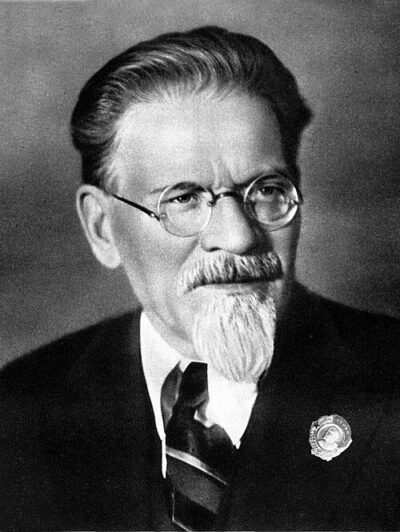
Mikhail Ivanovich Kalinin
Mikhail Ivanovich Kalinin was a Soviet politician. Born November 7, 1875, in Verkhnaya Troitsa. Died June 3, 1946, in Moscow. Positions held include member of the Presidium of the Supreme Soviet of the USSR (1946), Member of the Russian Constituent Assembly and Chairman of the Central Executive Committee of the Congress of Soviets (1922–1938). Awards include Medal "For the Victory over Germany in the Great Patriotic War 1941–1945", Order of the Red Banner (2 times) and Order of Lenin (3 times).
Facts
36 facts · 1 confirmed by two sources · 6 cited · 28 from one source · 1 where the sources disagree
What’s different
- Born: we show November 7, 1875 (Sources disagree). Wikipedia says November 19, 1875
Where this comes from
Papalocal keeps its own record. It started from these sources; what each one said is kept here as it was copied, so a change on their side never changes this page by itself. Tap one to read its version.
What Wikidata says · copied November 16, 2026 · revision 2566064913
- Described as
- Soviet politician (1875–1946)
- Other names
- Mikhail Ivanowich Kalinin, M. I. Kalinin, Mikhail Kalinin
- Born
- November 7, 1875 · 3 references
- Died
- June 3, 1946 · 10 references
- Born in
- Verkhnaya Troitsa
- Died in
- Moscow · 3 references
- Buried in
- Kremlin Wall Necropolis
- Cause of death
- colorectal cancer
- Citizen of
- Russian Empire; Russian Socialist Federative Soviet Republic; Soviet Union
- Occupation
- politician · 2 references; teacher · 1 reference; engineer · 1 reference
- Positions held
- member of the Presidium of the Supreme Soviet of the USSR (1946); Member of the Russian Constituent Assembly; Chairman of the Central Executive Committee of the Congress of Soviets (1922–1938); Chairman of the Presidium of the Supreme Soviet of the Soviet Union (1938–1946) · 3 references; Member of the Politburo of the CPSU Central Committee (1926–1946); Candidate member of the Politburo of the CPSU Central Committee (1919–1926); member of the Supreme Soviet of the Byelorussian SSR of the 1st convocation
- Political party
- Russian Social Democratic Labour Party (–1917); Russian Social Democratic Labour Party (bolshevik) (1917–1918); Communist Party of the Soviet Union (1918–1946)
- Member of
- Politburo of the Central Committee of the Communist Party of the Soviet Union; All-Russian Central Executive Committee; Central Executive Committee of the Soviet Union; All-Union Society of Old Bolsheviks
- Awards
- Medal "For the Victory over Germany in the Great Patriotic War 1941–1945"; Order of the Red Banner (2 times) (1928, 1930); Order of Lenin (3 times) (1935, 1944, 1945); Hero of Socialist Labour (1944); Medal "For the Defence of Moscow"; Medal "For Valiant Labour in the Great Patriotic War 1941–1945"
- Spouse
- Ekaterina Kalinina · 1 reference
- Father
- Ivan Kalinin
- Siblings
- Fyodor Kalinin · 1 reference
- Religion
- atheism
- Wikipedias with a page
- 77
Wikidata item Q229828 (wikidata.org/wiki/Q229828), public domain (CC0). Copied November 16, 2026.
What Wikipedia says · copied November 16, 2026 · revision 1385904004
Mikhail Ivanovich Kalinin (Russian: Михаил Иванович Калинин, IPA: [mʲɪxɐˈ(j)iɫ kɐˈlʲinʲɪn] ; 19 November [O.S. 7 November] 1875 – 3 June 1946) was a Soviet politician and Russian Old Bolshevik revolutionary who served as the head of state of the Soviet Union from 1919 until his resignation in 1946. (This position was largely ceremonial, with actual power residing with Communist Party leader Joseph Stalin.) From 1926 until his death, he was a member of the Politburo of the All-Union Communist Party (Bolsheviks).
Born to a peasant family, Kalinin worked as a metal worker in Saint Petersburg and took part in the 1905 Russian Revolution as an early member of the Bolsheviks. During and after the October Revolution, he served as mayor of Petrograd (St. Petersburg). After the revolution, Kalinin became the head of the new Soviet state, as well as a member of the Central Committee of the Communist Party and the Politburo. He also was the Chairman of the Central Executive Committee of the Soviet Union.
Kalinin remained the titular head of state of the Soviet Union after the rise of Joseph Stalin, with whom he enjoyed a privileged relationship, but held little real power or influence. He retired in 1946 and died in the same year. The former East Prussian city of Königsberg, annexed by the Soviet Union in 1945, was renamed Kaliningrad after him a year later. The city of Tver was also known as Kalinin until 1990, when its historic name was restored, one year before the eventual fall of the Soviet Union. At 19 years, Kalinin's tenure was the longest of any non-monarchical Russian head of state until it was surpassed by Vladimir Putin in 2020.
- Born, in its opening lines
- November 19, 1875
- Died, in its opening lines
- June 3, 1946
From the Wikipedia article “Mikhail Kalinin” (en.wikipedia.org/wiki/Mikhail_Kalinin), by its contributors, under CC BY-SA 4.0 (creativecommons.org/licenses/by-sa/4.0/). Copied November 16, 2026; not changed.
Confirmed Two sources agree. Cited One source, and it names where it got it. One source One source, without a reference of its own. Sources disagree The sources disagree. We show the best-supported value and keep theirs below.
