
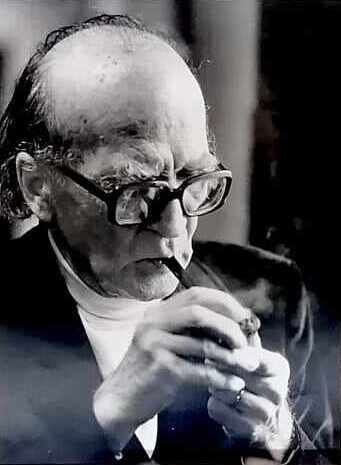
Mircea Eliade
Mircea Eliade was a Romanian-American historian, writer, philosopher and professor at the University of Chicago. Born March 9, 1907, in Bucharest. Died April 22, 1986, in Chicago. Educated at University of Calcutta and University of Bucharest. Awards include Gordon J. Laing Award, Knight of the Legion of Honour and doctor honoris causa from the Paris-Sorbonne University.
Facts
31 facts · 1 confirmed by two sources · 9 cited · 20 from one source · 1 where the sources disagree
What’s different
- Born: we show March 9, 1907 (Sources disagree). Wikipedia says March 13, 1907
Where this comes from
Papalocal keeps its own record. It started from these sources; what each one said is kept here as it was copied, so a change on their side never changes this page by itself. Tap one to read its version.
What Wikidata says · copied November 13, 2026 · revision 2558171730
- Described as
- Romanian-American historian, writer, philosopher and professor at the University of Chicago (1907–1986)
- Born
- March 9, 1907 · 7 references
- Died
- April 22, 1986 · 14 references
- Born in
- Bucharest · 2 references
- Died in
- Chicago · 2 references
- Buried in
- Oak Woods Cemetery
- Citizen of
- Kingdom of Romania; Romanian People's Republic; United States (1966–) · 1 reference
- Occupation
- anthropologist; diplomat; historian of religion; historian · 2 references; journalist; novelist; philosopher · 2 references; essayist
- Political party
- Iron Guard
- Worked for
- University of Chicago; University of Bucharest
- Education
- University of Calcutta; University of Bucharest
- Member of
- Academie Royale de Langue et de littérature Françaises (1975–1986) · 1 reference; American Academy of Arts and Sciences; Romanian Academy
- Awards
- Gordon J. Laing Award (1986) · 1 reference; Knight of the Legion of Honour · 1 reference; doctor honoris causa from the Paris-Sorbonne University (1976) · 1 reference
- Field
- religious studies
- Spouse
- Nina Mareş (1934–1944) · 1 reference; Christinel Eliade · 1 reference
- Religion
- Eastern Orthodox Church
- Wikipedias with a page
- 70
Wikidata item Q41590 (wikidata.org/wiki/Q41590), public domain (CC0). Copied November 13, 2026.
What Wikipedia says · copied November 13, 2026 · revision 1384588929
Mircea Eliade (Romanian: [ˈmirt͡ʃe̯a eliˈade]; 13 March [O.S. 28 February] 1907 – April 22, 1986) was a Romanian historian of religion, fiction writer, philosopher, and professor at the University of Chicago. One of the most influential scholars of religion of the 20th century and interpreter of religious experience, he established paradigms in religious studies. His theory that hierophanies form the basis of religion, splitting the human experience of reality into sacred and profane space and time, has proved influential. One of his most instrumental contributions to religious studies was his theory of eternal return, which holds that myths and rituals do not simply commemorate hierophanies, but (at least in the minds of the religious) actually participate in them.
Eliade's literary works belong to the fantastic and autobiographical genres. The best known are the novels Maitreyi ('La Nuit Bengali' or 'Bengal Nights', 1933), Noaptea de Sânziene ('The Forbidden Forest', 1955), Isabel și apele diavolului ('Isabel and the Devil's Waters'), and Romanul Adolescentului Miop ('Novel of the Nearsighted Adolescent', 1989); the novellas Domnișoara Christina ('Miss Christina', 1936) and Tinerețe fără tinerețe ('Youth Without Youth', 1976); and the short stories Secretul doctorului Honigberger ('The Secret of Dr. Honigberger', 1940) and La Țigănci ('With the Gypsy Girls', 1963).
Early in his life, Eliade was a journalist and essayist, a disciple of Romanian philosopher and journalist Nae Ionescu, and a member of the literary society Criterion. In the 1940s, he served as cultural attaché of the Kingdom of Romania to the United Kingdom and Portugal. Several times during the late 1930s, Eliade publicly expressed his support for the Iron Guard, a Romanian Christian fascist organization. His involvement with fascism at the time, as well as his other far-right connections, came under frequent criticism after World War II.
Eliade had fluent command of five languages (Romanian, French, German, Italian, and English) and a reading knowledge of three others (Hebrew, Persian, and Sanskrit). In 1990 he was elected a posthumous member of the Romanian Academy.
- Born, in its opening lines
- March 13, 1907
- Died, in its opening lines
- April 22, 1986
From the Wikipedia article “Mircea Eliade” (en.wikipedia.org/wiki/Mircea_Eliade), by its contributors, under CC BY-SA 4.0 (creativecommons.org/licenses/by-sa/4.0/). Copied November 13, 2026; not changed.
Confirmed Two sources agree. Cited One source, and it names where it got it. One source One source, without a reference of its own. Sources disagree The sources disagree. We show the best-supported value and keep theirs below.
