
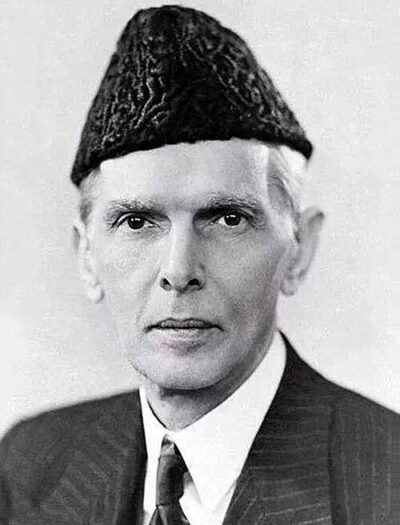
Mohammad Ali Jinnah
Mohammad Ali Jinnah was a politician and the founder of Pakistan. Born December 25, 1876, in Karachi. Died September 11, 1948, in Karachi. Positions held include Governor-General of Pakistan (1947–1948), Speaker of the National Assembly of Pakistan (1947–1948) and President of the Constituent Assembly of Pakistan (1947–1948). Educated at University of Oxford and Lincoln's Inn.
Facts
32 facts · 2 confirmed by two sources · 4 cited · 26 from one source
Where this comes from
Papalocal keeps its own record. It started from these sources; what each one said is kept here as it was copied, so a change on their side never changes this page by itself. Tap one to read its version.
What Wikidata says · copied November 16, 2026 · revision 2568861175
- Described as
- politician and the founder of Pakistan (1876–1948)
- Other names
- Mohammed Ali Jinnah, Baba-e-Qaum, Quaid-e-Azam, Qaid-e-Azam, Muhammad Ali Jinnah
- Born
- December 25, 1876 · 10 references
- Died
- September 11, 1948 · 8 references
- Born in
- Karachi · 1 reference
- Died in
- Karachi
- Buried in
- Mazar-e-Quaid
- Cause of death
- tuberculosis
- Citizen of
- Pakistan; British Raj (–1947)
- Occupation
- lawyer; barrister; freedom fighter; politician · 2 references
- Positions held
- Governor-General of Pakistan (1947–1948); Speaker of the National Assembly of Pakistan (1947–1948); President of the Constituent Assembly of Pakistan (1947–1948); member of the Central Legislative Assembly
- Political party
- Indian National Congress (1906–1920); All India Muslim League (1913–1947); Muslim League (1947–1948)
- Education
- University of Oxford (1887–1892); Lincoln's Inn (1893–1896); Cathedral and John Connon School
- Member of
- Fabian Society
- Spouse
- Emibai Jinnah (1892–1893); Rattanbai Jinnah (1918–1929)
- Children
- Dina Wadia
- Father
- Jinnahbhai Poonja · 1 reference
- Mother
- Mitthibai Jinnahbhai
- Siblings
- Fatima Jinnah
- Religion
- Sunni Islam; Shia Islam · 2 references
- Website
- http://majinnah.com.pk · 1 reference
- Wikipedias with a page
- 109
Wikidata item Q160554 (wikidata.org/wiki/Q160554), public domain (CC0). Copied November 16, 2026.
What Wikipedia says · copied November 16, 2026 · revision 1382579195
Muhammad Ali Jinnah (born Mahomedali Jinnahbhai; 25 December 1876 – 11 September 1948) was a barrister, statesman, and the founder of Pakistan. He served as the leader of the All-India Muslim League from 1913 until the independence of Pakistan on 14 August 1947, and then as the first Governor-General of Pakistan until his death a year later in 1948.
Born at Wazir Mansion in Karachi, Jinnah was trained as a barrister at Lincoln's Inn in London, England. Upon his return to India, he enrolled at the Bombay High Court, and took an interest in national politics, which eventually replaced his legal practice. Jinnah rose to prominence in the Indian National Congress in the first two decades of the 20th century. In these early years of his political career, Jinnah advocated for Hindu–Muslim unity, helping to shape the 1916 Lucknow Pact between the Congress and the All-India Muslim League, in which Jinnah had also become prominent. Jinnah became a key leader in the All-India Home Rule League, and proposed a fourteen-point constitutional reform plan to safeguard the political rights of Muslims in the Indian subcontinent. In 1920, however, Jinnah resigned from the Congress when it agreed to follow a campaign of satyagraha, which he regarded as political anarchy.
After joining the All-India Muslim League, Jinnah worked for the rights of Muslims in the subcontinent to protect them from the threat of marginalisation in a Hindu-dominated state. In 1940, the Muslim League, led by Jinnah, passed the Lahore Resolution. During the Second World War, the League gained strength while leaders of the Congress were imprisoned, and in the provincial elections held shortly after the war, it won most of the seats reserved for Muslims. Ultimately, the Congress and the Muslim League could not reach a power-sharing formula that would allow the entirety of British India to be united as a single state following independence, leading all parties to agree instead to the independence of a Hindu-majority India, and for a predominantly Muslim state of Pakistan.
As the first governor-general of Pakistan, Jinnah worked to establish the government of the new nation and policies to aid the millions of Muslim migrants who had emigrated from regions that became part of the Dominion of India to Pakistan after the independence of both states, personally supervising the establishment of refugee camps. Jinnah died at age 71 in September 1948, just over a year after Pakistan gained independence from the United Kingdom. He left a deep and respected legacy in Pakistan. Several universities and public buildings in Pakistan bear Jinnah's name. He is revered in Pakistan as the Quaid-e-Azam ("Great Leader") and Baba-e-Qaum ("Father of the Nation"). His birthday is also observed as a national holiday in the country. According to his biographer, Stanley Wolpert, Jinnah remains Pakistan's greatest leader.
- Born, in its opening lines
- December 25, 1876
- Died, in its opening lines
- September 11, 1948
From the Wikipedia article “Muhammad Ali Jinnah” (en.wikipedia.org/wiki/Muhammad_Ali_Jinnah), by its contributors, under CC BY-SA 4.0 (creativecommons.org/licenses/by-sa/4.0/). Copied November 16, 2026; not changed.
Confirmed Two sources agree. Cited One source, and it names where it got it. One source One source, without a reference of its own. Sources disagree The sources disagree. We show the best-supported value and keep theirs below.
