
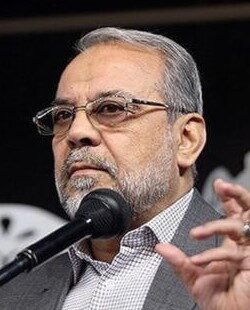
Mohammad Bagher Zolghadr
Mohammad Bagher Zolghadr is an Iranian military commander. Born 1954, in Fasa. Positions held include Secretary of the Expediency Discernment Council (2022–2026), Member of the Expediency Discernment Council (2021–) and Deputy Commander-in-Chief of the Islamic Revolutionary Guard Corps (1997–2006). Educated at University of Tehran.
Facts
15 facts · 0 confirmed by two sources · 0 cited · 15 from one source
Where this comes from
Papalocal keeps its own record. It started from these sources; what each one said is kept here as it was copied, so a change on their side never changes this page by itself. Tap one to read its version.
What Wikidata says · copied November 18, 2026 · revision 2543814272
- Described as
- Iranian military commander
- Born
- 1954
- Born in
- Fasa · 1 reference
- Citizen of
- Iran
- Occupation
- army officer; politician
- Positions held
- Secretary of the Expediency Discernment Council (2022–2026); Member of the Expediency Discernment Council (2021–); Deputy Commander-in-Chief of the Islamic Revolutionary Guard Corps (1997–2006); Secretary of the Supreme National Security Council (2026) · 1 reference; commanding officer
- Political party
- Mojahedin of the Islamic Revolution of Iran Organization
- Education
- University of Tehran
- Religion
- Islam
- Military branch
- Islamic Revolutionary Guard Corps
- Military rank
- brigadier general of IRGC
- Wikipedias with a page
- 20
Wikidata item Q4193730 (wikidata.org/wiki/Q4193730), public domain (CC0). Copied November 18, 2026.
What Wikipedia says · copied November 18, 2026 · revision 1382681825
Mohammad Bagher Zolghadr (born 1954) is an Iranian politician and former military officer who serves as a political advisor to the Supreme Leader of Iran. He previously served as secretary of the Supreme National Security Council from March to August 2026 and as secretary of the Expediency Discernment Council from 2021 to 2026.
Before the 1979 Islamic revolution, Zolghadr was active in carrying out attacks against the monarchy, and in 1978 he killed an American engineer and an oil company manager. He served as the commander of the IRGC Irregular Warfare Headquarters, as well as the Ramazan Headquarters, which formed the basis for the Quds Force, the IRGC’s foreign branch that conducts asymmetric warfare outside of Iran. He was later a Brigadier General in the IRGC, with whom he served from 1979 to 2010. He was the Chief of the Joint Staff of the IRGC from 1989 to 1997, and Second-in-Command of the IRGC from 1997 to 2006.
After he helped Mahmoud Ahmadinejad come to power with a "multilayered plan," from 2005 to 2007 he was Deputy Interior Minister for Security Affairs and Police under Ahmadinejad. From 2012 to 2021 he was the deputy for strategic, societal–security and crime prevention affairs in the judicial system of Iran. In March 2026, he was appointed Secretary of the Supreme National Security Council, succeeding Ali Larijani, who was assassinated by an Israeli airstrike during the war.
He is known for his hard-line views, and said on 24 March 2026 that the IRGC should gain more control over the country. The Economist described him as an "IRGC apparatchik".
From the Wikipedia article “Mohammad Bagher Zolghadr” (en.wikipedia.org/wiki/Mohammad_Bagher_Zolghadr), by its contributors, under CC BY-SA 4.0 (creativecommons.org/licenses/by-sa/4.0/). Copied November 18, 2026; not changed.
Confirmed Two sources agree. Cited One source, and it names where it got it. One source One source, without a reference of its own. Sources disagree The sources disagree. We show the best-supported value and keep theirs below.
