
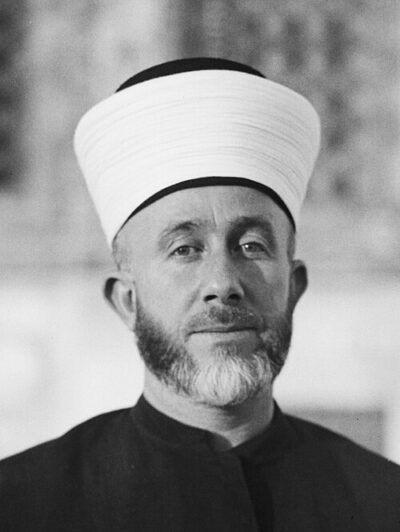
Mohammed Amin al-Husseini
Mohammed Amin al-Husseini was a Palestinian Arab nationalist. Born January 1, 1895, in Jerusalem. Died July 4, 1974, in Beirut. Positions held include Grand Mufti. Educated at Al-Azhar University.
Facts
20 facts · 1 confirmed by two sources · 2 cited · 16 from one source · 1 where the sources disagree
What’s different
- Born: we show January 1, 1895 (Sources disagree). Wikipedia says c. 1897
Where this comes from
Papalocal keeps its own record. It started from these sources; what each one said is kept here as it was copied, so a change on their side never changes this page by itself. Tap one to read its version.
What Wikidata says · copied November 16, 2026 · revision 2569380037
- Described as
- Palestinian Arab nationalist (1897–1974)
- Other names
- Muḥammad Amīn al- Husainī, Amin al-Husseini
- Born
- January 1, 1895
- Died
- July 4, 1974 · 4 references
- Born in
- Jerusalem · 1 reference
- Died in
- Beirut
- Buried in
- Martyrs' Cemetery in Beirut
- Citizen of
- Ottoman Empire (–1920); Mandatory Palestine (1920–1948)
- Occupation
- politician · 1 reference; mufti
- Positions held
- Grand Mufti
- Political party
- Arab Higher Committee
- Education
- Al-Azhar University
- Member of
- Arab Higher Committee
- Father
- Mohammed Tahir al-Husayni
- Religion
- Islam
- Military branch
- Modern Ottoman Army
- Lived in
- Jerusalem; Baghdad (1939–1941); Berlin (1941–1945); Cairo
- Wikipedias with a page
- 55
Wikidata item Q164745 (wikidata.org/wiki/Q164745), public domain (CC0). Copied November 16, 2026.
What Wikipedia says · copied November 16, 2026 · revision 1383797414
Mohammed Amin al-Husseini (Arabic: محمد أمين الحسيني; c. 1897 – 4 July 1974) was a Palestinian Arab nationalist and Muslim leader in Mandatory Palestine. He was the scion of the al-Husayni family of Jerusalemite Arab nobles, who trace their origins to the Islamic prophet Muhammad.
Husseini was born in Jerusalem, Ottoman Empire in 1897, he received education in Islamic, Ottoman, and Catholic schools. In 1912, he pursued Salafist religious studies in Cairo. Husseini later went on to serve in the Ottoman army during World War I. At war's end he stationed himself in Damascus as a supporter of the Arab Kingdom of Syria, but following its disestablishment, he moved back to Jerusalem, shifting his pan-Arabism to a form of Palestinian nationalism. From as early as 1920, he actively opposed Zionism, and as a leader of the 1920 Nebi Musa riots, was sentenced for ten years imprisonment but pardoned by the British. In 1921, Herbert Samuel, the British High Commissioner appointed him Grand Mufti of Jerusalem, a position he used to promote Islam while rallying a non-confessional Arab nationalism against Zionism. During the 1921–1936 period, he was considered an important ally by the British authorities. His appointment by the British for the role of grand mufti of all Palestine (a new role established by the British) helped divide the Palestinian leadership structure and national movement.
In 1937, evading an arrest warrant for aligning himself against British rule as leader of the 1936–1939 Arab revolt in Palestine, he fled and took refuge in Lebanon and afterwards Iraq. He then established himself in Fascist Italy and Nazi Germany, which he collaborated with during World War II against Britain, requesting during a meeting with Adolf Hitler backing for Arab independence and opposition to the establishment of a Jewish national home in Palestine. Upon the end of the war, he came under French protection, and then sought refuge in Cairo. In the lead-up to the 1948 Palestine war, Husseini opposed both the 1947 UN Partition Plan and Jordan's plan to annex the West Bank. Failing to gain command of the Arab League's Arab Liberation Army, Husseini built his own militia, the Holy War Army. In September 1948 he participated in the establishment of an All-Palestine Government in Egyptian-ruled Gaza, but this government won limited recognition and was eventually dissolved by Egypt in 1959. After the war and the 1948 Palestinian expulsion and flight, his claims to leadership were discredited and he was eventually sidelined by the establishment of the Palestine Liberation Organization in 1964. He died in Beirut, Lebanon, in July 1974.
Husseini was and remains a highly controversial figure. Historians dispute whether his fierce opposition to Zionism was grounded in nationalism or antisemitism, or a combination of both. Opponents of Palestinian nationalism have pointed to Husseini's wartime residence and propaganda activities in Nazi Germany to associate the Palestinian national movement with antisemitism in Europe.
- Born, in its opening lines
- c. 1897
- Died, in its opening lines
- July 4, 1974
From the Wikipedia article “Amin al-Husseini” (en.wikipedia.org/wiki/Amin_al-Husseini), by its contributors, under CC BY-SA 4.0 (creativecommons.org/licenses/by-sa/4.0/). Copied November 16, 2026; not changed.
Confirmed Two sources agree. Cited One source, and it names where it got it. One source One source, without a reference of its own. Sources disagree The sources disagree. We show the best-supported value and keep theirs below.
