
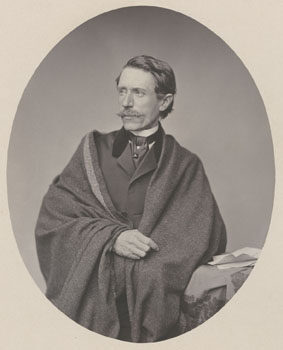
Moritz Wagner
Moritz Wagner was a German naturalist. Born October 3, 1813, in Bayreuth. Died May 30, 1887, in Munich. Educated at University of Erlangen–Nuremberg and LMU Munich.
Facts
23 facts · 1 confirmed by two sources · 9 cited · 12 from one source · 1 where the sources disagree
What’s different
- Died: we show May 30, 1887 (Sources disagree). Wikipedia says May 31, 1887
Where this comes from
Papalocal keeps its own record. It started from these sources; what each one said is kept here as it was copied, so a change on their side never changes this page by itself. Tap one to read its version.
What Wikidata says · copied November 17, 2026 · revision 2569206630
- Described as
- German naturalist (1813-1887)
- Other names
- M.Wagner, Moritz Friedrich Wagner, M Wagner, M. F. Wagner
- Born
- October 3, 1813 · 4 references
- Died
- May 30, 1887 · 1 reference
- Born in
- Bayreuth · 1 reference
- Died in
- Munich · 1 reference
- Buried in
- Alter Nordfriedhof
- Citizen of
- Kingdom of Bavaria
- Occupation
- explorer · 2 references; writer · 1 reference; botanist · 2 references; university teacher · 1 reference; ethnographer; zoologist · 2 references; geographer · 2 references; naturalist · 1 reference
- Worked for
- LMU Munich · 1 reference
- Education
- University of Erlangen–Nuremberg; LMU Munich · 1 reference
- Member of
- Bavarian Academy of Sciences and Humanities · 1 reference; German Academy of Sciences Leopoldina
- Field
- biology · 1 reference; geography · 1 reference
- Father
- Lorenz Heinrich Wagner
- Siblings
- Rudolf Wagner · 1 reference
- Wikipedias with a page
- 24
Wikidata item Q68757 (wikidata.org/wiki/Q68757), public domain (CC0). Copied November 17, 2026.
What Wikipedia says · copied November 17, 2026 · revision 1353083645
Moritz Wagner (Bayreuth, 3 October 1813 – Munich, 31 May 1887) was a German explorer, collector, geographer and natural historian. A contemporary of Charles Darwin, he already accepted that species are not constant in time, but his formative biological work preceded Darwin's 1859 On the Origin of Species. At the end of his university studies, Wagner devoted three years (1836–1839) to the exploration of Algiers: and graduated with a doctorate in philosophy. While his travelogues were popular, he had found his scientific training insufficient, and in the early 1840s studied for another doctorate, in geology.
In May 1843, Wagner toured the Lake Sevan region of Armenia with Armenian writer Khachatur Abovian. From 1852 to 1855, together with Carl Scherzer, Wagner travelled through North and Central America and the Caribbean. During his travels, he made important observations in natural history, which he later supplemented and developed: that geographical isolation could play a key role in speciation. However, his insistence that what later came to be called peripatric and allopatric speciation, not natural selection, was the main driving force in the evolution of species, led to his ideas on geographic isolation being disregarded, unti lrevalidated in the evolutionary synthesis of the mid-20th century. A marginal figure by the 1880s, Wagner committed suicide in Munich, aged 73. His brother Rudolf was a physiologist and anatomist.
- Born, in its opening lines
- October 3, 1813
- Died, in its opening lines
- May 31, 1887
From the Wikipedia article “Moritz Wagner (naturalist)” (en.wikipedia.org/wiki/Moritz_Wagner_(naturalist)), by its contributors, under CC BY-SA 4.0 (creativecommons.org/licenses/by-sa/4.0/). Copied November 17, 2026; not changed.
Confirmed Two sources agree. Cited One source, and it names where it got it. One source One source, without a reference of its own. Sources disagree The sources disagree. We show the best-supported value and keep theirs below.
