
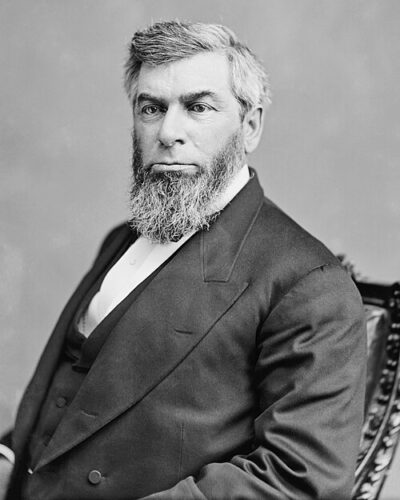
Morrison Waite
Morrison Waite was an American jurist (1816–1888); Chief Justice of the United States Supreme Court from 1874 to 1888. Born November 29, 1816, in Lyme. Died March 23, 1888, in Washington, D.C.. Positions held include Chief Justice of the United States (1874–1888), member of the State Senate of Ohio and Mayor of Maumee. Educated at Yale University and Bacon Academy.
Facts
21 facts · 2 confirmed by two sources · 5 cited · 14 from one source
Where this comes from
Papalocal keeps its own record. It started from these sources; what each one said is kept here as it was copied, so a change on their side never changes this page by itself. Tap one to read its version.
What Wikidata says · copied November 16, 2026 · revision 2533471004
- Described as
- American jurist (1816–1888); Chief Justice of the United States Supreme Court from 1874 to 1888
- Other names
- Morrison R. Waite, Mott Waite, Morrison Remick Waite
- Born
- November 29, 1816 · 4 references
- Died
- March 23, 1888 · 4 references
- Born in
- Lyme · 1 reference
- Died in
- Washington, D.C.
- Buried in
- Woodlawn Cemetery · 1 reference
- Cause of death
- pneumonia
- Citizen of
- United States
- Occupation
- lawyer; judge; politician; jurist · 1 reference
- Positions held
- Chief Justice of the United States (1874–1888); member of the State Senate of Ohio; Mayor of Maumee
- Political party
- Republican Party
- Education
- Yale University; Bacon Academy
- Member of
- Phi Beta Kappa Society
- Children
- Henry Seldon Waite
- Father
- Henry Matson Waite · 1 reference
- Mother
- Maria Waite · 1 reference
- Wikipedias with a page
- 22
Wikidata item Q1349419 (wikidata.org/wiki/Q1349419), public domain (CC0). Copied November 16, 2026.
What Wikipedia says · copied November 16, 2026 · revision 1376321660
Morrison Remick "Mott" Waite (November 29, 1816 – March 23, 1888) was an American attorney, jurist, and politician from Ohio who served as the seventh chief justice of the United States from 1874 until his death in 1888. During his tenure, the Waite Court took a narrow interpretation of federal authority related to laws and amendments that were enacted during the Reconstruction Era to expand the rights of freedmen and protect them from attacks by white supremacist groups such as the Ku Klux Klan.
Born in Lyme, Connecticut, Waite established a legal practice in Toledo, Ohio, after graduating from Yale University. As a member of the Whig Party, Waite won election to the Ohio House of Representatives. An opponent of slavery, he helped establish the Ohio Republican Party. He served as a counsel in the Alabama Claims and presided over the 1873 Ohio constitutional convention.
After the May 1873 death of Chief Justice Salmon P. Chase, President Ulysses S. Grant underwent a prolonged search for Chase's successor. With the backing of Secretary of the Interior Columbus Delano, Grant nominated Waite in January 1874. The nomination of the relatively obscure Waite was poorly received by some prominent politicians, but the Senate unanimously confirmed Waite and he took office in March 1874. Despite some support for his nomination, he declined to run for president in the 1876 election, arguing that the Supreme Court should not serve as a mere stepping stone to higher office. He served on the court until his death of pneumonia in 1888.
Waite did not emerge as an important intellectual force on the Supreme Court, but he was well regarded as an administrator and conciliator. He sought a balance between federal and state power and joined with most other Justices in narrowly interpreting the Reconstruction Amendments. His majority opinion in Munn v. Illinois upheld government regulation of grain elevators and railroads and influenced constitutional understandings of government regulation. He also helped establish the legal concept of corporate personhood in the United States. However in the Civil Rights Cases he sided with a majority to strike down the Civil Rights Act of 1875, which had prohibited discrimination in access to public services, that was not restored until the Civil Rights Act of 1964.
- Born, in its opening lines
- November 29, 1816
- Died, in its opening lines
- March 23, 1888
From the Wikipedia article “Morrison Waite” (en.wikipedia.org/wiki/Morrison_Waite), by its contributors, under CC BY-SA 4.0 (creativecommons.org/licenses/by-sa/4.0/). Copied November 16, 2026; not changed.
Confirmed Two sources agree. Cited One source, and it names where it got it. One source One source, without a reference of its own. Sources disagree The sources disagree. We show the best-supported value and keep theirs below.
