
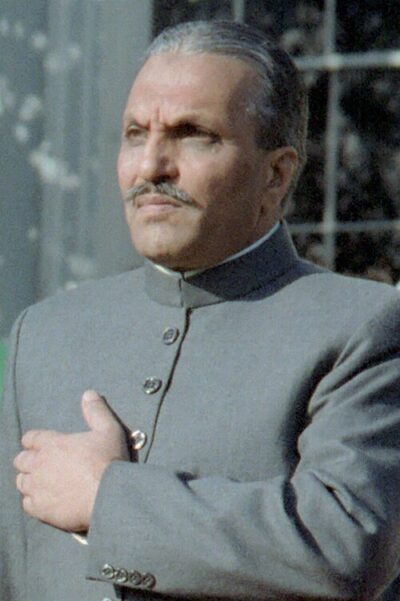
Muhammad Zia-ul-Haq
Muhammad Zia-ul-Haq was a President of Pakistan from 1978 to 1988, of Saudi origin. Born August 12, 1924, in Jalandhar. Died August 17, 1988, in Bahawalpur. Positions held include President of Pakistan (1978–1988), Chief of Army Staff (1976–1988) and Federal Minister for Defence (2 times) (1978–1985). Educated at St. Stephen's College and University of Delhi. Awards include Order of the Rajamitrabhorn, Order of the Yugoslavian Great Star and Grand Cross of the Order of Excellence.
Facts
28 facts · 2 confirmed by two sources · 1 cited · 25 from one source
Where this comes from
Papalocal keeps its own record. It started from these sources; what each one said is kept here as it was copied, so a change on their side never changes this page by itself. Tap one to read its version.
What Wikidata says · copied November 16, 2026 · revision 2568865862
- Described as
- President of Pakistan from 1978 to 1988, of Saudi origin
- Other names
- Muhammad Zia Ul-Haq, Mukhammed Zia-үl-Kha
- Born
- August 12, 1924 · 7 references
- Died
- August 17, 1988 · 6 references
- Born in
- Jalandhar
- Died in
- Bahawalpur
- Buried in
- Faisal Mosque
- Cause of death
- aircraft crash
- Citizen of
- British Raj; Pakistan
- Occupation
- politician · 1 reference; military officer
- Positions held
- President of Pakistan (1978–1988); Chief of Army Staff (1976–1988); Federal Minister for Defence (2 times) (1978–1985) · 1 reference
- Political party
- independent politician · 1 reference
- Education
- St. Stephen's College; University of Delhi; United States Army Command and General Staff College
- Awards
- Order of the Rajamitrabhorn; Order of the Yugoslavian Great Star; Grand Cross of the Order of Excellence · 1 reference; 1939–45 Star · 1 reference; Burma Star · 1 reference; Grand Order of Mugunghwa · 1 reference
- Children
- Muhammad Ijaz-ul-Haq
- Religion
- Sunni Islam
- Military branch
- British Indian Army (1943–1947); Pakistan Army (1947–)
- Military rank
- general
- Wikipedias with a page
- 73
Wikidata item Q200499 (wikidata.org/wiki/Q200499), public domain (CC0). Copied November 16, 2026.
What Wikipedia says · copied November 16, 2026 · revision 1384850022
Muhammad Zia-ul-Haq (12 August 1924 – 17 August 1988) was a Pakistani general who ruled Pakistan from his coup in 1977 until his death in an airplane crash in 1988. He served as the chief martial law administrator from 1977 to 1985, and as the president of Pakistan from 1978 until his death. Zia was also the chief of the army staff of the Pakistan Army from 1976. He remains Pakistan's longest-serving de-facto ruler to date, and his political ideology is known as Ziaism.
Educated at Delhi University, Zia saw action in World War II as a British Indian Army officer in Burma and Malaya, before opting for Pakistan in 1947 and fighting as a tank commander in the Indo-Pakistani War of 1965. In 1970, he led a military training mission to Jordan, proving instrumental to defeating the Black September insurgency against King Hussein. Prime Minister Zulfikar Ali Bhutto appointed Zia Chief of Army Staff in 1976. Following civil disorder after the controversial 1977 general election, Zia deposed Bhutto in a military coup and declared martial law on 5 July 1977. Bhutto was controversially tried by the Supreme Court and executed less than two years later, for authorising the murder of a political opponent.
Assuming the presidency in 1978, Zia played a major role in the Soviet-Afghan War. Backed by the United States and Saudi Arabia, Zia coordinated the Afghan mujahideen against the Soviet occupation throughout the 1980s. This culminated in the Soviet Union's withdrawal in 1989, but also led to the proliferation of millions of refugees, with heroin and weaponry into Pakistan's North-West Frontier Province. Zia also bolstered ties with China and the United States, and emphasised Pakistan's role in the Islamic world, while relations with India worsened amid the Siachen conflict and accusations that Pakistan was aiding the Khalistan movement. Domestically, Zia passed broad-ranging legislation as part of Pakistan's Islamization, curbed civil liberties, and heightened press censorship. He also escalated Pakistan's atomic bomb project, and instituted industrialisation and deregulation, helping Pakistan's economy become the fastest-growing in South Asia. Averaged over Zia's rule, GDP growth was the highest in the country's history.
After lifting martial law and holding non-partisan elections in 1985, Zia appointed Muhammad Khan Junejo Prime Minister but accumulated more presidential powers via the Eighth Amendment to the Constitution. After Junejo signed the Geneva Accords in 1988 against Zia's wishes, and called for an inquiry into the Ojhri Camp disaster, Zia dismissed Junejo's government and announced fresh elections in November 1988. He was killed along with several of his top military officials and two American diplomats in a mysterious plane crash near Bahawalpur on 17 August 1988.
Zia remains a polarising figure in Pakistan's history, credited for preventing wider Soviet incursions into the region and introducing an era of economic prosperity, but decried for weakening democratic institutions and passing laws encouraging religious intolerance. He is also cited for promoting the early political career of Nawaz Sharif, who would be elected Prime Minister three times.
- Born, in its opening lines
- August 12, 1924
- Died, in its opening lines
- August 17, 1988
From the Wikipedia article “Zia-ul-Haq” (en.wikipedia.org/wiki/Zia-ul-Haq), by its contributors, under CC BY-SA 4.0 (creativecommons.org/licenses/by-sa/4.0/). Copied November 16, 2026; not changed.
Confirmed Two sources agree. Cited One source, and it names where it got it. One source One source, without a reference of its own. Sources disagree The sources disagree. We show the best-supported value and keep theirs below.
