
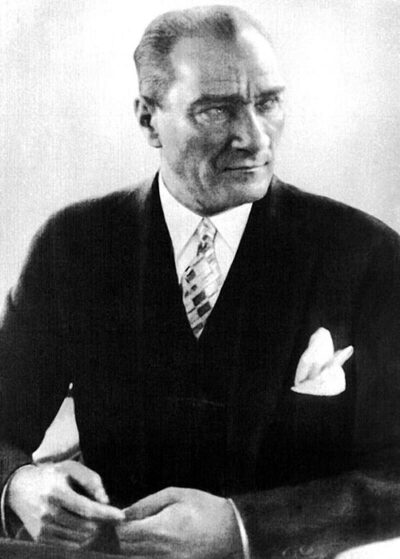
Mustafa Kemal Atatürk
Mustafa Kemal Atatürk was a founding father of the Republic of Turkey (c. 1881–1938). Born 1881, in Thessaloniki. Died November 10, 1938, in Dolmabahçe Palace. Positions held include President of Turkey (1923–1938), member of the Grand National Assembly of Turkey and Chairman of the Cabinet of the Executive Ministers of Turkey (1920–1921). Educated at Turkish Military Academy and Monastir Military High School. Awards include Order of Saint Alexander, Medal of Independence and Liakat Medal.
Facts
62 facts · 2 confirmed by two sources · 14 cited · 46 from one source
Where this comes from
Papalocal keeps its own record. It started from these sources; what each one said is kept here as it was copied, so a change on their side never changes this page by itself. Tap one to read its version.
What Wikidata says · copied November 16, 2026 · revision 2569089775
- Described as
- founding father of the Republic of Turkey (c. 1881–1938)
- Other names
- Gazi Mustafa Kemal, Mustafa Kemal Paşa, Ghazi Moustapha Kemal Pasha, Kamâl Atatürk, Mustafa K. Atatürk, Attaturk, Gazi Mustafa Kemal Pasha, M. Kemal Ataturk, Gazi Mustafa Kemal Atatürk, Ali Rıza oğlu Mustafa, K. Atatürk, MKA
- Born
- 1881 · 4 references
- Died
- November 10, 1938 · 7 references
- Born in
- Thessaloniki · 4 references
- Died in
- Dolmabahçe Palace · 1 reference
- Buried in
- Anıtkabir · 1 reference
- Cause of death
- liver cirrhosis
- Name at birth
- Ali Rıza oğlu Mustafa
- Citizen of
- Turkey (1922–); Ottoman Empire (–1922)
- Occupation
- politician · 2 references; statesperson; writer; revolutionary; army officer; military officer · 1 reference
- Positions held
- President of Turkey (1923–1938); member of the Grand National Assembly of Turkey; Chairman of the Cabinet of the Executive Ministers of Turkey (1920–1921) · 1 reference; Prime Minister of Turkey (1920–1921); president · 1 reference
- Political party
- Republican People's Party (1923–1938); Committee of Union and Progress (1907–1918); Ottoman Liberal People's Party (1918–1919)
- Education
- Turkish Military Academy (1899–1902); Monastir Military High School (1896–1898); Ottoman Military College (–1905); Şemsi Efendi School
- Member of
- Homeland and Liberty (1906–1907); Association for Defense of National Rights (1919–1923)
- Awards
- Order of Saint Alexander; Medal of Independence (1923); Liakat Medal (1915); Gallipoli Star (1918); Imtiyaz Medal (1915); Iron Cross (1915); Military Merit Cross III. Class (1916); Bronze Military Merit Medal (1916); Silver Military Merit Medal (1917); 1st Class Order of the Crown (1918); 1st class, Order of the Medjidie (1917) · 1 reference; 2nd class, Order of the Medjidie (1916) · 1 reference; 5th class, Order of the Medjidie (1906) · 1 reference; Order of Osmanieh 2nd Class (1916); Order of Osmanieh 3rd Class (1915)
- Spouse
- Latife Uşşakî (1923–1925) · 1 reference
- Children
- Sabiha Gökçen; Ülkü Adatepe; Abdurrahim Tuncak; Afet İnan; Zehra Aylin; Rukiye Erkin; Nebile İrdelp; Mustafa Demir
- Father
- Ali Rıza Efendi
- Mother
- Zübeyde Hanım · 1 reference
- Siblings
- Makbule Atadan · 1 reference
- Military branch
- Turkish Land Forces
- Military rank
- mareşal (1921–1927) · 1 reference; general · 1 reference
- Lived in
- Thessaloniki; Şahinbey district · 1 reference
- Height
- 1.74 m (5 ft 9 in) · 1 reference
- Wikipedias with a page
- 253
Wikidata item Q5152 (wikidata.org/wiki/Q5152), public domain (CC0). Copied November 16, 2026.
What Wikipedia says · copied November 16, 2026 · revision 1385440121
Mustafa Kemal Atatürk (c. 1881 – 10 November 1938) was a Turkish field marshal and revolutionary statesman who was the founder of the Republic of Turkey and served as its first president from 1923 until his death in 1938. He led sweeping reforms, turning Turkey into an industrialising nation. Ideologically a republican, secularist, and nationalist, his policies and socio-political theories became known as Kemalism. Atatürk's personality cult and the Kemalist historiography developed around it have had significant and ongoing influences on Turkey's political culture and historical narrative.
Born in Salonica in the Ottoman Empire, Atatürk was early on persecuted for agitating against Sultan Abdul Hamid II's autocracy, joining opposition movements like the Committee of Union and Progress and the Young Turks. He participated in the Young Turk Revolution and the 31 March Incident. His early military career saw him involved in the Italo-Turkish and Balkan Wars. He rose to prominence with his role in the Defence of Gallipoli during World War I. Following his country's defeat after the war, in the Turkish War of Independence he directed the Turkish National Movement in a nationalist resistance against Turkey's partition among the victorious Allied powers. Establishing the provisional "Ankara government", he achieved a Turkish victory against Greece, Armenia, France, and the United Kingdom, confirmed in the Treaty of Lausanne. During and after the war, the ethnic cleansing of Armenians and Greeks from Anatolia outside of Istanbul, including the Kars region invaded by the Kemalist armies, was largely completed via large-scale massacres, flight, expulsions, and the population exchange between Greece and Turkey. His government subsequently proceeded to abolish the Ottoman sultanate in 1922 and proclaimed the Republic of Turkey in 1923.
As the president of the newly formed Turkish Republic, Atatürk introduced far reaching reforms to build a republican and secular nation-state with a modern, Western facing society. By the mid-1920s, opponents to Atatürk's rule were suppressed as a one-party regime was cemented around him. This included abolishing the Ottoman Caliphate and curtailing religion as part of a larger secularist campaign. The semi-secular Mecelle was replaced by a fully secular civil code. Western cultural mores were encouraged: such as the banning of the fez and certain men's clothing. State-owned enterprises were established, foreign industrial assets were nationalised, and the first five-year plan was implemented. He opened thousands of schools and introduced the Latin-based Turkish alphabet. Turkish women received equal civil and political rights during his presidency. His government carried out a policy of Turkification, trying to create a homogeneous, unified, and above all secular nation under the Turkish banner. Atatürk attempted rapprochement with Iran, Yugoslavia, Iraq, Romania, and Greece, as well as the creation of the Balkan Pact that resisted the expansionist aggressions of Italy and Bulgaria during the interwar period of the 1930s. He died on 10 November 1938 at Dolmabahçe Palace in Istanbul, at the age of 57; he was succeeded as president by his long-time prime minister İsmet İnönü.
Atatürk has been praised for his military accomplishments, nation-building efforts, social and economic reforms, and diplomatic successes, serving as an inspiration to anti-colonial and anti-imperialist movements. He has been condemned for instituting a dictatorship, introducing assimilationist policies that targeted minorities like the Kurds, and continuing a persecution of Christian minorities started by the CUP, while conservative Muslims have criticised his secular agenda. The Turkish Parliament granted him the surname Atatürk in 1934, meaning "Father of the Turks" or "Turk like his ancestors", in recognition of the role he played in building the Turkish Republic.
- Born, in its opening lines
- c. 1881
- Died, in its opening lines
- November 10, 1938
From the Wikipedia article “Mustafa Kemal Atatürk” (en.wikipedia.org/wiki/Mustafa_Kemal_Atatürk), by its contributors, under CC BY-SA 4.0 (creativecommons.org/licenses/by-sa/4.0/). Copied November 16, 2026; not changed.
Confirmed Two sources agree. Cited One source, and it names where it got it. One source One source, without a reference of its own. Sources disagree The sources disagree. We show the best-supported value and keep theirs below.
