
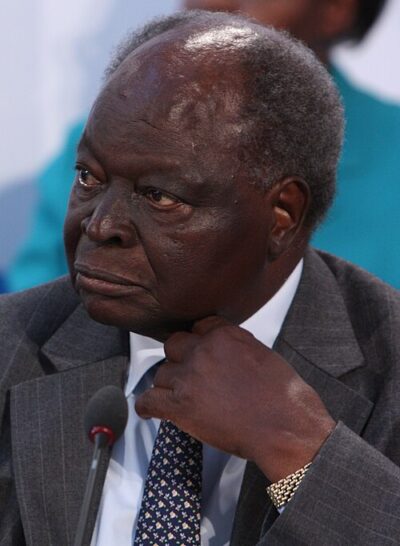
Mwai Kibaki
Mwai Kibaki was the 3rd President of Kenya. Born November 15, 1931, in Gatuyaini. Died April 21, 2022, in Nairobi. Positions held include President of Kenya (2002–2013), Member of the National Assembly (1963–2013) and Vice-President of Kenya (1978–1988). Educated at Makerere University and London School of Economics and Political Science.
Facts
24 facts · 2 confirmed by two sources · 4 cited · 18 from one source
Where this comes from
Papalocal keeps its own record. It started from these sources; what each one said is kept here as it was copied, so a change on their side never changes this page by itself. Tap one to read its version.
What Wikidata says · copied November 16, 2026 · revision 2563107750
- Described as
- 3rd President of Kenya (1931–2022)
- Other names
- Mwai Emilio Stanley, Emilio Stanley Mwai Kibaki
- Born
- November 15, 1931 · 6 references
- Died
- April 21, 2022 · 2 references
- Born in
- Gatuyaini · 2 references
- Died in
- Nairobi
- Buried in
- Munyange
- Name at birth
- Emilio Stanley Mwai Kibaki
- Citizen of
- Kenya · 1 reference
- Occupation
- economist; politician · 1 reference; minister · 1 reference
- Positions held
- President of Kenya (2002–2013); Member of the National Assembly (1963–2013); Vice-President of Kenya (1978–1988); Minister for Finance of Kenya (1969–1982); Minister of Health of Kenya (1988–1991) · 1 reference; Minister of Home Affairs (1982–1988) · 1 reference; presidential candidate (2002–) · 1 reference
- Political party
- Party of National Unity
- Education
- Makerere University; London School of Economics and Political Science; Nyeri High School; Mang'u High School
- Spouse
- Lucy Kibaki (1961–2016) · 1 reference
- Religion
- Catholic Church
- Wikipedias with a page
- 65
Wikidata item Q57291 (wikidata.org/wiki/Q57291), public domain (CC0). Copied November 16, 2026.
What Wikipedia says · copied November 16, 2026 · revision 1383925379
Emilio Stanley Mwai Kibaki (15 November 1931 – 21 April 2022) was a Kenyan politician who served as the third President of Kenya from December 2002 until April 2013. He served in various leadership positions in Kenya's government including being the longest serving Member of Parliament (MP) in Kenya from 1963 to 2013. He was the fourth Vice-President of Kenya for ten years from 1978 to 1988 under President Daniel arap Moi. He also held cabinet positions in the governments of Jomo Kenyatta and Daniel arap Moi, serving as Minister for Finance (1969–1981) under Kenyatta, Minister for Home Affairs (1982–1988) and Minister for Health (1988–1991) under Moi.
Kibaki served as an opposition Member of Parliament from 1992 to 2002. He unsuccessfully ran for the presidency in 1992 and 1997. He served as the Leader of the Official Opposition in Parliament from 1998 to 2002. Following the 2002 presidential election, he was elected as the President of Kenya.
As president of Kenya, Kibaki presided over a period of significant economic growth, infrastructural development, and institutional reforms. His administration introduced free primary education in 2003, expanded access to schooling for numerous Kenyan children. Under his leadership, Kenya experienced improvements in road networks, telecommunications, and public service delivery, while the country also adopted a new constitution in 2010 that introduced far reaching political and governance reforms. However, his presidency was also marked by the disputed 2007 presidential election and the post election violence that followed, resulting in the deaths and displacement of thousands of people. Despite these challenges, Kibaki is widely regarded as one of Kenya's most influential leaders due to his contributions to economic recovery, constitutional transformation, and national development.
- Born, in its opening lines
- November 15, 1931
- Died, in its opening lines
- April 21, 2022
From the Wikipedia article “Mwai Kibaki” (en.wikipedia.org/wiki/Mwai_Kibaki), by its contributors, under CC BY-SA 4.0 (creativecommons.org/licenses/by-sa/4.0/). Copied November 16, 2026; not changed.
Confirmed Two sources agree. Cited One source, and it names where it got it. One source One source, without a reference of its own. Sources disagree The sources disagree. We show the best-supported value and keep theirs below.
