
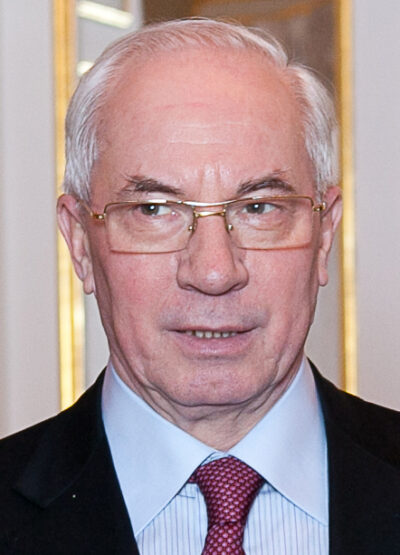
Mykola Azarov
Mykola Azarov is an Ukrainian politician. Born December 17, 1947, in Kaluga. Positions held include Prime Minister of Ukraine (2 times) (2004–2014), Minister of Finance of Ukraine (2002–2007) and People's Deputy of Ukraine (3 times) (1994–2012). Educated at Moscow State University Faculty of Geology. Awards include Order of Honour, Lenin Komsomol Prize and Order of Friendship.
Facts
32 facts · 1 confirmed by two sources · 6 cited · 25 from one source
Where this comes from
Papalocal keeps its own record. It started from these sources; what each one said is kept here as it was copied, so a change on their side never changes this page by itself. Tap one to read its version.
What Wikidata says · copied November 16, 2026 · revision 2569175144
- Described as
- Ukrainian politician (born 1947)
- Other names
- Mykola Yanovych Azarov, Mykola Janovyč Azarov
- Born
- December 17, 1947 · 2 references
- Born in
- Kaluga · 1 reference
- Citizen of
- Soviet Union; Ukraine
- Occupation
- politician · 1 reference; statesperson; university teacher; economist; engineer; geologist · 2 references
- Positions held
- Prime Minister of Ukraine (2 times) (2004–2014); Minister of Finance of Ukraine (2002–2007); People's Deputy of Ukraine (3 times) (1994–2012) · 1 reference
- Political party
- Party of Regions; Communist Party of the Soviet Union
- Worked for
- Donetsk National Technical University
- Education
- Moscow State University Faculty of Geology (–1971)
- Member of
- National Academy of Sciences of Ukraine; 6th Verkhovna Rada; 5th Verkhovna Rada; 4th Verkhovna Rada
- Awards
- Order of Honour (2012); Lenin Komsomol Prize (1979); Order of Friendship (2007); Order of Rio Branco · 1 reference; Order of the Lithuanian Grand Duke Gediminas · 1 reference; Honorary Diploma of the Cabinet of Ministers of Ukraine (2003) · 1 reference
- Field
- politics · 1 reference; geology · 1 reference
- Children
- Olexii Azarov
- Father
- Yan Pakhlo
- Mother
- Ekaterina Azarova
- Wikipedias with a page
- 60
Wikidata item Q57590 (wikidata.org/wiki/Q57590), public domain (CC0). Copied November 16, 2026.
What Wikipedia says · copied November 16, 2026 · revision 1379448539
Mykola Yanovych Azarov (né Pakhlo, Cyrillic: Пахло; born 17 December 1947) is a Russo-Ukrainian politician who was the Prime Minister of Ukraine from 11 March 2010 to 27 January 2014. He was the First Vice Prime Minister and Finance Minister from 2002 to 2005 and again from 2006 to 2007. Azarov also served ex officio as an acting prime minister in the First Yanukovych Government when Viktor Yanukovych ran for president at first and then upon the resignation of his government.
Following the victory of Viktor Yanukovych in the 2010 presidential election, Azarov succeeded Yanukovych as leader of the Party of Regions and was appointed as prime minister in March 2010. In January 2014, after weeks of Euromaidan protests and the 2014 Hrushevskoho Street riots, Azarov offered his letter of resignation. After the Revolution of Dignity, Azarov fled to Russia and according to Azarov himself, was allegedly offered "political refugee status on the personal instructions of Vladimir Putin". Since then he has been reportedly living in the vicinity of the Russian village of Petrovo-Dalneye, near Moscow.
Since July 2014, Azarov has been on the international wanted list for alleged abuse of power. On 19 January 2015 Kyiv District Court of Pechersk Raion issued an arrest warrant as a preventive measure to allow for the extradition of Azarov from the Russian Federation. Azarov is currently the subject of international sanctions from the U.S., European Union, Norway, Canada, and Switzerland due to his role in the Euromaidan. In 2015, he set up the Ukraine Salvation Committee, a government in exile that was widely seen as a pro-Russian puppet.
- Born, in its opening lines
- December 17, 1947
From the Wikipedia article “Mykola Azarov” (en.wikipedia.org/wiki/Mykola_Azarov), by its contributors, under CC BY-SA 4.0 (creativecommons.org/licenses/by-sa/4.0/). Copied November 16, 2026; not changed.
Confirmed Two sources agree. Cited One source, and it names where it got it. One source One source, without a reference of its own. Sources disagree The sources disagree. We show the best-supported value and keep theirs below.
