
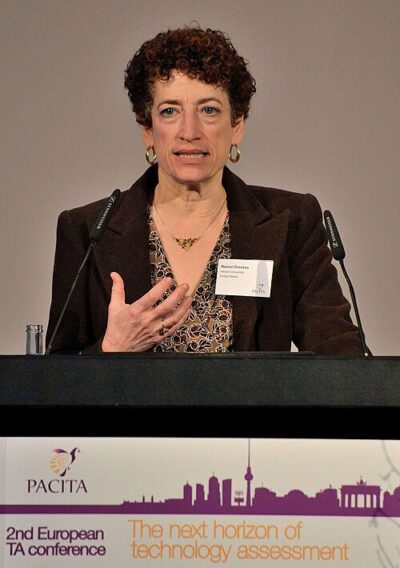
Naomi Oreskes
Naomi Oreskes is an American historian, scientist, academic. Born November 25, 1958, in New York City. Known for Merchants of Doubt, Naomi Oreskes: Why we should trust scientists and The Michael Shermer Show - 173. Naomi Oreskes — Why Trust Science?. Educated at Stanford University and Imperial College London. Awards include Watson, Helen, Miles, and Audrey Davis Prize, Margaret W. Rossiter History of Women in Science Prize and Waldemar Lindgren Award.
Facts
44 facts · 1 confirmed by two sources · 20 cited · 23 from one source
Where this comes from
Papalocal keeps its own record. It started from these sources; what each one said is kept here as it was copied, so a change on their side never changes this page by itself. Tap one to read its version.
What Wikidata says · copied November 16, 2026 · revision 2567305594
- Described as
- American historian, scientist, academic
- Other names
- N. Oreskes, Oreskes, N., Oreskes, Naomi
- Born
- November 25, 1958 · 1 reference
- Born in
- New York City
- Citizen of
- United States
- Occupation
- historian of science; university teacher; geophysicist; earth scientist · 2 references; historian · 1 reference
- Worked for
- Harvard University (2013–) · 2 references; New York University (1996–1998); University of California, San Diego (1998–2013); Dartmouth College (1990–1996)
- Education
- Stanford University (–1990); Imperial College London (–1981); Stuyvesant High School
- Member of
- American Academy of Arts and Sciences (2017–) · 1 reference
- Known for
- Merchants of Doubt; Naomi Oreskes: Why we should trust scientists; The Michael Shermer Show - 173. Naomi Oreskes — Why Trust Science?
- Awards
- Watson, Helen, Miles, and Audrey Davis Prize (2011); Margaret W. Rossiter History of Women in Science Prize (2000) · 1 reference; Waldemar Lindgren Award (1993) · 1 reference; Guggenheim Fellowship (2018) · 1 reference; Stephen H. Schneider Award (2016) · 1 reference; Francis Bacon Award (2010); Fellow of the Committee for Skeptical Inquiry (2015) · 1 reference; Mary C. Rabbitt History And Philosophy of Geology Award (2019) · 1 reference; honorary doctor of ETH Zürich (2018) · 1 reference; Ambassador Award (2016) · 1 reference; honorary doctor of the Université libre de Bruxelles (2023) · 1 reference; Fellow of the American Association for the Advancement of Science (2007) · 1 reference; Volvo Environment Prize (2025) · 1 reference; honorary doctorate (2015) · 1 reference; honorary doctorate of Roskilde University (2016) · 1 reference
- Field
- history of science · 1 reference; geophysics · 1 reference; geology · 1 reference; historiography · 1 reference
- Father
- Irwin Oreskes
- Mother
- Susan Oreskes
- Siblings
- Michael Oreskes; Daniel Oreskes
- Lived in
- United States · 1 reference
- Website
- https://histsci.fas.harvard.edu/people/naomi-oreskes
- Wikipedias with a page
- 22
Wikidata item Q205618 (wikidata.org/wiki/Q205618), public domain (CC0). Copied November 16, 2026.
What Wikipedia says · copied November 16, 2026 · revision 1378501326
Naomi Oreskes (; born November 25, 1958) is an American historian of science.
After 15 years as Professor of History and Science Studies at the University of California, San Diego, she became professor of the history of science and affiliated professor of earth and planetary sciences at Harvard University in 2013, and in 2020 was also named the Henry Charles Lea Professor of the History of Science.
She has worked on studies of geophysics, environmental issues such as global warming, and the history of science. In 2010, Oreskes co-authored Merchants of Doubt, which identified significant parallels between the climate change debate and earlier public controversies, notably the tobacco industry's campaign to obscure the link between smoking and serious disease.
- Born, in its opening lines
- November 25, 1958
From the Wikipedia article “Naomi Oreskes” (en.wikipedia.org/wiki/Naomi_Oreskes), by its contributors, under CC BY-SA 4.0 (creativecommons.org/licenses/by-sa/4.0/). Copied November 16, 2026; not changed.
Confirmed Two sources agree. Cited One source, and it names where it got it. One source One source, without a reference of its own. Sources disagree The sources disagree. We show the best-supported value and keep theirs below.
