
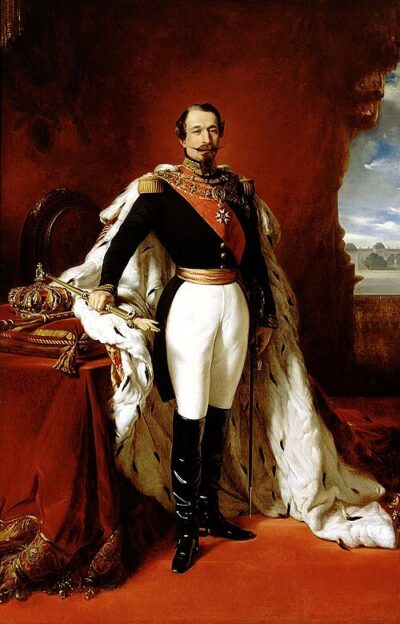
Napoleon III
Napoleon III was a President of the Second French Republic, Emperor of the Second French Empire and last monarch of France. Born April 20, 1808, in Paris. Died January 9, 1873, in Chislehurst. Positions held include President of the French Republic (1848–1852), Emperor of the French (1852–1870) and Member of the 1848 Constituent Assembly (1848–1849). Educated at Waffenplatz Thun. Awards include Grand Cross of the Legion of Honour, Knight of the Order of the Golden Fleece and Knight of the Order of St. Alexander Nevsky.
Facts
43 facts · 2 confirmed by two sources · 9 cited · 32 from one source
Where this comes from
Papalocal keeps its own record. It started from these sources; what each one said is kept here as it was copied, so a change on their side never changes this page by itself. Tap one to read its version.
What Wikidata says · copied November 16, 2026 · revision 2564208475
- Described as
- President of the Second French Republic, Emperor of the Second French Empire and last monarch of France (1808–1873)
- Other names
- Louis-Napoléon Bonaparte, Charles-Louis-Napoléan, Emperor of the French Bonaparte, Louis-Napoléan, Emperor of the French Bonaparte, Louis-Napoleon Bonaparte, Louis Napoleon, Napoléon III
- Born
- April 20, 1808 · 13 references
- Died
- January 9, 1873 · 13 references
- Born in
- Paris · 4 references
- Died in
- Chislehurst · 1 reference
- Buried in
- Sarcophagus of Emperor Napoleon III
- Cause of death
- sepsis
- Name at birth
- Charles Louis Napoléon Bonaparte
- Citizen of
- France · 1 reference
- Occupation
- politician; writer · 1 reference; draftsperson · 1 reference; illustrator · 1 reference
- Positions held
- President of the French Republic (1848–1852); Emperor of the French (1852–1870); Member of the 1848 Constituent Assembly (1848–1849) · 1 reference; head of government of France (1851–1870); Grand Master of the Legion of Honour; French co-prince of Andorra (1848–1870)
- Education
- Waffenplatz Thun · 1 reference
- Awards
- Grand Cross of the Legion of Honour; Knight of the Order of the Golden Fleece; Knight of the Order of St. Alexander Nevsky; Order of Saint Anna, 1st class; Order of the White Eagle; Order of St. Andrew; Knight Grand Cross of the Military Order of William (1855); Albert Medal (1865) · 1 reference; Order of the Red Eagle 1st Class; Knight Grand Cross of the Order of Saint Joseph; Order of the Redeemer · 1 reference; Order of Saint Stephen of Hungary · 1 reference; Knight of the Order of the Elephant (1855)
- Spouse
- Eugénie de Montijo (1853–1873) · 1 reference
- Children
- Napoléon, Prince Imperial; Eugène Bure; Alexandre Bure
- Father
- Louis Bonaparte
- Mother
- Hortense de Beauharnais
- Siblings
- Napoleon Louis Bonaparte; Napoleon Charles Bonaparte; Charles de Morny, Duke of Morny
- Religion
- Catholic Church
- Military rank
- army general
- Wikipedias with a page
- 128
Wikidata item Q7721 (wikidata.org/wiki/Q7721), public domain (CC0). Copied November 16, 2026.
What Wikipedia says · copied November 16, 2026 · revision 1385042970
Napoleon III (born Charles-Louis Napoléon Bonaparte; 20 April 1808 – 9 January 1873) was the first president of France from 1848 to 1852 and then Emperor of the French from 1852 until his deposition in 1870. He was the first elected president, second emperor, and the last monarch of France. He established the Second French Empire in 1852, which began a period of rapid industrialization and expansion of infrastructure in France and saw the rise of French influence in geopolitics after several decades of instability. As head of state of France for 22 years, he was the longest-reigning French head of state since the end of the Ancien régime.
Napoleon III was born at the height of the First French Empire in the Tuileries Palace in Paris, the son of Louis Bonaparte, King of Holland (r. 1806–1810), and Hortense de Beauharnais. He was the paternal nephew of the reigning Emperor Napoleon I. As a young man, he led two failed coups against the July Monarchy, for which he was imprisoned in 1840. In 1848, after the overthrow of the July Monarchy in the February Revolution, he was elected president of the French Second Republic. He seized power by force in 1851 when he could not constitutionally be re-elected. He later proclaimed himself Emperor of the French and founded the Second Empire, reigning until the defeat of the French Army and his capture by Prussia and its allies at the Battle of Sedan in 1870.
Napoleon III commissioned a grand reconstruction of Paris carried out by the prefect of the Seine, Georges-Eugène Haussmann. He expanded and consolidated the railway system throughout the nation and modernized the banking system in France. Napoleon promoted the building of the Suez Canal in Egypt and established modern agriculture, which ended famines in France and made the country an agricultural exporter. He negotiated the 1860 Cobden–Chevalier Treaty with Britain and similar agreements with France's other European trading partners. Social reforms were enacted giving workers the right to organize and the right to strike, and women the right to be admitted to universities.
In foreign policy, Napoleon III aimed to reassert French influence in Europe and elsewhere. In Europe, he allied the French with Britain and defeated Russia in the Crimean War (1853–1856). His regime assisted Italian unification by defeating the Austrian Empire in the Second Italian War of Independence and later annexed Savoy and Nice through the Treaty of Turin as its deferred reward. At the same time, his forces defended the Papal States against annexation by Italy. He was also favourable towards the 1859 union of the Danubian Principalities, which resulted in the establishment of the United Principalities of Moldavia and Wallachia. Napoleon III doubled the area of the French colonial empire with acquisitions in Asia, Africa, and the Pacific. On the other hand, the intervention in Mexico, which aimed to create a Second Mexican Empire under French protection, ended up in total failure.
From 1866, Napoleon III had to face the aggressive mounting power of Prussia as its minister president Otto von Bismarck sought German unification (later serving as its first chancellor) under Prussian leadership. In July 1870, Napoleon III reluctantly declared war on Prussia after pressure from the general public. The French Army was rapidly defeated, and Napoleon III was captured at Sedan. He was swiftly dethroned and the French Third Republic was proclaimed in Paris. After he was released from German custody, he went into exile in the United Kingdom, where he died in 1873.
- Born, in its opening lines
- April 20, 1808
- Died, in its opening lines
- January 9, 1873
From the Wikipedia article “Napoleon III” (en.wikipedia.org/wiki/Napoleon_III), by its contributors, under CC BY-SA 4.0 (creativecommons.org/licenses/by-sa/4.0/). Copied November 16, 2026; not changed.
Confirmed Two sources agree. Cited One source, and it names where it got it. One source One source, without a reference of its own. Sources disagree The sources disagree. We show the best-supported value and keep theirs below.
