
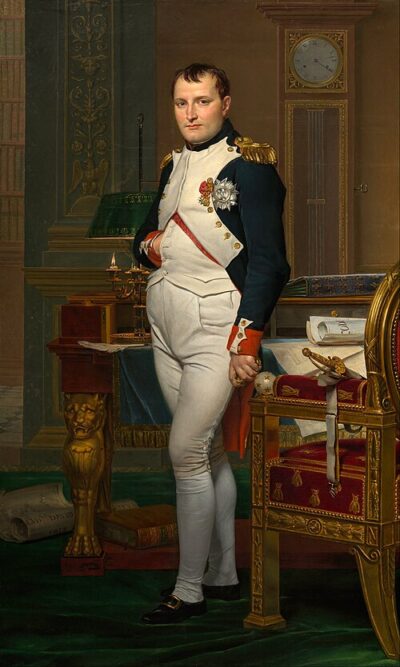
Napoleon
Napoleon was a French military leader, French Emperor 1804–1814 and again in 1815. Born August 15, 1769, in Ajaccio. Died May 5, 1821, in Longwood House. Positions held include Emperor of the French (1804–1815), French co-prince of Andorra (2 times) (1806–1815) and First Consul (1799–1804). Educated at École Militaire. Awards include Knight of the Order of the Elephant, Order of the White Eagle and Knight of the Order of the Golden Fleece.
Facts
66 facts · 2 confirmed by two sources · 21 cited · 42 from one source · 1 where the sources disagree
What’s different
- Name at birth: we show Napulione Buonaparte (Sources disagree). Wikidata also lists Napoleone di Buonaparte
Where this comes from
Papalocal keeps its own record. It started from these sources; what each one said is kept here as it was copied, so a change on their side never changes this page by itself. Tap one to read its version.
What Wikidata says · copied November 16, 2026 · revision 2567767072
- Described as
- French military leader, French Emperor 1804–1814 and again in 1815 (1769–1821)
- Other names
- Napulione di Buonaparte, The Little Corporal, Napoleon Buonaparte, Napoleon I of France, the Corsican Napolean, Empereur des Français Napoléon I, Napulione Buonaparte, Little Corporal, Napoleone Bonaparte, Emperador dels Francesos Napoleó I, Napoleone I, Napoleone Buonaparte
- Born
- August 15, 1769 · 10 references
- Died
- May 5, 1821 · 12 references
- Born in
- Ajaccio · 7 references
- Died in
- Longwood House · 1 reference
- Buried in
- Cathédrale Saint-Louis-des-Invalides (1840–); Valley of the Tomb (–1840)
- Cause of death
- stomach cancer
- Name at birth
- Napulione Buonaparte; Napoleone di Buonaparte
- Citizen of
- France · 4 references
- Occupation
- politician · 5 references; art collector · 1 reference; emperor · 1 reference; sovereign · 2 references; militant · 1 reference; military leader · 1 reference; army officer
- Positions held
- Emperor of the French (1804–1815); French co-prince of Andorra (2 times) (1806–1815); First Consul (1799–1804); Monarch of Italy (1805–1814); head of state of France; president of the French Academy of Sciences (1800)
- Education
- École Militaire (1784–)
- Member of
- French Academy of Sciences; Napoleon I of France and Josephine
- Awards
- Knight of the Order of the Elephant (1808) · 1 reference; Order of the White Eagle; Knight of the Order of the Golden Fleece; Order of Saint Anna, 1st class; Order of St. Andrew; Grand Master of the Legion of Honour; Knight Grand Cross of the Order of Saint Joseph; Order of Saint Stephen of Hungary · 1 reference; Order of Saint Hubert (1805); Order of the Black Eagle (1805); Knight Grand Cordon of the Order of Christ (1810) · 1 reference; Grand Cross of the Legion of Honour · 1 reference; Order of the Reunion · 1 reference; French Order of Academic Palms · 1 reference; Royal Order of the Two-Sicilies · 1 reference
- Spouse
- Joséphine de Beauharnais (1796–1809) · 3 references; Marie Louise, Duchess of Parma (1810–1821) · 2 references
- Children
- Napoleon II · 1 reference; Charles Léon; Alexandre Colonna-Walewski · 2 references; Eugen Megerle von Mühlfeld; Jules Barthélemy-Saint-Hilaire
- Father
- Carlo Bonaparte · 2 references
- Mother
- Maria-Letizia Bonaparte · 1 reference
- Siblings
- Elisa Bonaparte; Louis Bonaparte; Caroline Bonaparte · 1 reference; Pauline Bonaparte; Joseph Bonaparte · 1 reference; Lucien Bonaparte · 1 reference; Jérôme Bonaparte · 1 reference; unnamed daughter Bonaparte
- Religion
- Catholicism; deism
- Military rank
- brigadier general; divisional general · 1 reference
- Lived in
- Saint Helena (1815–1821); Ajaccio (1769–1779); Paris (1792–1814); Elba (1814–1815)
- Height
- 1.68 m (5 ft 6 in)
- Wikipedias with a page
- 288
Wikidata item Q517 (wikidata.org/wiki/Q517), public domain (CC0). Copied November 16, 2026.
What Wikipedia says · copied November 16, 2026 · revision 1385249981
Napoleon Bonaparte (born Napoleone di Buonaparte; 15 August 1769 – 5 May 1821) was Emperor of the French from 18 May 1804 until his first abdication in 1814, with a brief restoration during the Hundred Days in 1815. He rose to prominence as a general during the French Revolution and led a series of military campaigns across Europe and the Middle East during the French Revolutionary and Napoleonic Wars. As a statesman, he implemented numerous legal and administrative reforms in France and Europe.
Born on the island of Corsica to a family of Italian origin, Napoleon moved to mainland France in 1779 and was commissioned as an officer in the French Royal Army in 1785. He supported the French Revolution in 1789 and promoted its cause in Corsica. He rose rapidly through the ranks after winning the siege of Toulon in 1793 and defeating royalist insurgents in Paris on 13 Vendémiaire in 1795. In 1796 he commanded a military campaign against the Austrians and their Italian allies in the War of the First Coalition, scoring decisive victories and becoming a national hero. He led an invasion of Egypt and Syria in 1798, which served as a springboard for his rise to political power. In November 1799 Napoleon engineered the Coup of 18 Brumaire against the French Directory and became First Consul of the Republic. He won the Battle of Marengo in 1800, which secured France's victory in the War of the Second Coalition, and in 1803 he sold the territory of Louisiana to the United States. In December 1804 Napoleon crowned himself Emperor of the French, further consolidating his power.
The breakdown of the Treaty of Amiens led to the War of the Third Coalition by 1805. Napoleon shattered the coalition with a decisive victory at the Battle of Austerlitz, which led to the dissolution of the Holy Roman Empire. In the War of the Fourth Coalition, Napoleon defeated Prussia at the Battle of Jena–Auerstedt in 1806, marched his Grande Armée into Eastern Europe, and defeated the Russians in 1807 at the Battle of Friedland. Seeking to extend his trade embargo against Britain, Napoleon invaded the Iberian Peninsula and installed his brother Joseph as King of Spain in 1808, provoking the Peninsular War. In 1809 the Austrians again challenged France in the War of the Fifth Coalition, during which Napoleon consolidated his dominance over Europe after winning the Battle of Wagram. In the summer of 1812 he launched an invasion of Russia. After forcing the Russians to abandon Moscow following the Battle of Borodino, Napoleon briefly occupied the city before conducting a catastrophic retreat of his army that winter. In 1813 Prussia and Austria joined Russia in the War of the Sixth Coalition, in which Napoleon was decisively defeated at the Battle of Leipzig. The coalition invaded France and captured Paris, forcing Napoleon to abdicate in April 1814. He was exiled to the Mediterranean island of Elba and the Bourbons were restored to power. Ten months later Napoleon escaped from Elba with around a thousand men and marched on Paris, reclaiming control of the country. His opponents responded by forming a Seventh Coalition, which defeated him at the Battle of Waterloo in June 1815. Napoleon was exiled to the remote island of Saint Helena in the South Atlantic, where he died of stomach cancer in 1821, aged 51.
Since his death, Napoleon has maintained a prominent place in historical research and popular culture. He is considered one of the greatest military commanders in history, and Napoleonic tactics are still studied at military schools worldwide. His legacy endures through the legal and administrative reforms he enacted in France and Western Europe, most notably the Napoleonic Code. He established a system of public education, abolished the vestiges of feudalism, emancipated Jews and other religious minorities, abolished the Spanish Inquisition, enacted the principle of equality before the law for an emerging middle class, and centralized state power at the expense of religious authorities. His conquests also acted as a catalyst for political change and the development of nation-states. However, he remains controversial because of his role in wars that devastated Europe, his looting of conquered territories, and his mixed record on civil rights. He abolished the free press, ended directly elected representative government, exiled and imprisoned critics of his regime, reinstated slavery in French colonies, banned the entry of black people and mulattos into France, reduced the civil rights of women and children, reintroduced a hereditary monarchy and nobility, and violently repressed popular uprisings against his rule.
- Born, in its opening lines
- August 15, 1769
- Died, in its opening lines
- May 5, 1821
From the Wikipedia article “Napoleon” (en.wikipedia.org/wiki/Napoleon), by its contributors, under CC BY-SA 4.0 (creativecommons.org/licenses/by-sa/4.0/). Copied November 16, 2026; not changed.
Confirmed Two sources agree. Cited One source, and it names where it got it. One source One source, without a reference of its own. Sources disagree The sources disagree. We show the best-supported value and keep theirs below.
