
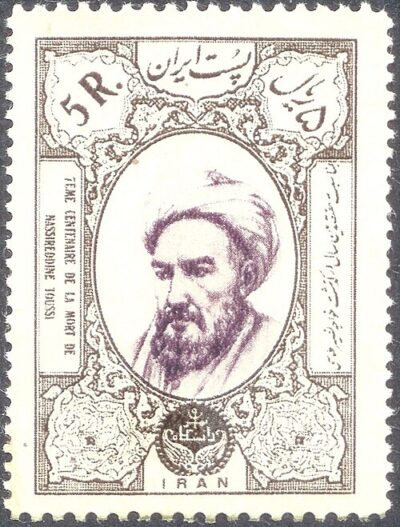
Nasir al-Din al-Tusi
Nasir al-Din al-Tusi was a Persian astronomer. Born February 18, 1201, in Tus. Died June 26, 1274, in Kadhimiya. Positions held include vizier (1256–1263). Known for Zij-i Ilkhani, Akhlaq-i Nasiri and Sharh al-isharat. Educated at Hawza of Hilla.
Facts
41 facts · 2 confirmed by two sources · 11 cited · 28 from one source
Where this comes from
Papalocal keeps its own record. It started from these sources; what each one said is kept here as it was copied, so a change on their side never changes this page by itself. Tap one to read its version.
What Wikidata says · copied November 16, 2026 · revision 2559092887
- Described as
- Persian astronomer (1201–1274)
- Other names
- Khajeh Nasir Toosi, Nasîroddîn Tûsî, Alnaaṣīr alṭuuwsy
- Born
- February 18, 1201 · 2 references
- Died
- June 26, 1274 · 2 references
- Born in
- Tus · 2 references
- Died in
- Kadhimiya · 1 reference
- Buried in
- Al-Kadhimiya Mosque · 1 reference
- Name at birth
- مُحمد بن مُحمد بن الحسن الطُوسي
- Citizen of
- Khwarazmian Empire; Abbasid Caliphate; Nizari Ismaili state; Ilkhanate (1256–)
- Occupation
- philosopher · 1 reference; scientist · 1 reference; mathematician · 2 references; astronomer · 2 references; polymath · 1 reference; architect; physician; intellectual
- Positions held
- vizier (1256–1263)
- Worked for
- Alamut Library; Maragheh Observatory · 1 reference; Hawza of Hilla · 1 reference
- Education
- Hawza of Hilla · 1 reference
- Known for
- Zij-i Ilkhani; Akhlaq-i Nasiri; Sharh al-isharat; Tajrīd al-Iʿtiqād; Tusi couple; Sayr wa Suluk
- Field
- astronomy; Ilm al-Kalam; Islamic philosophy; mathematics; chemistry; biology
- Religion
- Shia Islam · 1 reference
- Lived in
- Tus; Mosul; Quhistan; Maymun-Diz; Alamut Castle
- Wikipedias with a page
- 74
Wikidata item Q302835 (wikidata.org/wiki/Q302835), public domain (CC0). Copied November 16, 2026.
What Wikipedia says · copied November 16, 2026 · revision 1385160779
Muḥammad ibn Muḥammad ibn al-Ḥasan al-Ṭūsī (1201–1274; AH 598–673), commonly known as Naṣīr al-Dīn al-Ṭūsī (Arabic: نصیر الدین الطوسی; Persian: نصیر الدین طوسی) or simply (al-)Tusi, was a Persian polymath, architect, philosopher, physician, scientist, and theologian, as well as a prominent Shi'ite scholar. He wrote extensively on mathematics, engineering, prose, mysticism, philosophy, theology, and the sciences, and is widely regarded as one of the greatest scientists of medieval Islam.
Born in Ṭūs, from which his name derives, al-Tusi later worked under an Ismāʿīlī ruler at Alamūt, the centre of the Nizārī Ismāʿīlīs, and produced Ismāʿīlī works that acquired considerable authority, although his own personal religious allegiance during this period remains uncertain. When Hūlāgū Khān and the Mongols captured Alamūt in 1256, al-Tusi entered Hūlāgū's service as an astrologer and was instrumental in saving numerous libraries from destruction.
Al-Tusi made significant contributions across several scientific disciplines. In astronomy, he compiled highly accurate tables of planetary motion, developed an improved planetary model, criticized aspects of Ptolemaic astronomy, and compiled the astronomical tables known as the Zīj al-Khānī. He also introduced the mathematical device later known as the "Ṭūsī couple". His work extended to logic, mathematics, biology, chemistry, and especially trigonometry, which he is often credited with establishing as an independent mathematical discipline rather than merely an instrument of astronomy. The Muslim historian Ibn Khaldun regarded him as the greatest of the later non-Arab scholars. His astronomical work has also been discussed as a possible influence on Copernicus and the development of Copernican heliocentrism.
A prolific author on subjects ranging across the sciences, philosophy, theology, ethics, and mysticism, al-Tusi's most enduring works include al-Akhlāq al-Nāṣiriyya ("The Nasirean Ethics", 1235) and Tajrīd al-Iʿtiqādāt ("The Definition of the Articles of Faith"). His broad intellectual output, together with his mathematical and astronomical innovations, secured his reputation as one of the major polymaths of the medieval Islamic world.
- Born, in its opening lines
- 1201
- Died, in its opening lines
- 1274
From the Wikipedia article “Nasir al-Din al-Tusi” (en.wikipedia.org/wiki/Nasir_al-Din_al-Tusi), by its contributors, under CC BY-SA 4.0 (creativecommons.org/licenses/by-sa/4.0/). Copied November 16, 2026; not changed.
Confirmed Two sources agree. Cited One source, and it names where it got it. One source One source, without a reference of its own. Sources disagree The sources disagree. We show the best-supported value and keep theirs below.
