
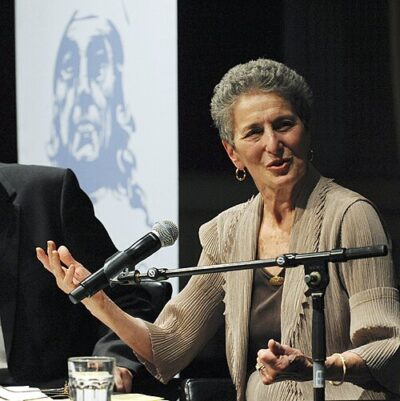
Natalie Zemon Davis
Natalie Zemon Davis was a Canadian-American historian. Born November 8, 1928, in Detroit. Died October 21, 2023, in Toronto. Known for The Return of Martin Guerre. Educated at Radcliffe College and Harvard University. Awards include honorary doctorate from University of Lyon-II, Guggenheim Fellowship and honorary doctorate from Columbia University.
Facts
48 facts · 2 confirmed by two sources · 20 cited · 26 from one source
Where this comes from
Papalocal keeps its own record. It started from these sources; what each one said is kept here as it was copied, so a change on their side never changes this page by itself. Tap one to read its version.
What Wikidata says · copied November 15, 2026 · revision 2565556963
- Described as
- Canadian-American historian (1928-2023)
- Other names
- N. Z. Davis
- Born
- November 8, 1928 · 4 references
- Died
- October 21, 2023 · 1 reference
- Born in
- Detroit · 1 reference
- Died in
- Toronto
- Cause of death
- cancer
- Name at birth
- Natalie Zemon
- Citizen of
- Canada; United States · 1 reference
- Occupation
- historian · 2 references; screenwriter; university teacher; women's rights activist; writer · 1 reference
- Worked for
- University of Toronto; School for Advanced Studies in the Social Sciences; Yale University; University of California, Berkeley; Princeton University
- Education
- Radcliffe College (–1950) · 1 reference; Harvard University; Smith College (–1949) · 1 reference; University of Michigan (–1959) · 1 reference; Cranbrook Educational Community
- Member of
- American Academy of Arts and Sciences; American Historical Association; Royal Society of Canada; American Philosophical Society (2011–)
- Known for
- The Return of Martin Guerre · 1 reference
- Awards
- honorary doctorate from University of Lyon-II (1983) · 1 reference; Guggenheim Fellowship (1985) · 1 reference; honorary doctorate from Columbia University (1990); Honorary doctorate from University of Toronto (1991); honorary doctor of Harvard University (1996); The Smith College Medal (1996) · 1 reference; honorary doctorate from the University of Cambridge (1998); honorary doctor of the University of Edinburgh (1998); Aby Warburg Prize (2000); honorary doctor of the Hebrew University of Jerusalem (2000); Holberg International Memorial Prize (2010); honorary doctor of the University of Toulouse-II (2010) · 1 reference; doctor honoris causa from the Paris-Sorbonne University (2011) · 1 reference; National Humanities Medal (2012) · 2 references; Companion of the Order of Canada (2012) · 1 reference
- Field
- history · 1 reference; modern period · 1 reference; social history · 1 reference; cultural history · 2 references
- Spouse
- Chandler Davis · 1 reference
- Wikipedias with a page
- 29
Wikidata item Q266185 (wikidata.org/wiki/Q266185), public domain (CC0). Copied November 15, 2026.
What Wikipedia says · copied November 15, 2026 · revision 1377897356
Natalie Zemon Davis, (November 8, 1928 – October 21, 2023) was an American-Canadian historian of the early modern period. She was the Henry Charles Lea Professor of History at Princeton University. Her work originally focused on France, but it later broadened to include other parts of Europe, North America, and the Caribbean. For example, her book, Trickster Travels (2006), views Italy, Spain, Morocco and other parts of North Africa and West Africa through the lens of Leo Africanus's travels. Davis' books have been widely translated into other languages: twenty-two for The Return of Martin Guerre, one of her most well-known works. She was the second female president of the American Historical Association.
Davis was awarded the Holberg International Memorial Prize and National Humanities Medal and was named Companion of the Order of Canada.
- Born, in its opening lines
- November 8, 1928
- Died, in its opening lines
- October 21, 2023
From the Wikipedia article “Natalie Zemon Davis” (en.wikipedia.org/wiki/Natalie_Zemon_Davis), by its contributors, under CC BY-SA 4.0 (creativecommons.org/licenses/by-sa/4.0/). Copied November 15, 2026; not changed.
Confirmed Two sources agree. Cited One source, and it names where it got it. One source One source, without a reference of its own. Sources disagree The sources disagree. We show the best-supported value and keep theirs below.
